

CICT to reconfigure parts of Paragon, including Metro space
The retailer is likely to remain in the Orchard Road mall under new retail concept stores

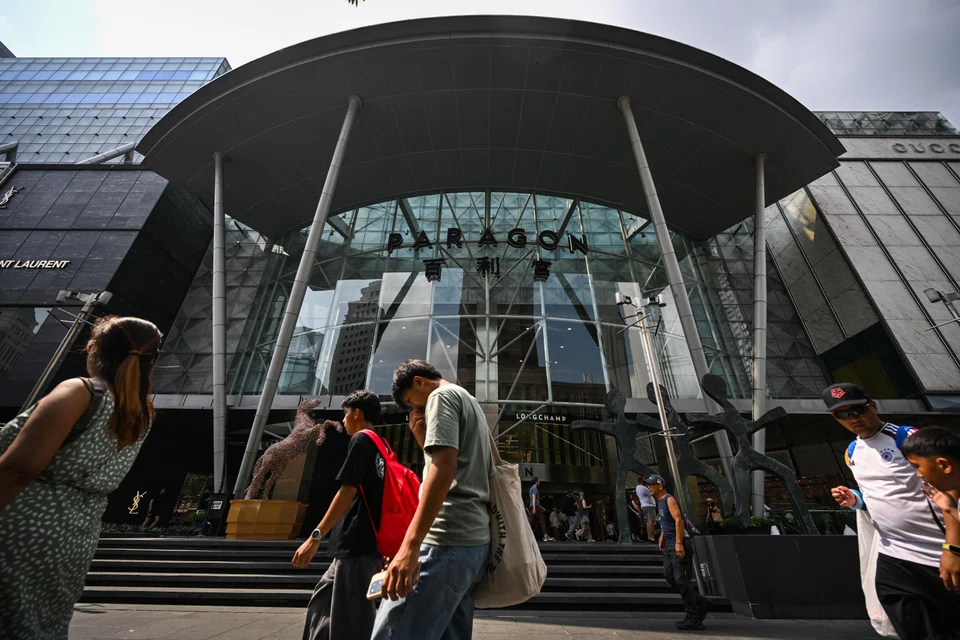
[SINGAPORE] CapitaLand Integrated Commercial Trust (CICT) is advancing plans to optimise and selectively reconfigure parts of Paragon, including areas currently occupied by department store Metro.
“(Metro) has expressed interest in remaining at Paragon under new retail concept stores, and discussions are ongoing. Feasibility studies are currently under way, and we will share further details once plans are finalised,” said the manager of CICT on Monday (Jul 20).
The latest announcement comes as CICT plans to “further strengthen Paragon’s tenant mix and create opportunities to introduce fresh concepts and experiences”.
Separately, Metro said in a bourse filing that it intends to progressively shift away from operating traditional large-format department stores towards a more flexible retail model centred on “specialised retail concepts”.
As a result, it will not continue operating its existing large-format stores at Paragon and Causeway Point, whose landlord is Frasers Centrepoint Trust, when their current leases expire.
The retailer said it is in discussions with existing and prospective landlords on rolling out new multi-concept stores.
“The group has commenced evaluating potential locations and opportunities with existing landlords as well as other landlords for the roll-out of its new retail multi-concept stores,” said Metro.
“In assessing these options, management will consider, among other things, location suitability, rental terms, financial viability, implementation timelines, and other commercial and operational matters,” it added.
The retailer will continue expanding its retail presence through Grand Brands Asia, its brand management joint venture, which focuses on bringing international lifestyle brands and immersive retail concepts to Singapore.
SEE ALSO


The implementation timeline and scope of Metro’s new retail concepts remain subject to ongoing evaluation and execution planning.
“As the retail landscape continues to transform, it is important that we evolve alongside it,” said Metro chairman Tan Soo Khoon.
He added: “Following a comprehensive review, the board believes this strategic repositioning will better position Metro for long-term sustainable growth by creating a more agile retail platform that can adapt to changing consumer expectations and capture new opportunities.”
While the financial impact of the repositioning on Metro’s earnings cannot be determined yet, the board believes it will strengthen the long-term competitiveness of its retail business.
Against the backdrop of a challenging retail environment and slowing sales for department stores, Metro in 2025 told The Business Times that it was pivoting to global tie-ups and immersive concept stores to bring shoppers back.
Over the past year, it partnered Shinsegae International, bringing in six brands from the South Korea retail conglomerate. It also launched two flagship experiential concept zones: SleepLab and MiniMuse, that allow shoppers to try out mattresses, and cosmetic and beauty products before purchasing.
Despite efforts to refresh its retail offerings, Metro’s retail arm reported a loss after tax of S$11.4 million for its financial year ended Mar 31, 2026, compared with a loss after tax of S$6.9 million in FY2025. This was mainly due to lower revenue, lower gross margins and higher impairment loss amid the challenges confronting Singapore’s retail sector.
“Consumer expectations today are fundamentally different. Amidst the challenging operating environment, our refreshed retail strategy is designed to meet customers’ evolving expectations while having greater flexibility to introduce new concepts, brands and partnerships,” said Metro group CEO and executive director Yip Hoong Mun.
CICT said it has been reviewing short and medium-term enhancement initiatives since completing its S$3.9 billion acquisition of Paragon on Jul 1.
The latest update comes after questions emerged over the mall’s redevelopment plans after the real estate investment trust (Reit) acquired the Orchard Road mall from Cuscaden Peak.
When Cuscaden Peak privatised Paragon Reit in 2025, it argued that the mall required a major overhaul to remain competitive. The planned redevelopment was estimated to take up to four years to complete, with a potential capital expenditure of up to S$600 million. Unitholders were warned that staying on board meant enduring a painful period of construction dust, execution risks and a heavily crushed distribution per unit.
But when CICT acquired the asset a year later, it said it would “explore” asset enhancement opportunities, noting that Cuscaden Peak’s preliminary estimate of some S$300 million to S$600 million “may differ” from its own eventual plans.
“Paragon will continue to strengthen its positioning through a differentiated retail mix spanning luxury fashion, beauty, home and living, sports, wellness and kids, catering to evolving consumer preferences,” said CICT’s manager on Monday.
“We are also actively engaging partners and relevant authorities to enhance sheltered connectivity between Paragon and some surrounding properties.”
Units of CICT ended Monday 0.8 per cent or S$0.02 lower at S$2.45, and shares of Metro closed 1.1 per cent or S$0.005 higher at S$0.46.
Decoding Asia newsletter: your guide to navigating Asia in a new global order. Sign up here to get Decoding Asia newsletter. Delivered to your inbox. Free.
Copyright SPH Media. All rights reserved.
TRENDING NOW

DBS, OCBC, UOB rout lops billions off STI as inflation, rate concerns spook investors

Grab CEO’s wife Chloe Tong on life with Anthony Tan and finding her purpose

OCBC sheds S$8 billion in value as shares close nearly 6% down; analysts cautious on banks

Deal between tycoon friends sparks scrutiny of Philippine power sector

