Amid pressure for easy solutions and better tools, economists’ discipline is key: PM Wong
They must act based on the principles of economics – price, cost, incentives – when shaping policy decisions

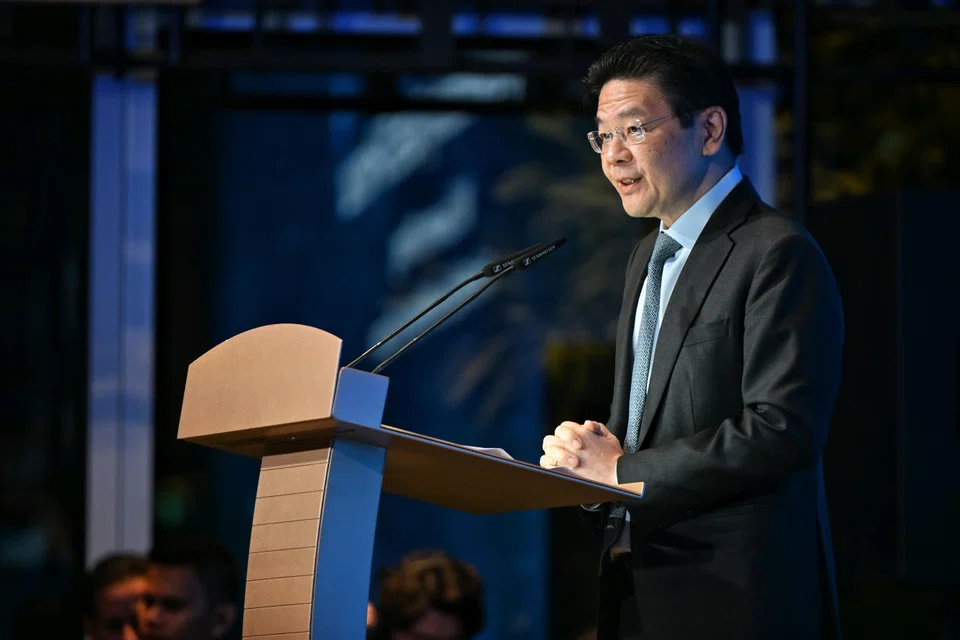
[SINGAPORE] Even when faced with mounting pressures to act quickly or pursue easy policy solutions, or given access to advanced tools, Singapore’s economists must maintain discipline and act on economic principles, said Prime Minister Lawrence Wong on Wednesday (Sep 30) night.
Speaking at the 25th anniversary dinner of the Economist Service, he noted that “basic principles of economic thinking have stood the test of time”.
“They help us think more clearly about our choices: the trade-offs involved, the incentives we create, and the consequences that follow,” he said.
He was one of five economists in the Economist Service when it was set up in 2001 as a part of the civil service to strengthen economic analysis in the formulation of public policy.
Today, the service comprises more than 100 economists spread across 20 government agencies and two international organisations.
In his keynote address at the dinner, PM Wong, who is also minister for finance, highlighted three such economic principles.
First, prices matter. They are signals of what is scarce, what people demand, and where resources are most needed, and they shape behaviour and influence resource allocation.
“If we suppress or distort these price signals, we may end up allocating scarce resources poorly – and creating bigger problems down the road,” he said.
The prices of essentials such as water and electricity in Singapore reflect the underlying cost to encourage conservation and preserve the price signal, but targeted support is provided to keep them affordable.
SEE ALSO



Second, costs matter. Every policy comes with costs, not just in dollars and cents, but also in opportunity cost.
This is illustrated in Singapore’s land use, for which the government has to weigh what Singapore needs and what its people value, and to recognise that using it for one purpose means forgoing another.
“Good policymaking requires us to recognise that trade-off – even when the cost is not immediately visible,” PM Wong said.
Third, incentives matter. People respond to incentives by changing what they buy or invest in or who they employ, he added.
This is at work in the careful design of the SkillsFuture Jobseeker Support Scheme, which ties temporary financial support to job searching and training.
PM Wong said that the government attempts to strike a balance between overly generous benefits – which could weaken the incentive to return to work – and no support – which could compel workers struggling financially to take the first available job, which may be a poor fit.

Stay disciplined
Good economics requires economists to anticipate responses to changes, whether these responses are intended or not, and then design policies accordingly, PM Wong said.
And while the basic principles may seem obvious, they “can be surprisingly easy to ignore”.
Well-intended policies, such as keeping prices artificially low or protecting industries long after the original justification has passed, can have attractive immediate effects, but lead to costs emerging later, he added.
“And by the time these consequences become clear, the policy may be difficult to unwind.”
The prime minister acknowledged that Singapore also faces growing pressure for easy solutions, with global uncertainty, tech disruptions and job displacements.
The government will need to step in at times, to correct market failures, pool risks and achieve important social objectives, PM Wong said.
“But precisely because government intervenes, we need to intervene carefully,” he added, noting the importance of diagnosing problems correctly, understanding the incentives created, recognising the costs and trade-offs, and thinking through second and third-order consequences.
“This discipline has served Singapore well. And maintaining it is one of the most important responsibilities of the Economist Service.”
The same discipline must also be exercised when using more advanced tools, PM Wong said. He noted that economists today have access to tools such as high-frequency microdata, sophisticated empirical techniques and artificial intelligence.
They should make full use of these tools, he said, though he warned: “Never mistake better tools for better judgment.”
Policymaking happens in the real world, where there is imperfect information and uncertainty. Theory may also not translate as intended to practice.
PM Wong said that economists should have more than technical competence. They need judgement and intellectual honesty; the professional conviction to flag uncomfortable conclusions; and the ability to explain complex issues simply and clearly, so that good analysis translates into good policy.
“The most enduring value of economics lies not in any particular theory, model or technique,” he added. “It lies in a way of thinking.”
Decoding Asia newsletter: your guide to navigating Asia in a new global order. Sign up here to get Decoding Asia newsletter. Delivered to your inbox. Free.
Copyright SPH Media. All rights reserved.