

COE review: Motor traders suggest using vehicle length, engine size and power to classify cars
Trade body supports LTA’s proposals, but says using OMV to judge car class needs more clarity

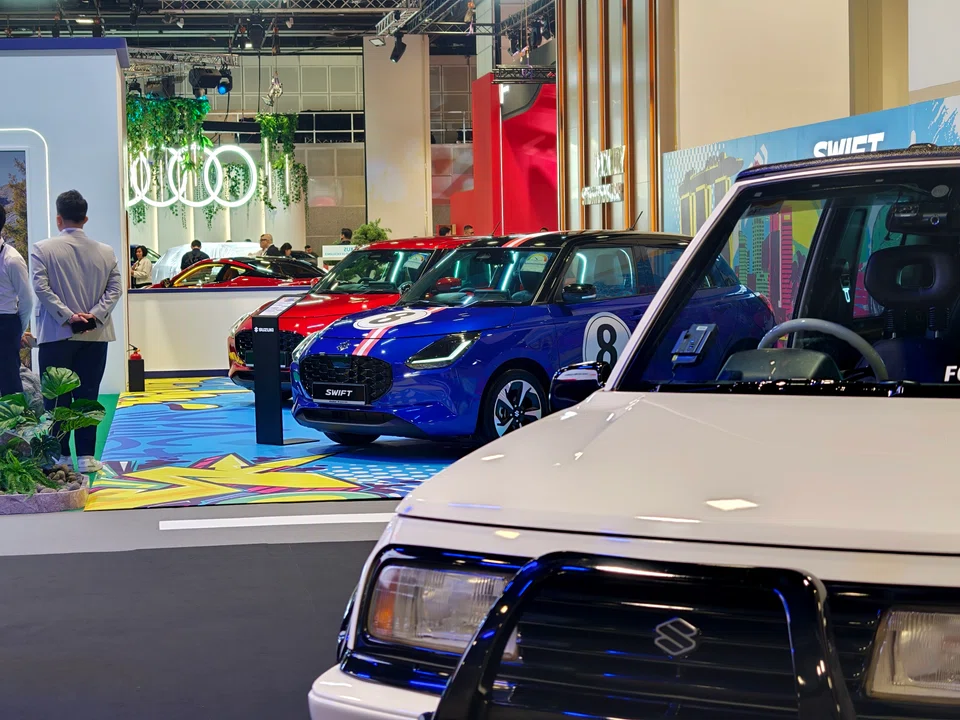
[SINGAPORE] The Motor Traders Association of Singapore (MTA) supports the Land Transport Authority’s proposed changes to the Certificate of Entitlement (COE) system, but it argues for the use of exterior length in differentiating between mass-market and luxury cars.
This is in addition to existing engine capacity and horsepower metrics.
MTA, the trade organisation for authorised car distributors and dealers in Singapore, said it prefers to include the factor of size as it is objective, supported by homologation records, and already used in the Europe and Japan to distinguish mass-market from premium models.
It added that if open market value (OMV) is used to segment vehicles, more clarity is required.
MTA president Glenn Tan said: “For cars, engine size, horsepower and dimensions are still a clear way of judging the segment the car belongs to. If OMV is to be used, we think it should have a simpler, more transparent approach that includes a fixed OMV cap.”
In a document dated Oct 20 and seen by The Business Times on Wednesday (Oct 28), MTA laid out its recommendations for maintaining the distinction between mass-market and higher-value cars.
Size, power still matter

The document was a response to LTA’s proposed changes to the COE system and has been shared with the regulator, said MTA.
Announced on Oct 8 for public consultation, LTA’s proposal calls for combining the existing mainstream and luxury car categories, A and B, into a single car category.
Cars would then be banded according to their OMV, with more expensive vehicles incurring a surcharge of up to S$15,000 and less expensive ones receiving a rebate of up to the same amount.
SEE ALSO


The bands would be determined by the percentile of vehicles registered, taking into account the entire distribution of OMVs for passenger car registrations in the preceding year.
OMV would be judged based on past registrations of that same model over a set time period and take the median value, to smooth out price fluctuations from exchange rates and dealer changes.
The adjustments have been mooted as Category A has seen an influx of higher-value models, particularly electric vehicles, which have driven its COE premium to match – and at times even exceed – Category B’s premium in 2026.
Mass-market cars should be smaller
MTA noted that a mass-market car should be “relatively smaller in size, with a smaller engine and lower power output”.
“Exterior length is an easily understood and objective measure that reinforces the principle that mass-market cars should be relatively smaller in size,” it said.
“Importantly, a model’s exterior length generally remains unchanged throughout its life cycle.”
The trade body therefore calls for the existing engine capacity and power limits to be preserved, and to include car length as a factor to distinguish mainstream and luxury vehicles.
For mainstream cars, the engine and power limits are 1,600 cubic centimetres (cc) and 97 kilowatts (kW) for regular cars, and 110 kW for EVs.
MTA said that vehicle length is reliable and readily verifiable data, as it is widely published in catalogues and online sources, as well as declared when the vehicle is undergoing approval for use in Singapore.
“Vehicle dimensions are already used in various transport and emissions policies in Europe and Japan, demonstrating that exterior length is a practical, measurable and robust parameter for vehicle classification,” it noted.
OMV cap suggested
MTA also said that the bands for rebates and surcharges should not be based on OMV percentile alone, but take into account size, engine capacity and horsepower as well for a more accurate gauge of car value.
For example, a car with a relatively large 2,500 cc engine, or with high horsepower of 200 kW, could be considered a mainstream vehicle as long as its OMV is in the correct band.
Additionally, using historical median OMV values risks lagging behind prevailing market conditions. This is because a model could fall below the qualifying threshold for a rebate in the preceding year, even though a subsequent upgrade raised its current OMV above that threshold.
Different sellers also have different OMVs for similar models. For example, authorised distributors typically have higher OMVs than parallel importers.
The trade body suggested comparing each vehicle’s current OMV against a predetermined cap set by LTA. It suggested an OMV of S$30,000 for mainstream cars, between S$30,000 and S$40,000 for mid-range cars, and above S$40,000 for higher-value or luxury cars.
Decoding Asia newsletter: your guide to navigating Asia in a new global order. Sign up here to get Decoding Asia newsletter. Delivered to your inbox. Free.
Copyright SPH Media. All rights reserved.
TRENDING NOW

If Europe goes to war, the fallout will be felt in East Asia

Shanmugam says firms linked to haze probe pledge cooperation; government to table changes to haze law

Indonesia stocks suffer worst plunge in nearly 30 years as MSCI proposes standalone status

Keppel seeks US$1 billion for Vietnam investments as it joins country’s international financial centre

