

Small correction after recent highs, but COE premiums remain elevated
No dips expected in 2026; Land Transport Authority mulls increased differentiation of car categories

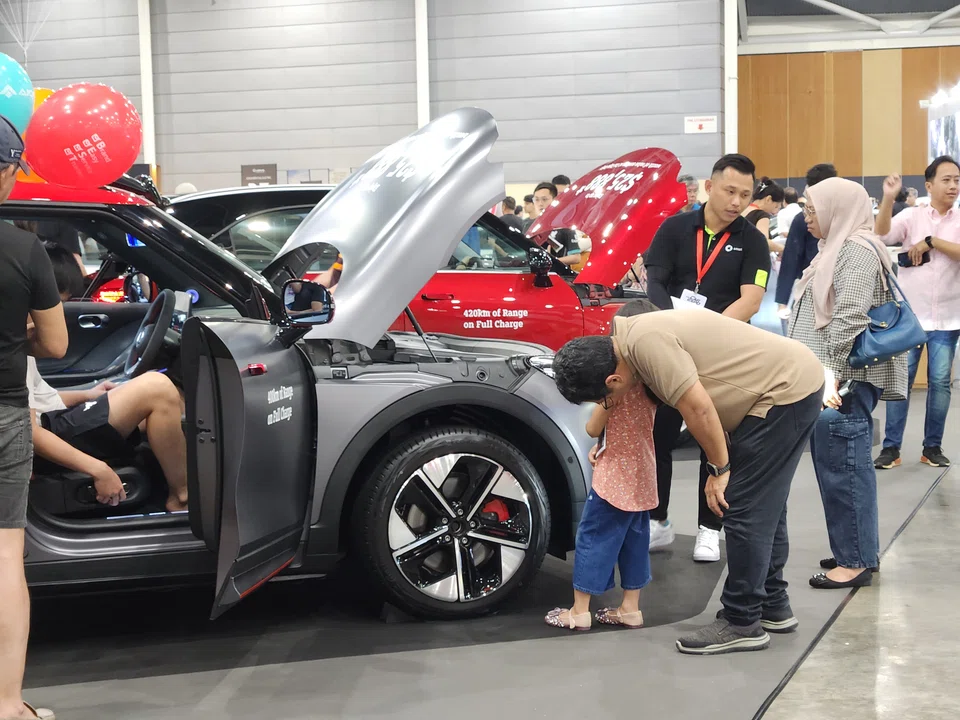
[SINGAPORE] Certificate of Entitlement (COE) premiums dipped across the board for September’s second round of bidding on Wednesday (Sep 23) as the market softened, although continued demand means prices remained relatively high, said industry observers.
Jason Lim, managing director of Mazda Singapore for Eurokars, said: “The market has been quieter over the last two weeks after the high premiums we saw in September’s first round of bidding. However, this is just a slight correction as demand is still strong.”
“COE prices remain elevated, although they have fallen across the categories compared with the previous bidding exercise, which was conducted over three weeks instead of the usual two weeks,” said a Land Transport Authority (LTA) spokesperson.
For the major vehicle categories premiums were down ranging from 0.6 per cent for Category E (open) to 1.5 per cent for Category B (luxury cars). The motorcycle category, D, fell the most, dropping 2.8 per cent or S$355 to S$12,201.
Take a dip
Market observers attributed the drop to buyers backing away as premiums reached notably high levels in multiple categories in September’s first round of bidding.
In that round, Category A posted a new record of S$133,009, and Category B reached its highest level in 2026.
Category C, for commercial vehicles, was S$93,101, not far from its all-time high of S$95,000, despite a major reduction in heavy commercial electric vehicle rebates.
Car dealers BT spoke to reported fewer sales and less customer interest over the past two weeks.
Corinne Chua, managing director of Volvo at Wearnes Automotive, said: “The all-time high result for Category A last round also slowed demand, as can be seen from the percentage of unsuccessful bids today.”
Unsuccessful bids are calculated from the difference between bids received and the category quota. It is used as a gauge of demand for the category.
For Category A, unsuccessful bids dropped to 26 per cent from 43 per cent, while those in Category B dropped to 22 per cent from 43 per cent.
Adelene Tan, managing director of BYD distributor and dealer Vantage Automotive, said that the gradual, upward trend for passenger car COE premiums has meant dealers are increasingly conservative in bidding, while balancing the need to obtain certificates to fulfil orders. She added: “I don’t think anyone is going big to grab a large number of COEs, and when the market is quieter, dealers bid accordingly – so there was a dip.”
However, demand remains high as a large number of cars reach the end of their 10-year COE lifespan in 2026. It is also driven by a forthcoming electric vehicle subsidy reduction of S$10,000 after Dec 31, 2026.
Lee Hoe Lone, managing director of Premium Automobiles, distributor for Avatr, Deepal, XPeng and Zeekr, said: “There’s simply too little supply compared to demand.”
He noted that from January to August this year, the passenger car population had dropped by around 9,000 to 556,133, while the private hire car population increased by 2,017 to an all-time high of 98,330.
He explained that this indicates an imbalance of demand – a large number of cars need to be de-registered and replaced by owners, but there are too few COEs available to replace them with new cars.
Premiums retreated only slightly in this round of bidding despite the drop in demand.
In fact, Categories A and C (commercial vehicles) remained less than two per cent of their all-time-high levels, while the motorcycle category was 7.5 per cent short of its record high of S$13,189.
Jason Lim, managing director of Mazda Singapore for Eurokars told BT: “The dip (for Categories A and B) isn’t a lot – it’s barely S$2,000. The market is still active, there are still a lot of car buyers out there.”
No quarter
Dealers do not expect premiums to fall significantly for the rest of the year, with the Car Expo in late October and EV incentives set to be cut by up to S$10,000 from 2027.
Vantage’s Tan said: “Everyone is hopeful for premiums to drop in a big way, but we don’t see this happening. Demand aside, in October there is the car show, then the EV incentives will be reduced at year-end. I think the whole industry will be doing what it can to boost sales.”
Matters could change further as the LTA reviews possible changes to the COE system.
Announced in March this year, the review aims to address the now closely matched mainstream and luxury car COE premiums.
In a statement after COE bidding ended on Wednesday, LTA said: “Category A and Category B COE prices remain similar. LTA’s review of COE categorisation for cars aims to differentiate between mass-market and higher-end cars more effectively.”
Observers told BT that the large number of EV models in Category A has made demand for such cars outsized compared with other categories, and this has spilt over to Category B.
An EV model with less than 110 kilowatts of power qualifies for Category A, while those with more than 110 kilowatts are in Category B.
Additionally, since Category A EVs are tuned by software to meet power limits rather than having different engines, the cost difference between A and B EV models is far less than that of combustion engine cars. Numerous brands also offer the same model with similar specifications in both categories.
The findings of the review are expected by the end of the year.






