Singapore factory growth slows in October as manufacturing PMI dips to 51.4
Expansion in electronics activity has eased, though AI-linked demand continues to support the sector

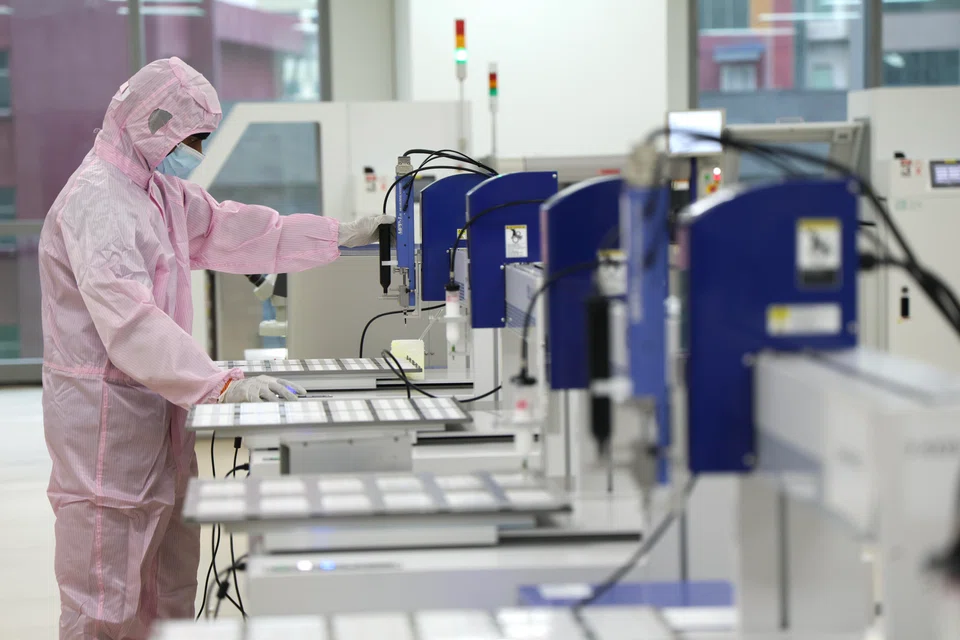
[SINGAPORE] Singapore’s factory activity expanded for the 15th consecutive month in October, albeit at a slower pace, with economists expecting manufacturing growth to remain resilient on the back of sustained demand for artificial intelligence-related electronics.
The purchasing managers’ index eased 0.3 point from September to 51.4 last month, data from the Singapore Institute of Purchasing and Materials Management (SIPMM) released on Monday (Nov 2) showed.
A reading above 50 indicates expansion, while one below 50 indicates contraction.
Within manufacturing, the PMI for the key electronics sector cooled, dipping 0.4 point to 52.5, signalling continued but slower expansion.
Stephen Poh, executive director of SIPMM, said the latest readings should be viewed from the context of a “sector cooling from a high base, not losing momentum”.
Singapore’s manufacturing sector has been buoyed by strong growth in electronics since the second half of 2025, driven largely by the global boom in AI-related demand.

October’s moderation was driven by slower growth in new orders, factory output, input inventories and employment, the report showed.
Imports and order backlogs also expanded more slowly, while growth in new exports and input prices picked up slightly.
Meanwhile, finished goods inventories contracted at a slower pace, while the supplier deliveries index “contracted much more slowly”, indicating fewer delivery delays.



Poh said that strong exports, AI-linked orders and elevated backlogs continue to underpin electronics growth, although output still lags orders and higher input costs remained a concern.
“Easing supplier delays help, but renewed Middle East shipping disruption could constrain output,” he said.
DBS senior economist Chua Han Teng expects Singapore’s manufacturing sector to remain resilient in the near term.
He noted that the electronics new export orders index rose to 53.2 in October, its highest since May 2018, while order backlogs remained elevated, pointing to sustained demand for electronics goods.
Chua said this reflects “strong external demand for AI-related hardware, supercharged by the ongoing AI infrastructure build-out”.
OCBC chief economist Selena Ling similarly expects manufacturing activity to continue expanding, although she cautioned against extrapolating the sector’s exceptional performance this year into 2027.
“While there is a reasonable prospect of continued expansion, growth rates are likely to normalise into 2027,” she said.
Ling also flagged growing investor concerns over the sustainability of the global AI investment boom, particularly on whether companies can generate sufficient returns to justify their heavy spending.
She noted that manufacturing PMIs in mainland China, Taiwan and South Korea had also softened, suggesting that the moderation is not unique to Singapore.
Regional trends
Manufacturing conditions across the region were mixed in October, with Indonesia and Thailand recording stronger growth, while expansion slowed in South Korea and Taiwan.
China’s official PMI slipped into contraction, although a private survey continued to signal growth.
China’s official manufacturing PMI fell to 49.3 in October from 50.1 in September, marking its third contraction in four months amid weak domestic demand and signs of softer exports.
In contrast, the RatingDog China General Manufacturing PMI, a private index compiled by S&P Global, edged down to 52 from 52.1, remaining in expansionary territory for the 11th consecutive month.
RatingDog founder Yao Yu noted that factory output grew at its fastest pace since April, supported by strong demand and improved production capacity. New orders continued to rise, while export orders expanded for a fourth straight month, albeit at a slower pace.
However, he added that business confidence fell to a nine-month low amid concerns over rising input costs and intensifying competition.
Elsewhere in Asia, South Korea’s PMI fell to 51.3 from 53.9, signalling its weakest improvement in manufacturing conditions since February.
Taiwan’s PMI eased to 54.9 from a more than five-year high of 56.7 in September, although it remained firmly in expansion territory for the 11th consecutive month.
South-east Asian manufacturers generally reported stronger conditions. Indonesia’s PMI climbed to 54 from 52.4, its highest since March 2024, while Thailand’s reading rose to 54.8 from 54.3, reaching its highest level since the end of 2025.
Vietnam’s PMI edged up to 52.3 from 51.9, extending its run of improving business conditions to 16 consecutive months.
Malaysia also returned to expansion, with its PMI rising to 51 from 49.9, marking its strongest improvement in manufacturing conditions since April.
Decoding Asia newsletter: your guide to navigating Asia in a new global order. Sign up here to get Decoding Asia newsletter. Delivered to your inbox. Free.
Copyright SPH Media. All rights reserved.