

US’ Hegseth hails Asian partners for boosting security spending; omits Taiwan in roll call
He was addressing the security and defence forum on May 30
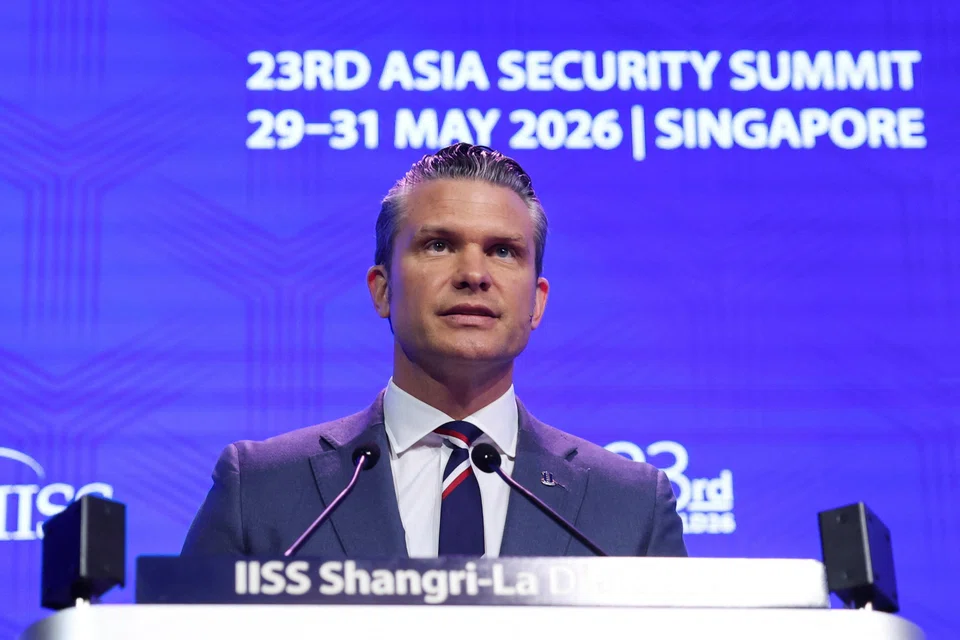
[SINGAPORE] The US has pledged to prioritise working with “model allies” that have risen to its call for a more equitable sharing of the security burden globally.
Drawing a sharp contrast to European allies, US Secretary of War Pete Hegseth praised the response of Indo-Pacific partners to the Trump administration’s expectation for nations to spend 3.5 per cent of their GDP on defence expenditure in an address.
“For those nations that rise to this challenge that embrace responsibility as true partners, the benefits will be clear,” Hegseth said in his address on Saturday (May 30) at the 23rd Shangri-La Dialogue, a leading security and defence forum focused on the Asia-Pacific (Apac).
“As our strategy states, we will prioritise working with model allies, those nations who are most capable, clear-eyed and ready to defend their national interests,” he added.
“For those nations, we are moving them to the front of the line: expedited arms sales, deep industrial base collaboration, expanded intelligence sharing.”
Hegseth listed Australia, Indonesia, Japan, Malaysia, the Philippines, South Korea, Singapore, Thailand, Vietnam among those that are stepping up. Taiwan and New Zealand were not mentioned.
Striking a more conciliatory tone towards China, Hegseth’s address is the first major US defence policy speech after the recent summit between Chinese President Xi Jinping and US President Donald Trump in Beijing two weeks ago, where they agreed on a new framework of “constructive strategic stability” between the world’s two largest economies.
“What we seek - and what the President has constantly articulated - is a genuinely stable equlibrium that works for Americans and our allies, a favourable but durable balance of power in which no state, including China, can impose its hegemony and hold the security or prosperity of our nation and our allies in question,” Hegseth said on Saturday.
He stressed that the US will act with “strong, quiet and clear” actions to foster stability in the region.
Some Asian delegates from countries that were cited breathed a sigh of relief. One from the Philippines quipped to another from Japan: “We were mentioned.”
But Taiwan’s former defence minister Andrew Yang noted the omission of the island, saying that it’s clear that the question of the US’ support for Taiwan can only be answered by Trump. “What can you do about it?”
Hegseth did not directly answer a question from the floor on arms sales to Taiwan.
After the recent Beijing summit with his Chinese counterpart, Trump added to uncertainty when the American president said he was unsure if he would approve what would have been the largest arms sale to Taiwan, the self-governing island that is a major security flashpoint in Apac and US-China ties.
The Taiwan Relations Act, enacted in 1979, permits the US to provide Taiwan with the resources required for its effective self-defence.
Trump’s transactionalism in prioritising trade negotiations with China has left some of its largest partners in Apac worried Taiwan would be relegated in importance.
This uncertainty was initially fanned by Trump’s public silence after Japanese Prime Minister Sanae Takaichi told Parliament in November that any Chinese attack on Taiwan that threatens Japan would justify a military response - enraging Beijing and triggering a major diplomatic dispute between the two neighbours.
Under the Trump administration, the US is demanding allies take more responsibility of their security needs. Its defence strategy is premised on defending the US with a focus on dominating its Western hemisphere and deterring China in the Indo-Pacific.
The Trump administration’s 2026 national defence strategy document stood out for wording that appears to be softer in tone on China.
“I know that Hegseth mentioned that the commitment remains strong here, but the truth of the matter is that the latest national defence strategy drafted by Trump and Hegseth downgraded the importance of the Indo-Pacific, which is contrary to what happened in the first Trump term,” US Senator Tammy Duckworth told reporters after Hegseth’s address in Singapore.
Still, on Saturday, Hegseth appeared to signal that the US is cognisant of the national interests of smaller partners in the Indo-Pacific, a term the Americans use to refer to nations around the Indian and Pacific oceans.
“Alliances only work when they are true partnerships,” Hegseth said. “We are ready to work with all of you, where you are, based on your situation, your own geography and your own cultural, political and economic realities to ensure that a Pacific free of any dominant hegemon is secured.”
Many countries in Asia have been disproportionately affected by the Trump administration’s Operation Epic Fury on Iran, since they receive the vast majority of the crude oil and liquefied natural gas produced in the Persian Gulf.
Despite claiming to eschew forever wars, the Trump adminstration - along with Israel - attacked Iran from end-February ostensibly to neutralise Tehran’s offensive capabilities, while expecting to be able to extricate itself from the region expeditiously - like its forces were able to do in Venezuela after arresting Nicolás Maduro in its quest to effect regime change.
Iran, however, turned out to be a more formidable foe in its resistance and has effectively shut down the Strait of Hormuz, a chokepoint that handles 20 per cent of the world’s oil and natural gas. THE STRAITS TIMES
Additional reporting by Kalicharan Veera Singam
Decoding Asia newsletter: your guide to navigating Asia in a new global order. Sign up here to get Decoding Asia newsletter. Delivered to your inbox. Free.
Share with us your feedback on BT's products and services






