

Marina Bay Sands casino’s winning streak puts pressure on rival Resorts World Sentosa
Singapore’s casino duopoly has become more lopsided in the past few years
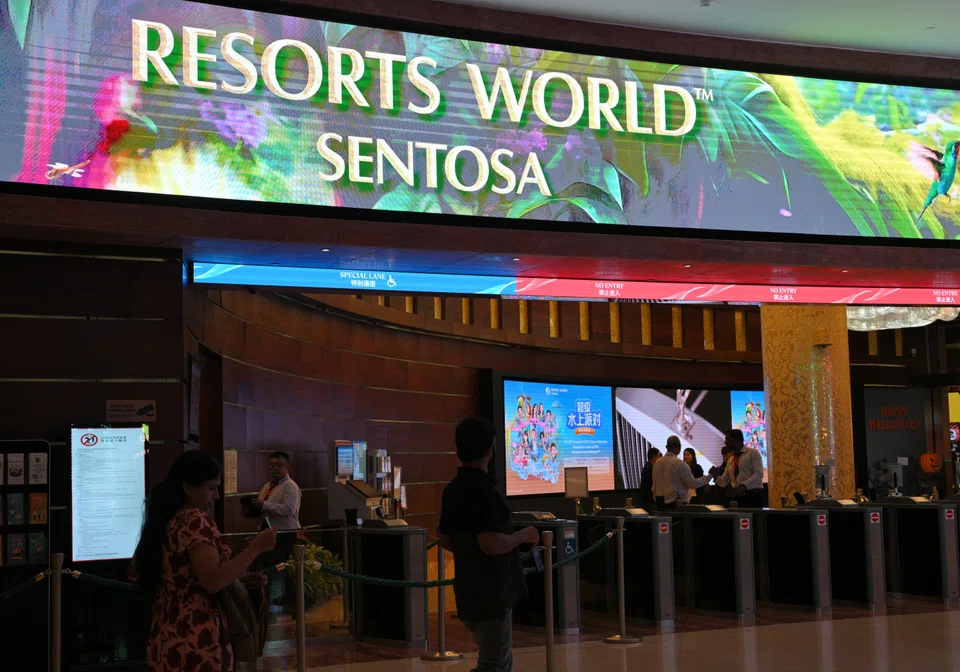
[SINGAPORE] At Singapore casino Resorts World Sentosa’s Chinese New Year lucky draw for high rollers earlier this year, the biggest prize was a bottle of Martell Cognac.
Across the harbour at rival Marina Bay Sands, the top sweepstakes winner walked away with a new Mercedes-Benz CLA 200 worth much more.
It is one of the incidents that has made the casino duopoly in one of the world’s top gambling venues more lopsided in the past few years.
That is putting pressure on the Sentosa island resort, whose gaming licence is due for renewal in the coming months.
The South-east Asian financial hub has seen a strong post-Covid rebound in tourist arrivals and an increase in wealthy gamblers from neighbouring countries and China.
It has also taken some business from Macau, which has been affected by Chinese government crackdowns on casino junkets and illegal money exchange activities.
The gains in Singapore have been heavily skewed towards Las Vegas Sands’ Marina Bay Sands.
Its casino revenues for the first half of 2026 topped US$2.1 billion, while Resorts World Sentosa’s comparable numbers were less than a third of that.
The struggle to attract more high rollers even in Singapore’s growing wealth hub underscores the challenges facing Resorts World Sentosa’s operator, Genting Singapore.

Back in November 2024, Singapore’s Gambling Regulatory Authority called the Sentosa resort’s tourism performance “unsatisfactory” and granted it a two-year casino licence that took effect in February 2025 instead of the usual three years.
“This is a soft threat” to pressure Resorts World Sentosa to improve its performance, said Zheng Feng Chee, a consumer analyst at DBS Group. “In reality, there are very few casinos that have the financial muscle to buy them out.”
The agency said it is currently assessing Resorts World Sentosa’s renewal application, and will announce its decision before the licence expires in February 2027.
The regulator’s evaluation takes into account the entire integrated resort’s performance. In 2025, it renewed Marina Bay Sands’ casino licence for another three years.
Genting Singapore said in April that it has “maintained close engagement” with authorities and believes the group is “well positioned for the next assessment cycle”.
A spokesperson for Resorts World Sentosa said in response to Bloomberg News queries that the integrated resort has over the past 18 months added new attractions and experiences, and has been “enhancing” its hospitality and gaming offerings.
Its goal is to position itself “for sustainable growth over the next decade”, the spokesperson said, adding that “the early signs of progress are encouraging”.
Marina Bay Sands declined to comment for this article.
The competition between the two casinos is likely to remain intense.
“I see them losing the battle, and even more market share,” said Ben Lee, managing partner at IGamiX, a Macau-based consulting firm, of Resorts World Sentosa.
Lee said it simply has not been able to match the “luxuriate experience” of Marina Bay Sands, which has been a big draw for so-called VIPs – the biggest spenders and most highly coveted casino customers.
Foreign money
Singapore’s casino industry has been heavily reliant on foreigners ever since Resorts World Sentosa first opened its doors in early 2010, with Marina Bay Sands launching shortly after.
Singapore citizens and permanent residents have to pay S$150 a day to enter either casino, while tourists can go in for free after showing their passports.
Gamblers from China have been flocking to Singapore, which offers visa-free entry to tourists from the mainland.
Concerns that their personal data could be shared with Chinese authorities have also made some high rollers wary of gambling in Macau, and they see Singapore as a more discreet alternative to protect their privacy.
These days, the crowd at Resorts World Sentosa’s VIP club is far smaller than that at Marina Bay Sands, said people familiar with both casinos.
In 2023, the Sentosa casino had a larger share of the VIP market, but that tumbled to around 20 per cent in the first quarter of this year before rebounding recently to 36 per cent, according to DBS research.
While there are fewer high rollers compared to so-called mass gamers, the former make outsized contributions to casino revenues and profits.
To become a VIP, gamblers typically have to deposit or spend at least S$100,000 for starters, then accumulate more spending by making bets and playing games over a fixed period to secure a club membership.
Benefits include access to private gaming suites, complimentary hotel stays, dining privileges and invitations to exclusive events.
Some members of Resorts World Sentosa’s casino club for VIPs have complained to the integrated resort’s management about what they consider as the Sentosa property’s dated infrastructure, its unresponsiveness to feedback, and even the process of exchanging cash and chips, said people familiar with the matter.
In addition to more generous lucky draw prizes, the VIP club at Marina Bay Sands offers perks and freebies that include suite stays with a butler service, tickets to musicals and dining credit at restaurants.
Its integrated resort – which is one of the world’s most profitable – includes three 57-storey hotel towers with a large boat-shaped rooftop, an art museum and shopping mall.
Resorts World Sentosa clawed back some high rollers’ market share in the recent second quarter, after Marina Bay Sands posted weaker VIP revenue.
The latter said that was partly because some of its high-value customers went to the World Cup, which drew spending away from casinos.
Genting Singapore is majority-owned by Malaysian leisure, real estate and hospitality group Genting Bhd, which is controlled by 75-year-old billionaire Lim Kok Thay.
In 2025, he became the Singapore unit’s acting chief executive officer following a series of leadership reshuffles.
In addition to its casino and multiple hotels, Resorts World Singapore operates Universal Studios Singapore, a large waterpark and other Sentosa attractions. The casino generates the majority of the integrated resort’s revenue and profits.
The Sentosa venue is in the midst of a S$6.8 billion revamp that includes building an all-suite luxury hotel, expanding its oceanarium and adding Super Nintendo World to Universal Studios Singapore.
The improved version of the resort is to be completed by 2030.
Marina Bay Sands, meanwhile, has kicked off its own US$8 billion makeover and expansion that will add another 55-storey hotel tower and a live entertainment arena.
Marina Bay Sands has “made the property more premium, more appealing to higher-value customers”, said Vitaly Umansky, Hong Kong-based senior analyst of global gaming at Seaport Research Partners.
“Resorts World has a lot of wood to chop in order to try to gain back some of that market share.” BLOOMBERG
Decoding Asia newsletter: your guide to navigating Asia in a new global order. Sign up here to get Decoding Asia newsletter. Delivered to your inbox. Free.
Share with us your feedback on BT's products and services
TRENDING NOW

Once staunchly pro-China, Malaysian Chinese businesses are now distancing themselves from Beijing

Looking beyond looming CEO succession, should UOB potentially pursue a transformative merger?

Could stablecoins be the future of money?

Grab CEO’s wife Chloe Tong on life with Anthony Tan and finding her purpose

