

MAS weighs Middle East conflict impact on Singapore, says forex, money markets ‘continue to function normally’
The central bank notes that it is in an ‘appropriate position’ to respond to risks to medium-term price stability, if necessary

[SINGAPORE] The Monetary Authority of Singapore (MAS) is “closely monitoring developments arising from the ongoing situation in the Middle East, and is assessing the impact on the domestic economy and financial system”, said a statement by the central bank on Monday (Mar 2).
The statement, made in response to media queries, comes as the Singapore stock market suffered a rout on Monday morning, after the US and Israel launched strikes against Iran over the weekend, as part of a campaign to dismantle the Islamic Republic’s nuclear programme and topple its government.
The conflict has caused a spike in oil prices, heightening risks of higher global energy prices amid the closure of the Strait of Hormuz – the maritime passage off Iran’s southern coast that handles one-fifth of global oil.
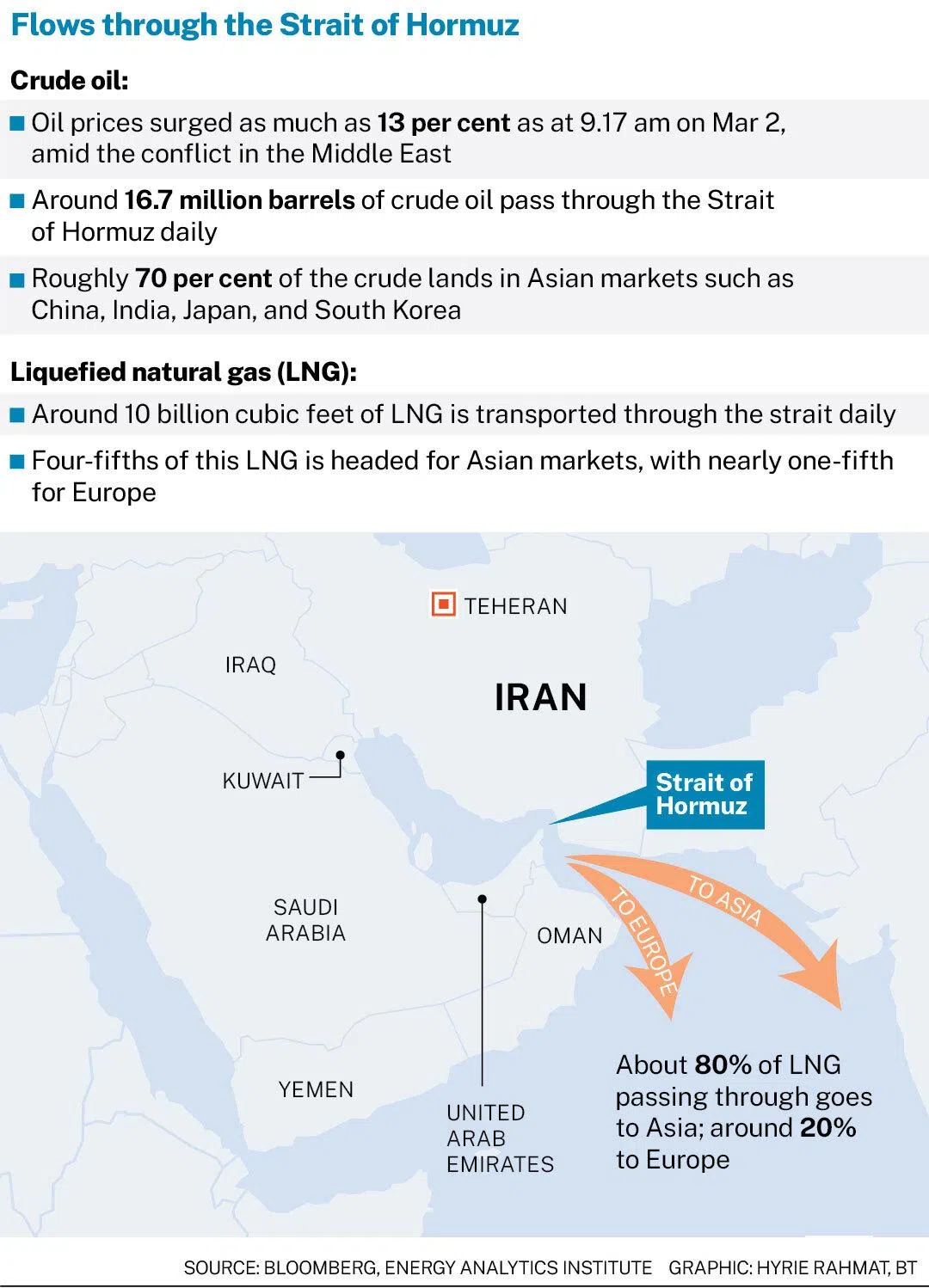
MAS has confirmed that the city-state’s foreign exchange and money markets continue to function normally, amid developments in the Middle East.
“The Singapore dollar nominal effective exchange rate remains within its appreciating policy band, which will continue to dampen imported inflationary pressures,” it said.
The authority added that it is in an “appropriate position” to respond to risks to medium-term price stability, if necessary.
Risks for businesses
Observers told The Business Times that the Middle East conflict poses risks for Singapore businesses, as the city-state’s highly open and trade-reliant economy make it vulnerable to external shocks.
Increased energy prices could raise costs for businesses and consumers, in turn weighing on the economy, noted Deputy Prime Minister and Minister for Trade and Industry Gan Kim Yong on Monday at his ministry’s Committee of Supply debate.
The Organization of the Petroleum Exporting Countries and its allies (Opec+) on Sunday had agreed to modestly boost oil production, in response to disruptions to oil shipments via the Strait of Hormuz, which have been halted as a result of the Middle East conflict. The bloc has historically raised oil production to buffer disruptions.

While Opec+ has agreed in principle to increase output by 206,000 barrels per day, analysts believe the group – with the exception of Saudi Arabia and the United Arab Emirates – has limited excess capacity to meaningfully increase supply.
Decoding Asia newsletter: your guide to navigating Asia in a new global order. Sign up here to get Decoding Asia newsletter. Delivered to your inbox. Free.
Copyright SPH Media. All rights reserved.
TRENDING NOW

Britain’s mansion tax shows the difficulty of targeting wealth

Once staunchly pro-China, Malaysian Chinese businesses are now distancing themselves from Beijing

The only common thing in S-E Asia is that we all eat rice: Cisco’s Asean president

Singapore data centre operator DayOne opts for US IPO at likely US$20 billion valuation

