

PAP internal election: Will there be new faces and what changes can we expect on Oct 25?
Insiders do not expect major changes, given the party’s performance at the 2025 General Election
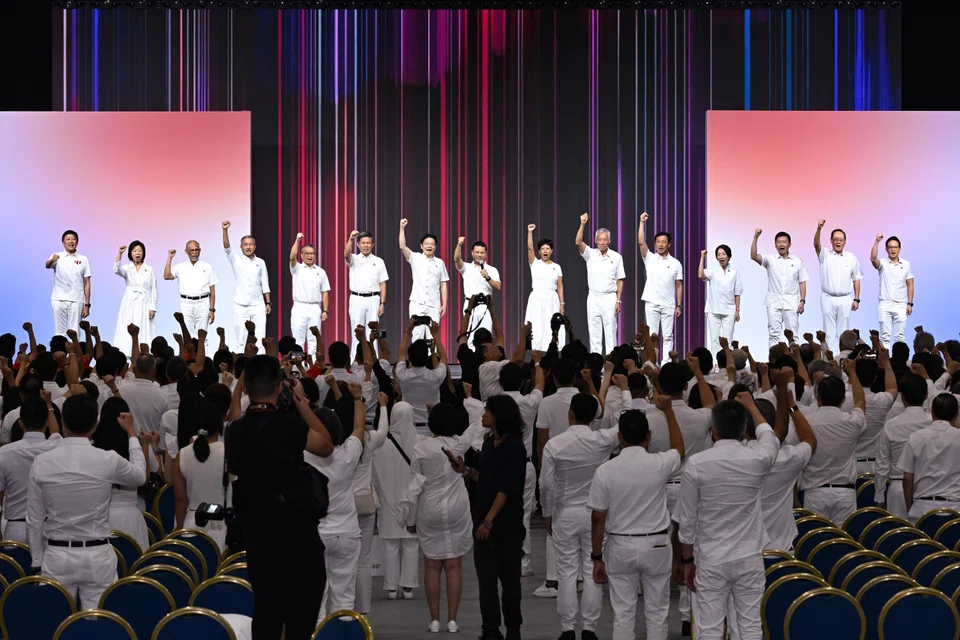
[SINGAPORE] Few moves are expected at the top when the PAP elects its leadership on Sunday (Oct 25), but newly promoted ministers could take their first step into the party’s innermost circle.
Party insiders do not expect major changes and the party’s performance at the 2025 General Election, where it won with 65.57 per cent of the vote, gives little impetus for change.
But on the back of a July Cabinet reshuffle, this weekend could see the party’s next generation start to take up some of its reins.
This follows a timeline set by Prime Minister Lawrence Wong, who took over as the ruling party’s secretary-general in 2024, completing a generational leadership transition from Senior Minister Lee Hsien Loong.
At 2025’s party convention, PM Wong said he hoped the outline of the PAP’s next generation of leaders will emerge by the next general election.
The general election is due by 2030, meaning this weekend and the next party election in 2028 are where this has to happen.
On Sunday, more than 2,000 party cadres will congregate to elect the PAP’s next central executive committee (CEC) which will serve for two years.
This will be the first chance for some of the PAP’s 27 first-term MPs to be elected to the committee.
The majority of the CEC is made up of the party’s 4G leaders, with the notable exceptions of Senior Ministers Lee and K Shanmugam. Both have been in Parliament since the 1980s.
SEE ALSO
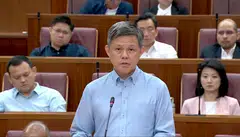
The entry of new blood would give the next generation seats at the table and a say over various aspects of the party including its composition in who becomes a member or cadre, and its wider direction.
This matters especially for those drawn from the public service.
Because of restrictions on political activity for public servants, they have not, unlike some of their peers in the party, spent years building familiarity with systems and people.
Being in the CEC gives them sway within the party and the ability to mobilise activists, which is important to winning votes come election time and serving residents during the term.
After July’s reshuffle, three helm ministries – Jeffrey Siow, David Neo and Jasmin Lau – while Goh Pei Ming was promoted to senior minister of state.
Siow and Neo’s promotions to full minister and Lau’s appointment as acting minister mark them out as frontrunners to make the CEC, as the party has traditionally filled its top leadership with many from its frontbench in Parliament.
The other side of the coin is also worth watching: if newcomers enter, some will have to leave the CEC to make room at the top.
This could be an early signal of who could leave politics by the next election, although some party leaders such as former chairman Gan Kim Yong have left the CEC and stayed on in high positions in Government.
At the 2018 party election, then-Coordinating Minister for Infrastructure Khaw Boon Wan left the CEC before retiring from politics at the 2020 election.
Then, former ministers who had in a recent reshuffle become backbench MPs – Yaacob Ibrahim and Lim Swee Say – also left the top leadership.
Vote or co-opt
At PAP elections, the party’s sitting CEC releases a list of about 19 candidates for cadres to choose from.
Within that list, a smaller group of about seven is marked out as recommended by the party’s inner circle as its core leaders.
Both lists are closely watched by the party faithful.
Cadres usually pick their 12 candidates from these lists for the CEC, which later parcels out the different roles such as chairman and treasurer amongst its members.
An inclusion of any new MP on either would signal the leadership’s support – to be validated by the wider vote.
The top 12 votegetters are elected and by custom the next two are co-opted. The CEC also has the option to co-opt up to four more members, and committees usually end up at 18 members – the maximum size.
The party has used both routes – the vote and co-option – in the past to add potential leaders to the CEC and has elected or co-opted several first-term MPs who later became prominent political figures.
From the 2011 batch of new MPs, Heng Swee Keat, Chan Chun Sing, and Tan Chuan-Jin were appointed into the CEC around six months after being elected into Parliament that year.
They were appointed to fill spots vacated by senior party leaders including former prime ministers Lee Kuan Yew and Goh Chok Tong who left the CEC to facilitate party renewal.
Later at the 2012 party election, Chan and Heng won seats outright, and PM Wong himself was also co-opted into that CEC. Tan was elected onto the next CEC in 2014, still in his first term as an MP.
Two from the 2015 batch of new MPs also entered the CEC in their first term: Ong Ye Kung and Ng Chee Meng. Ong was co-opted after the party election in 2016, while Ng was elected at the next one in 2018. Both now sit in PM Wong’s Cabinet.
But from the 2020 batch, only Tan See Leng made the CEC in his first term, having been co-opted after the vote in the 2022 party election.
In 2024, he was co-opted again along with Chee Hong Tat as the two next highest vote-getters after the first 12. Also co-opted to the CEC were Sim Ann, Desmond Choo and Lam Pin Min.
PM Wong has made renewing the party and Government a key priority since taking the reins of both in 2024.
He flagged this urgency to refresh the leadership in his speech at the party’s meeting in 2025, saying that renewal must never stop.
The July Cabinet reshuffle did so on the Government front.
On the party side, the onus is on this weekend and the next internal election in two years for PM Wong’s hope for the next generation to emerge by 2030 to come to pass. THE STRAITS TIMES
Decoding Asia newsletter: your guide to navigating Asia in a new global order. Sign up here to get Decoding Asia newsletter. Delivered to your inbox. Free.
Share with us your feedback on BT's products and services
TRENDING NOW
Knight Frank’s Tan Tee Khoon leaves firm, Nicholas Keong takes over auction business
Keppel Energy, Sembcorp Utilities and Tuas Power to supply biomethane in pilot project

GovTech retrenches another 38 staff in second round of layoffs
Take-up of new private homes dives 45% in Q3 as prices accelerate with 1.4% rise

