Singapore government slaps loan curbs on individual private-hire car buyers
Financing restrictions for PHCs will match those for regular cars, but experts expect no drop in COE premiums

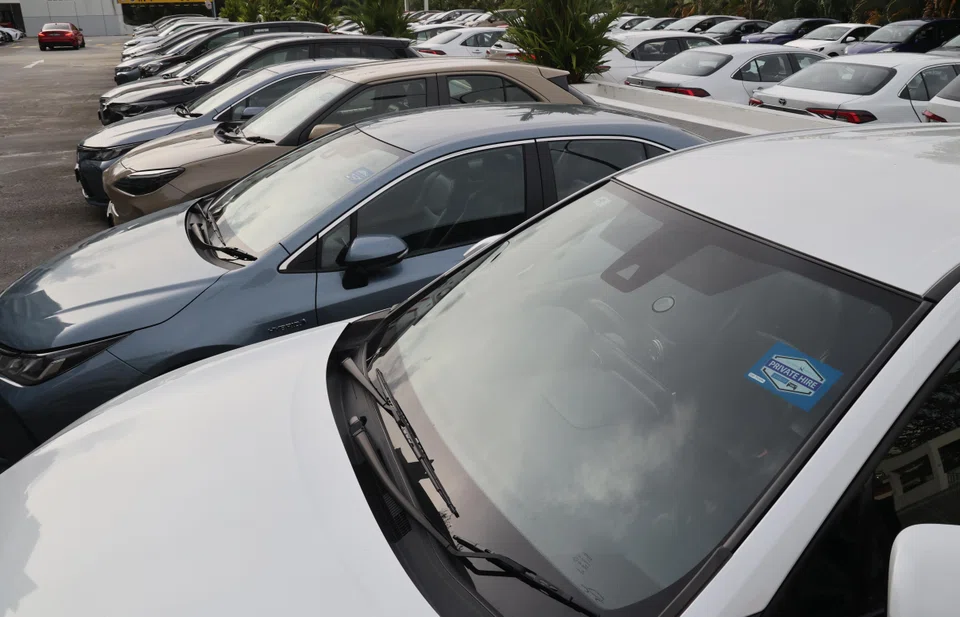
[SINGAPORE] From Friday (Oct 30), individuals who purchase private-hire cars (PHCs) will face the same financing restrictions as regular car buyers. These include a maximum loan amount of up to 70 per cent of the vehicle’s purchase price and a loan tenure limited to seven years.
In a joint statement on Thursday, the Ministry of Transport, Monetary Authority of Singapore (MAS), Ministry of Energy, Trade and Industry, and Ministry of Law said that this is in response to the growing number of individual-owned PHCs that take advantage of freer financing terms but are not being used to serve rides.
“To ensure that PHC purchases cannot be used to circumvent financing restrictions that apply to private car buyers, individual buyers of PHCs will now be subject to the same financing restrictions as private car buyers,” the authorities said.
“This will also ensure that new PHC drivers exercise the same financial prudence as other private car buyers.”
Industry observers welcomed the move as it could help prevent buyers from over-leveraging, though most said it would not reduce Certificate of Entitlement (COE) premiums.
Financing limited
From Friday, PHCs with an open market value (OMV) of S$20,000 or less can borrow up to a maximum of 70 per cent of the purchase price. This includes all taxes and the Certificate of Entitlement (COE) premium.
For vehicles with an OMV above S$20,000, the maximum loan amount is 60 per cent of the total price. For all vehicles, the tenure of financing arrangements is capped at seven years.
The restrictions apply to individuals who are getting vehicle loans from financial institutions and licensed/exempt moneylenders. They also apply to hire purchase or conditional sale agreements.
The loan restrictions will not apply to commercial vehicles (including goods vehicles and buses), PHCs owned by businesses, or motorcycles. However, individuals acting as sole proprietors will also be subject to the financing restrictions.
SEE ALSO





The authorities added in their joint statement that prior to the rule changes, individual-owned PHCs were exempt from financing restrictions on the basis that they were for commercial use.
But in recent times, there have been more instances of individual buyers using the exemption without the intent to offer ride services.
“A recent surge in individual-owned self-drive PHC registrations (around 500 per month) suggests that some may be doing so primarily to access more permissive financing terms,” they said.
Other measures were considered, including creating a separate COE category for PHCs. But that would likely mean higher rental costs for PHC drivers and higher fares for riders, “thus disadvantaging those who do not own a car or cannot drive”.
“It will also require more prescriptive rules on PHC drivers and cars, thus reducing the flexibility to meet the commuting demand of PHC users,” the authorities added.
The other method of avoiding loan restrictions may also be addressed as the “government will monitor market developments and take further steps to apply the same restrictions consistently across financing arrangements, such as in-house loans”.
One loophole closed, another closing?
The move comes amid growing calls to curb loopholes on car financing restrictions. Data secured by The Straits Times indicates that Singaporean household vehicle debt reached roughly S$12.4 billion by late 2025, marking a 12-year peak.
MAS re-implemented the current restrictions on financing for privately owned cars in 2013; the regulator has said that the measures are to encourage financial prudence among buyers of motor vehicles.
However, there have been a number of ways around this, including buying a PHC with a full loan; registering a company – usually a sole proprietorship – to purchase the car; and in-house loans from dealers.
Auto trade association representatives and car dealers told The Business Times that the move closes a major loophole in car financing restrictions.
Glenn Tan, president of the Motor Traders Association of Singapore (MTA), believes that it “closes one shortcut to get a 100 per cent car loan”.
Nicholas Wong, CEO of Honda distributor Kah Motor called it a “good measure that helps to close the gap for this issue”.
Soh Ming, CEO of Dongfeng, Voyah, BAIC and ArcFox distributor Volt Auto, said the move would help ensure buyers borrow within their limits, although it would also mean those who require a car urgently and cannot afford a high down payment would be left out.
Tan and Wong pointed out that determined buyers could still circumvent the rules by registering a private limited company and buying a car in that entity’s name.
“The change is not totally foolproof,” said Tan, “as one could register a company with S$1 starting capital to buy a car for example, though that comes with a host of other requirements.”
Others said that action on in-house loans would be a similarly positive step.
Vincent Ng, automotive business consultant at Vincar Group, said: “In-house loans usually come with higher interest rates, and that accounts for the additional risk that these finance companies are undertaking. So clamping down on that means reducing risks all around.”
In-house loans occupy a regulatory grey area, as they are not offered by licensed and exempt moneylenders, which are regulated by the Ministry of Law, nor by financial institutions, which are regulated by MAS.
Transport Minister Jeffrey Siow has said that in-house loans are effectively unsecured personal loans.
However, the moves are not expected to impact COE premiums.
A spokesperson for PHC rental company Lumens said the move is unlikely to reduce the COE demand from PHCs, as “not many new cars this year were registered as PHCs”.
“Additionally, in-house loans also form an extremely small portion of the market, especially in the current environment.”
For Kah Motor’s Wong, the move “closes one avenue and makes it harder to circumvent the financing hurdles, but it won’t stifle PHC demand”. “Those with bigger budgets to bid at higher prices are the larger car fleets, not individuals.”
Decoding Asia newsletter: your guide to navigating Asia in a new global order. Sign up here to get Decoding Asia newsletter. Delivered to your inbox. Free.
Copyright SPH Media. All rights reserved.