

Singapore launches national semicon brand initiative, inks R&D deals
Applied Materials, GlobalFoundries and KLA among firms deepening partnerships with A*Star


[SINGAPORE] The Republic will market its chip sector to the world under a new branding initiative called SG Semiconductor, as the country seeks to draw more high-value research and manufacturing.
The launch came alongside a slate of new partnerships with global chip firms including Applied Materials and GlobalFoundries.
Minister for Trade and Industry (Energy and Industry) Tan See Leng, who made the announcement on Friday (Sep 25), said that SG Semiconductor would serve as “a common national identity, reflecting our coordinated approach to partnering industry and advancing Singapore’s semiconductor sector”.
The aim is to pitch the country’s chip research, manufacturing, infrastructure and talent to international investors and talent as a single, coordinated semicon hub, said the Agency for Science, Technology and Research (A*Star).
Developed by A*Star and the Economic Development Board (EDB), SG Semiconductor will first be used to promote public-sector R&D.
It will cover seven technology areas: advanced packaging, silicon photonics, power electronics, radio frequency gallium nitride, piezoelectric micro-electro-mechanical systems, flat optics, and integrated circuit designs.
“SG Semiconductor provides a gateway to Singapore’s ecosystem, enabling companies to develop, scale and commercialise next-generation technologies from Singapore,” said EDB managing director Jermaine Loy.
A*Star chief executive Beh Kian Teik said that the new initiative signals a commitment to anchor high-value R&D and manufacturing in Singapore for the long term.
New tie-ups
In his speech Dr Tan noted that Singapore produces about one in 10 of the world’s chips and one-fifth of global semicon manufacturing equipment.
Meanwhile, the wider manufacturing sector accounts for around 20 per cent of gross domestic product. “We must not take this position for granted,” he said.
”As we raise the global profile of Singapore’s semiconductor ecosystem, build with us, and let us take the next generation of semiconductor innovations to the world, from Singapore,” added Dr Tan, addressing industry leaders at Innovate Together, an annual forum by A*Star, held as part of the Singapore Semiconductor Industry Association (SSIA) Summit.
Several global chip firms have already answered the call. At the forum, A*Star announced new and expanded tie-ups with Applied Materials, GlobalFoundries, KLA and Stats ChipPac, among others.
The largest deal announced was Phase 4 of the joint lab between Applied Materials and A*Star. Dr Tan described it as one of the US equipment maker’s largest R&D investments in Singapore to date.
The five-year expansion will significantly increase the joint lab’s infrastructure, equipment and headcount.
Work will cover areas including hybrid bonding for three-dimensional chiplet integration, high-density interposers and advanced substrates, with the aim of supporting artificial intelligence and high-performance computing.
The partnership began in 2011. Applied Materials has since launched more than 10 semicon manufacturing tools developed in Singapore through it, most of which have become global bestsellers.
Over the past five years, it has also enabled collaboration between A*Star and about 50 companies, including nine local small and medium-sized enterprises, on projects worth S$46 million in industry funding.
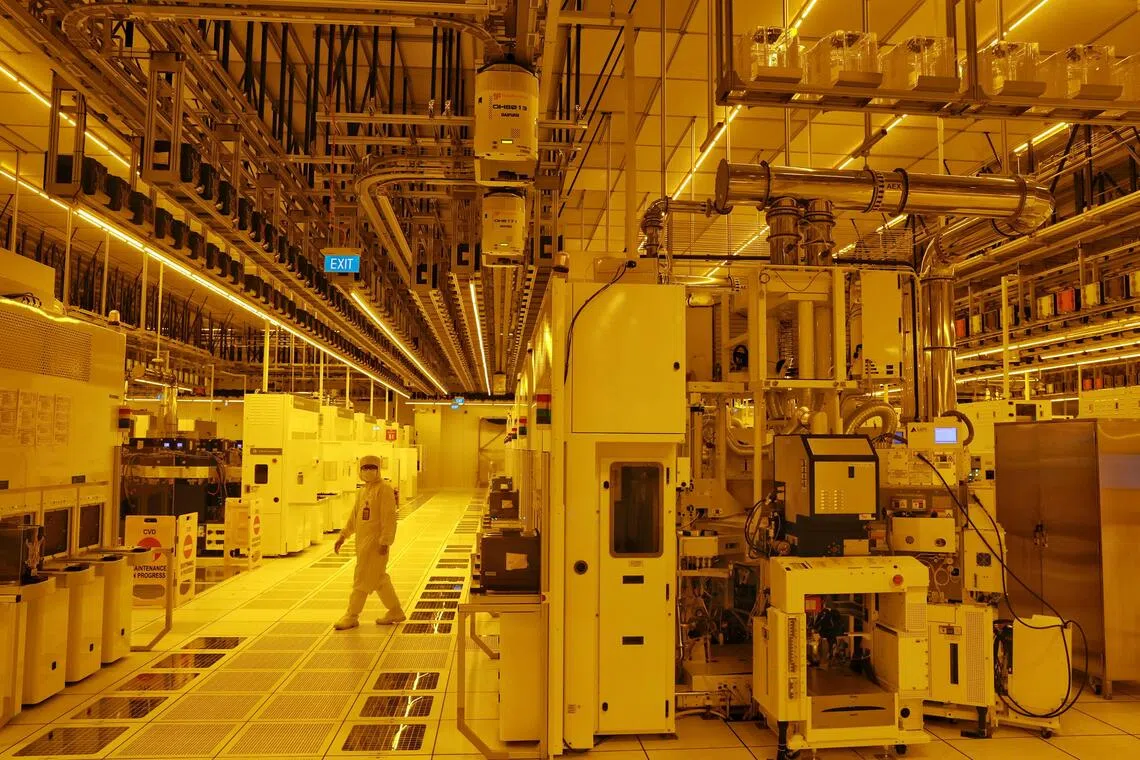
Separately, GlobalFoundries and A*Star will deepen their collaboration in silicon photonics. The two will develop next-generation technologies on 300-millimetre wafers in Singapore for high-performance computing, data communications, and potentially, quantum applications.
GlobalFoundries acquired Advanced Micro Foundry, an A*Star spin-off, in 2025.
“Singapore’s robust semiconductor ecosystem and strong government support for R&D are crucial in enabling us to develop and scale these innovations,” said Gregg Bartlett, chief technology officer of GlobalFoundries.
In advanced packaging, KLA will start a three-year collaboration with A*Star Institute of Microelectronics (IME). They will study process control solutions that detect defects early and improve manufacturing yield.
Meanwhile, Stats ChipPac will license proprietary advanced packaging solutions developed by IME for co-packed optics. It will combine these with its own manufacturing capabilities to create a pathway towards high-volume production for AI and data-centre applications.
Robotics startup Tacta Systems, which has opened operations in Singapore, will work with A*Star to develop micro-electro-mechanical, or Mems, systems tactical sensors for robots.
The work will use A*Star’s Lab-in-Fab platform, which lets companies develop and validate technologies in a production-relevant environment.
Lastly, the National Centre for Advanced Integrated Photonics (NCAIP), hosted at Nanyang Technological University, will embark on a 12-month research collaboration with Australian mineral employee Battery Age Minerals.
NCAIP will contribute its photonics research expertise, while Battery Age Minerals will bring its access to germanium resources.
Talent pipeline
As semicon technologies become more complex, Singapore needs researchers, engineers and technicians with specialised capabilities to execute them well, said Dr Tan.
Developing and attracting talent is thus also a priority. Over the past five years, 14 semicon companies have taken part in the Industrial Postgraduate Programme, producing close to 100 graduates.
Separately, the Singapore Institute of Technology will pilot a “2+2” undergraduate model from September 2027. Under this model, students will spend two years on campus, followed by almost two years of workplace immersion.
Separately, SSIA on Thursday signed a memorandum of understanding with the Brabant Development Agency (BOM), the economic development agency for the Dutch province of North Brabant, which includes the Brainport Eindhoven high-tech region.
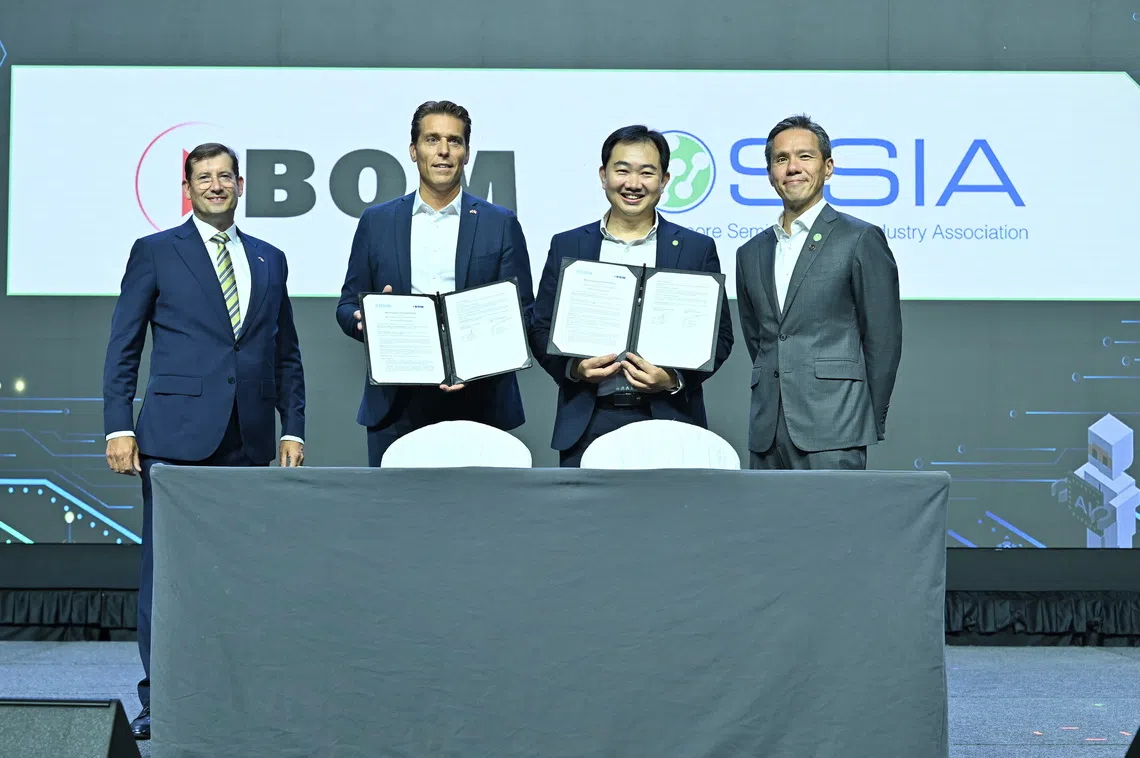
Under the agreement, the two organisations plan to build a pipeline of opportunities linking Dutch advanced manufacturing with Singapore suppliers. This includes business matching, supplier qualification and market access in both directions, including support for Singapore firms setting up in the Netherlands.
They will also work together on skills and workforce development, and explore exchanges between universities, innovation centres and industry.
“As semicon supply chains shift, companies are looking not only for alternative suppliers, but (also) for partners they can trust and scale with,” said SSIA executive director Ang Wee Seng.
BOM is in Singapore with a delegation of more than 15 Dutch semicon and advanced manufacturing companies. SSIA will send a Singapore delegation to the Dutch Precision Week in the Netherlands from Nov 16 to 20.
Decoding Asia newsletter: your guide to navigating Asia in a new global order. Sign up here to get Decoding Asia newsletter. Delivered to your inbox. Free.
Copyright SPH Media. All rights reserved.






