

Singapore’s Parf rebate cut likely to drive up EV sales, but financial and infrastructure hurdles linger
The move may speed up EV adoption, but EV buyers face an illiquid resale market and HDB charging bottlenecks

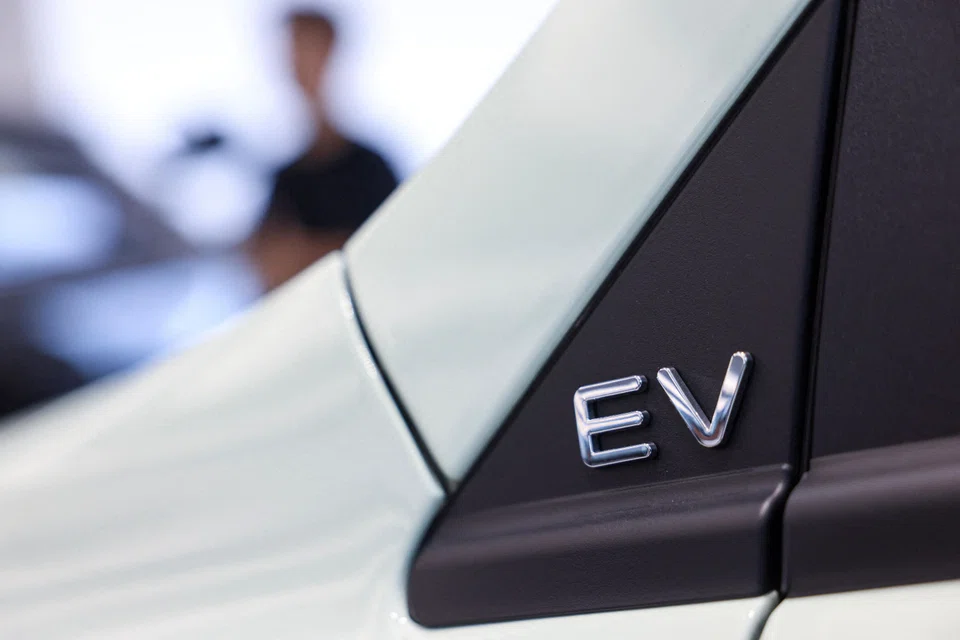
[SINGAPORE] Budget 2026 delivered a shock to the automotive sector through a 45-percentage-point slash to the preferential additional registration fee (Parf) rebate.
By drastically lowering the scrap value of internal combustion engine (ICE) cars, the policy effectively acts as a heavy disincentive for petrol car ownership, steering buyers toward electric vehicles (EVs).
EVs made up 45 per cent of new registrations in 2025, up from 34 per cent in 2024 and 18.2 per cent in 2023. Not only that, in the first Certificate of Entitlement (COE) bidding session following the Parf cut, mainstream car premiums rose higher than large-car premiums for the first time in almost six years.
Automotive consultant Say Kwee Neng attributed that to the “supercharged” Chinese dominance in the EV category.
But although policy levers are accelerating the EV transition, the market might be flashing warning signs.
A January EY study revealed that nearly a third of Singapore respondents plan to purchase an ICE vehicle in the next two years, an increase from about a quarter in 2024.
This suggests that while early adopters are flocking to EVs, Singapore’s wider green-mobility ambitions could be colliding with an illiquid secondary EV market, structural power-grid constraints and a fractured daily charging infrastructure.
Lars Nielsen, managing director at BMW Asia, said in an earlier interview: “Once (government incentives) are over or not the main driver anymore, then it’s really your daily life with the product.”
Frozen resale market
In Singapore, one of the most expensive places in the world to own a car, vehicles are treated as a financial asset class.
SEE ALSO

“The rest of the world is speculating in crypto; Singaporeans are speculating in COEs,” Nielsen had joked.
However, the secondary market for EVs is currently struggling to digest the influx of vehicles, upending the traditional financial math for buyers.
Ng Lee Kwang, managing director of new and used car dealer Octagon Motors, noted that used petrol cars typically sell in six weeks to three months, but that his network suggests dealers are having to budget up to six months to move a used EV.
Hesitance over battery technology becoming outdated means that some dealers now refuse to absorb inventory risk, and opt to take used EVs only on consignment.
This uncertainty is exacerbated by new market entrants’ aggressive pricing strategies, which can wipe out a car’s resale value overnight.
For some high-net-worth buyers, the lower entry prices of mass-market EVs have turned them into novelty purchases for which steep depreciation is simply an afterthought.
Ng noted that some wealthy individuals in his circle are buying affordable EV models like the BYD Sealion “just for fun” or to “try it out” – all while keeping their luxury petrol sports cars at home.
Insulated by their wealth, these buyers are largely unbothered by volatile EV resale values or the slashed Parf rebates, he added.
Not only that, the end of a 10-year COE cycle brings steep hidden costs. Ng said that specialised disposal companies now charge between S$2,000 and S$3,000 just to scrap an old high-voltage battery.
With the Parf rebate now slashed, owners can no longer rely on a robust government payout to cushion these “end-of-life” expenses for their vehicles.
Even day-to-day operating savings are increasingly heavily scrutinised. Some drivers hail the lower cost of electricity relative to petrol, but others are finding the ledger balanced out by punitive administrative fees.
N Meenakshi Sundaram, a procurement manager, recently switched from a diesel BMW to an electric BYD Atto 3, and is finding that the operational savings are entirely offset by higher annual EV road taxes and insurance premiums.
“If you think about the road tax and everything, it’s cut to square,” he said.
Soh Ming, Singapore managing director of Chinese EV maker Dongfeng, countered that the used EV market’s current volatility reflects “rapid model turnover rather than a structural weakness in EV residual values”.
Because EVs rely more on upfront green rebates than back-end Parf rebates, their depreciation curves are less affected by the Budget 2026 cuts, narrowing the lifecycle cost gap against petrol cars, he said.
Still, he admitted that the loss of a guaranteed scrap value remains a psychological hurdle.
“The transition will be more about changing how value is framed, from ‘what I get back at the end’ to ‘what I spend each month’,” he said.
Potential gridlock
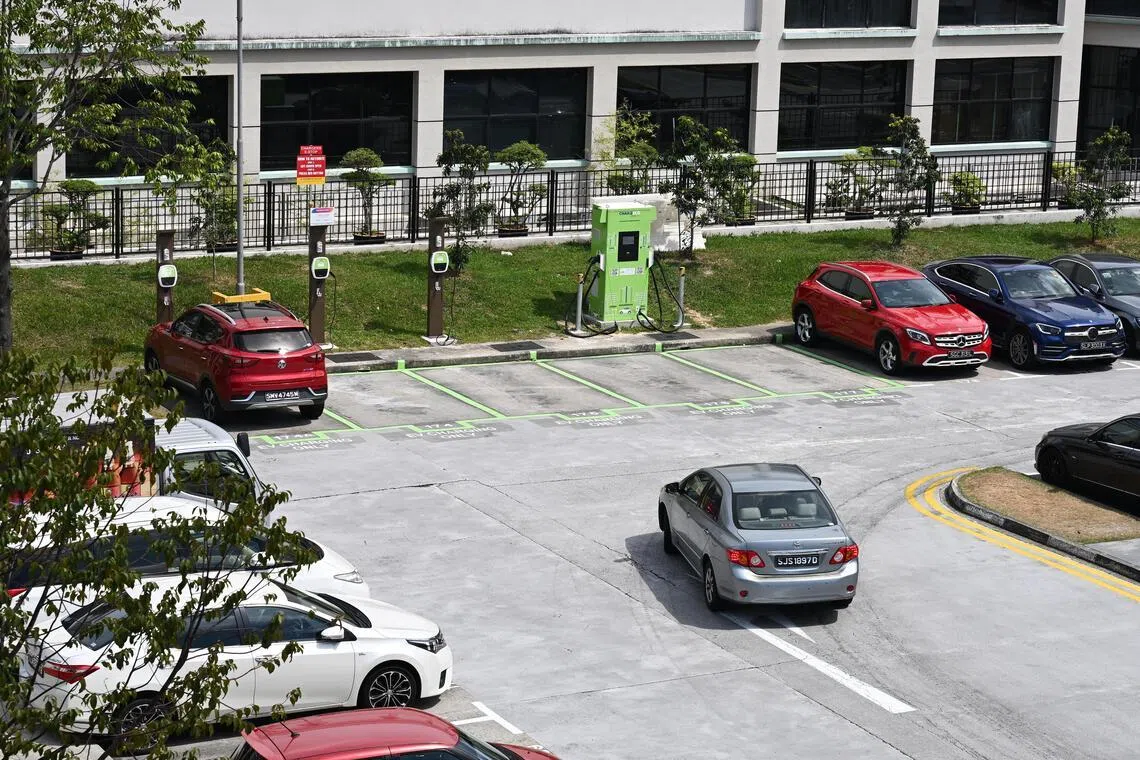
Beyond the financial friction, EV adoption faces a hard physical ceiling. The current battery-charging landscape dictates that the EV lifestyle is highly dependent on housing type. EV owners living in condominiums and HDB estates need to share charging stations; those living in landed property have the luxury of personal charging points in their own homes.
For private condominium resident Ashit Arora, who switched from a petrol Kia Cerato to a GAC Aion V electric crossover, the EV transition has been largely seamless. Residents in his estate, owning 20 to 30 EVs among them, share six chargers; they use an app to check on the availability of charging stations from the comfort of his living room.
A full charge costs him S$33, about 40 per cent less than a tank of petrol.
The reality is different for the majority of the market, however. As at last November, about 57 per cent of car-owning households were living in public HDB flats.
Sundaram, who lives in an HDB flat, said EV owners in three blocks of flats in his estate now share just three chargers – and slow ones at that.
“If more (EVs come in), then we will fight each other,” he said.
Such issues are compounded by the rapid electrification of commercial fleets and private-hire vehicles. Dongfeng’s Soh noted, however, that while these high-mileage drivers increase charger utilisation and friction in the short term, they also strengthen the commercial case for a faster rollout of charging infrastructure.
Ultimately, for mass-market buyers, “predictability matters more than the absolute number of chargers”, Soh said, calling reliable, overnight home-charging in HDB estates the “key unlock” for private ownership.
Last October, Acting Minister for Transport Jeffrey Siow disclosed that of the 25,000 EV charging points islandwide, more than 7,500 have been installed in about 85 per cent of HDB carparks.
“We are also on track to achieve our earlier target of deploying 60,000 charging points by 2030,” he had said.
However, Octagon Motors’ Ng believes that the national power grid’s capacity to handle mass charging might be a concern.
He suggested that it could be structurally impossible to outfit three-quarters of all 6,800 HDB multi-storey carparks with EV chargers without overwhelming local substations – and that Singapore’s pure EV population may top out at 50 to 55 per cent, with hybrids making up the rest.
The government is already bracing itself for this pressure. Minister-in-charge of Energy and Science and Technology Tan See Leng said last October that Singapore is taking measures to “future-proof” its power grid as demand from EVs and data centres increases.
Consequently, the Energy Market Authority (EMA) is working with transport operator ComfortDelGro on a 13-month sandbox to automatically adjust EV charger energy consumption in response to real-time power system needs.
The EMA website also states that it is working with the Land Transport Authority to “study the long-term electrical infrastructure needs” for EV charging.
The energy regulator said that preliminary findings indicate that upgrades will be needed for the consumer intake substations at the local level, the distribution grid network, as well as power generation. These upgrades will be implemented over the “next two decades”.
Quality-of-life friction
Charging limits compound daily consumer friction.
Dr Bimlesh Wadhwa, a professor at the National University of Singapore (NUS) who has owned a Hyundai Ioniq 5 EV for over two years, said that the straightforward petrol run has been replaced by a fractured tech ecosystem requiring multiple apps, a range of payment gateways and frustration over unstable Wi-Fi in underground carparks.
To scale properly, she suggested that the charging infrastructure must reach “the vending machine level of usability” – to the point that a driver can simply tap a card, pay, and walk away.
Still, with EV chargers located closer to her NUS residence than petrol pumps, her experience of driving out to charge her car has not been too dissimilar from petrol runs with her previous car.
But such daily friction for others, combined with battery range anxiety, explains why automakers foresee a moderation in the EV sector.
Ritu Chandy, head of sales for BMW in the Asia-Pacific, Eastern Europe, Middle East and Africa, told The Business Times in an earlier interview that she expects a potential plateau in EV sales, now that the initial wave of early adopters has bought in.
Pushing EV adoption past its current tipping point will thus likely require the broader support ecosystem to catch up to government mandates.
With a significant chunk of prospective buyers still hesitant, the next phase of Singapore’s green transition will no longer be driven by early adopters willing to overlook growing pains.
Instead, mass-market success will ultimately be dictated by the government’s ability to unlock neighbourhood charging for the public housing majority, and unfreeze an illiquid secondary asset market.
Additional reporting by Derryn Wong
Decoding Asia newsletter: your guide to navigating Asia in a new global order. Sign up here to get Decoding Asia newsletter. Delivered to your inbox. Free.
Copyright SPH Media. All rights reserved.
TRENDING NOW

Malaysian king buys stake in Singapore-listed mining firm expanding into rare earths

Grab CEO’s wife Chloe Tong on life with Anthony Tan and finding her purpose

Once staunchly pro-China, Malaysian Chinese businesses are now distancing themselves from Beijing
Longer wait times expected as S’pore healthcare institutions report system disruptions

