China’s robot makers have mastered the moves. Now comes the race for AI brains
Firms are racing to train their creations using real-world data and simulations
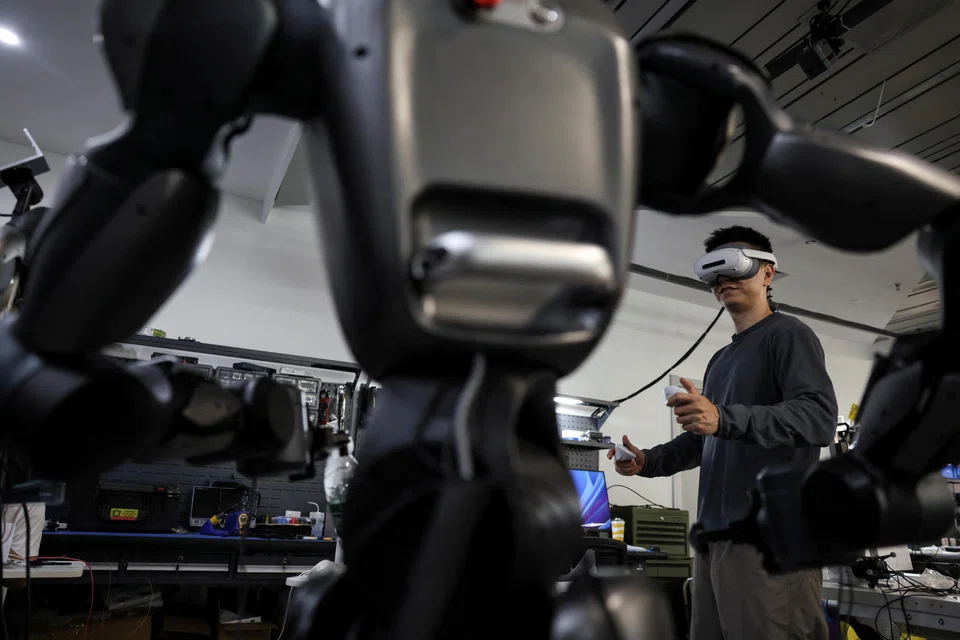
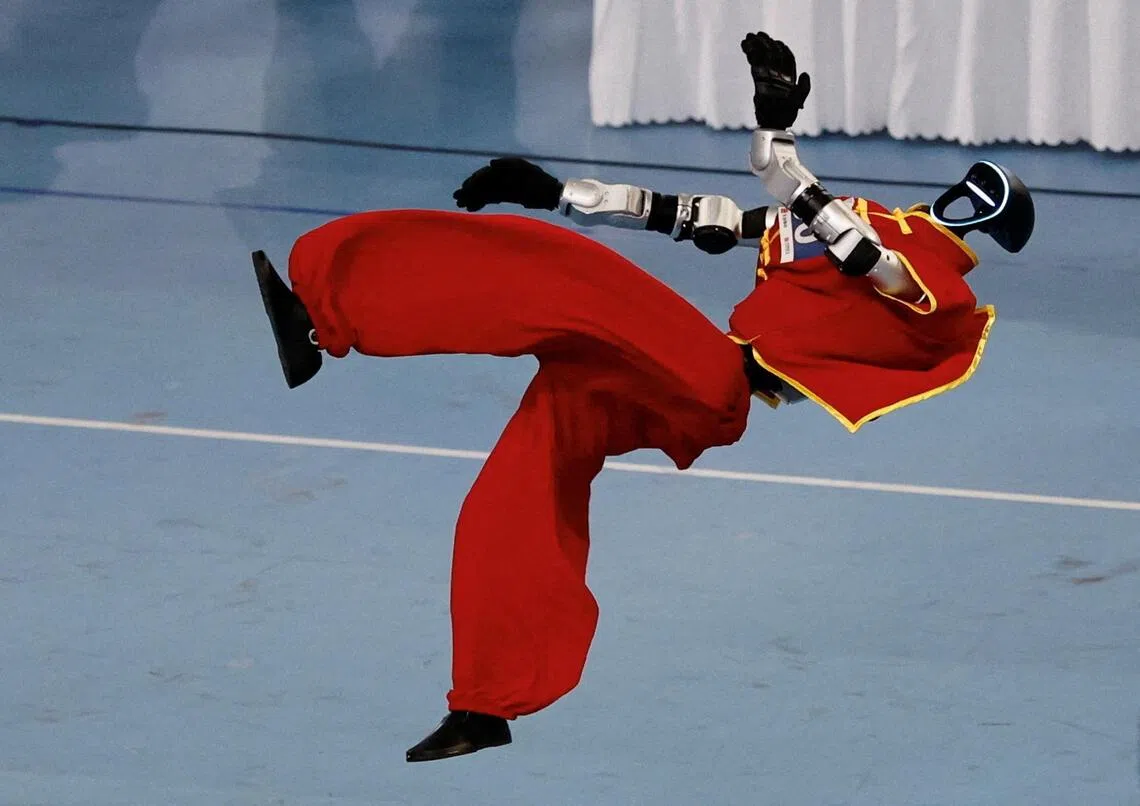
[BEIJING] After years of building humanoid robots capable of running, dancing and performing backflips, Chinese companies are pouring resources into a different challenge: developing the artificial intelligence that could make those machines useful across a wider range of jobs.
The shift is fuelling an investment boom in embodied AI, a field focused on software that allows robots to understand their surroundings, learn unfamiliar tasks and adapt without having to be programmed for every job.
Chinese embodied AI companies raised 93.5 billion yuan (US$14.1 billion) across 322 deals in the first half of 2026, five times the amount a year earlier, according to data research firm ITjuzi.
Funding is increasingly reaching specialist developers of robot intelligence alongside manufacturers.
As competition drives down hardware prices, robot makers have “concluded that the margin won’t come from the hardware but from the brain”, said Dermot McGrath, founder of Shanghai-based technology consultancy ZenGen Labs.
The emerging sector is opening a new front in the US-China tech rivalry. American companies lead in some advanced robot AI systems, while Chinese developers hope their manufacturing strength and access to real-world training data will help them challenge their US competitors, according to Reuters interviews with founders and top executives at five Chinese robotics firms, as well as industry analysts.

The country that best combines AI with machines could gain an advantage in automating factories and logistics, potentially reshaping industrial productivity and the global market for robotics technology.
“The brain is indeed the weakest link in the complete robotics stack,” said Spirit AI co-founder Gao Yang.
Race for intelligence
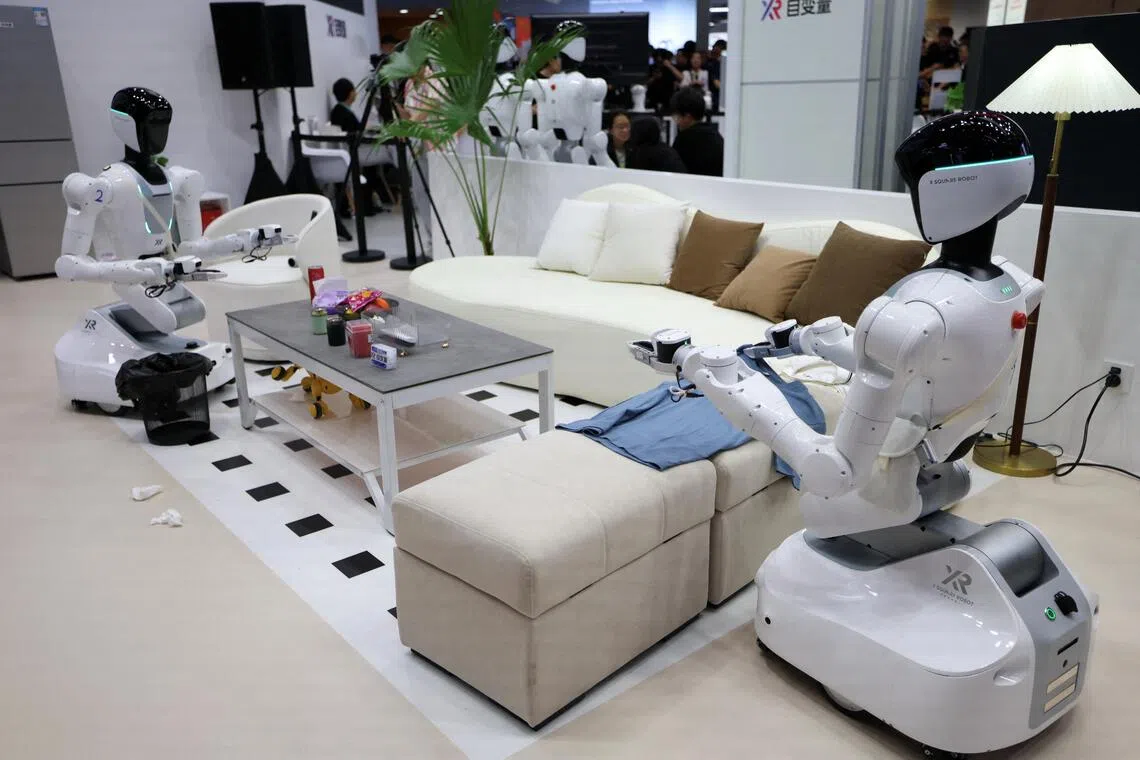
American startups, including Physical Intelligence, Skild AI and Generalist, are developing software intended to teach robots different skills without extensive retraining.


Generalist has said that its GEN-1.5 model completed around 60 per cent of simple tasks after viewing a demonstration lasting between three and 12 seconds.
China’s X Square has published research showing robots acquiring handling skills from a single human video without retraining the model for each task.
“The leading American labs are setting a demanding benchmark, particularly in how quickly robots can acquire and reuse skills,” said robotics consultant Georg Stieler, who considers China’s strongest startups credible competitors.
While US developers benefit from advanced AI research and greater access to powerful computing chips, Chinese companies can work closely with robot manufacturers and industrial customers to test and improve their systems.
Specialist Chinese startups, including X Square, Galaxea and Spirit AI, have each reached valuations of roughly US$3 billion, going by company disclosures.
“We want robots to shift from being driven by code to being driven by common sense,” said X Square co-founder and chief operating officer Yang Qian.
Established manufacturers are investing, too.
Hong Kong-listed UBTech advertised a chief scientist position overseeing AI model development with compensation of up to 124 million yuan, including equity and benefits.
Hangzhou-based Unitree, one of the world’s largest humanoid robot makers by shipments, has about 30 researchers developing AI that predicts how objects behave, said a person briefed by the company.
Unitree did not respond to a request for comment.
The training sprint
Unlike chatbots, which learn from vast quantities of Internet text, robots need examples of physical interactions, from gripping objects to handling flexible wires.
Chinese companies are pursuing different approaches to collecting that information, with some employing people to demonstrate tasks, others using computer simulations, and some combining both. The field remains crowded, with no company establishing itself as the clear leader.
Spirit AI’s Gao said that the company has hired around 1,000 people to record everyday and industrial activities. ACE Robotics, meanwhile, uses wearable sensors to capture workers’ movements and grip forces in stores and hotels.
Ant Group’s robotics unit Robbyant said it trained a model using 160,000 hours of material, including 50,000 hours of human-guided robot movements. It also trained software on 20 robot configurations from 17 brands, aiming to use the same AI across different machines.
DexForce is taking another approach, using computer-generated environments to teach robots. Chief operating officer Nicole Yang said the company can prepare some industrial tasks for deployment within six to eight hours, and reported success rates above 99.9 per cent in specified precision operations.
But simulations cannot perfectly reproduce physical interactions, said Jerry Wang of spatial intelligence company Manycore Tech, which designs simulated environments for AI training.
X Square’s Yang flagged that data quality “is more important than data diversity, and more important than simply collecting data at massive scale”.
Chinese robot firms also face additional headwinds, including shortages of advanced Nvidia chips due to US export controls, and a squeeze on initial public offering funding amid regulatory concerns over inflated valuations and overcrowding.
Zhu Mingxuan, who leads development of JoyIn Technology’s Aether robot AI, said that as robots become more powerful, the shortage of advanced chips will become a serious problem for China’s embodied AI industry.
From training to work
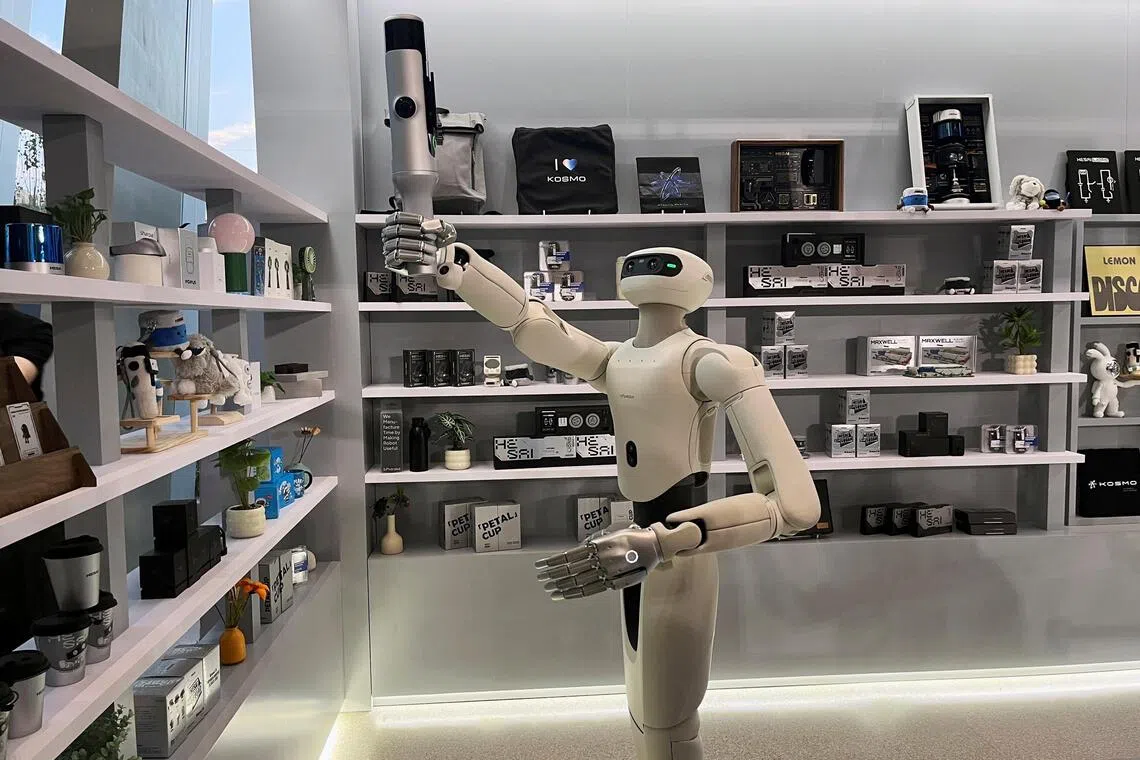
JoyIn and other developers are already testing whether their software can enable robots to tackle unfamiliar problems.
Zhu described an experiment in which a robot repeatedly failed to place headphones in a cupboard beyond its reach. Then, engineers showed it videos of how people managed the task, and the robot pushed a box towards the cupboard and tried stepping onto it.
“Every time it was exploring a different behaviour,” she said.
Real-world deployments in China leave no room for improvisation. Battery maker CATL said Spirit AI robots connect flexible wires during battery-pack testing at its Zhongzhou plant, reporting insertion success above 99 per cent. Robbyant said its robots handle orders in two Shanghai pharmacies, with staff checking medicines before dispatch.
But the longer-term prize is software capable of learning new jobs without extensive adaptation. Success will depend on how the same AI performs across different customers and workplaces and that will require companies to train increasingly powerful models with advanced chips.
Chinese companies are trying to reduce their computing requirements through more efficient models, synthetic data and simulations, while domestic chipmakers, including Huawei, are developing alternatives to Nvidia hardware. It remains unclear how far those efforts can offset the shortage.
Unitree founder Wang Xingxing said last month that the company had tested OpenAI’s GPT-6 on robots with encouraging results.
He said GPT-7, if released next year, could bring robotics its own “ChatGPT moment” – a step-change in capability akin to ChatGPT’s 2022 launch, which turned generative AI into a mainstream consumer and business technology.
Wang said he would consider that threshold reached when robots were able to complete 80 per cent of tasks in unfamiliar environments from spoken instructions.
But consultant Stieler said a breakthrough in demonstrations would not necessarily mean robots were ready for broad commercial use.
“If the question is when a model first handles a broad range of unfamiliar tasks in demonstrations, the optimists may well be right,” he said. “If the question is when a customer can count on it, I would add years, not months.” REUTERS
Decoding Asia newsletter: your guide to navigating Asia in a new global order. Sign up here to get Decoding Asia newsletter. Delivered to your inbox. Free.
Share with us your feedback on BT's products and services