

With AI, it’s not about coding better; workers need to think better: Koh Boon Hwee
The tech and investment veteran says humans must bring soft skills to the table and let AI handle the facts

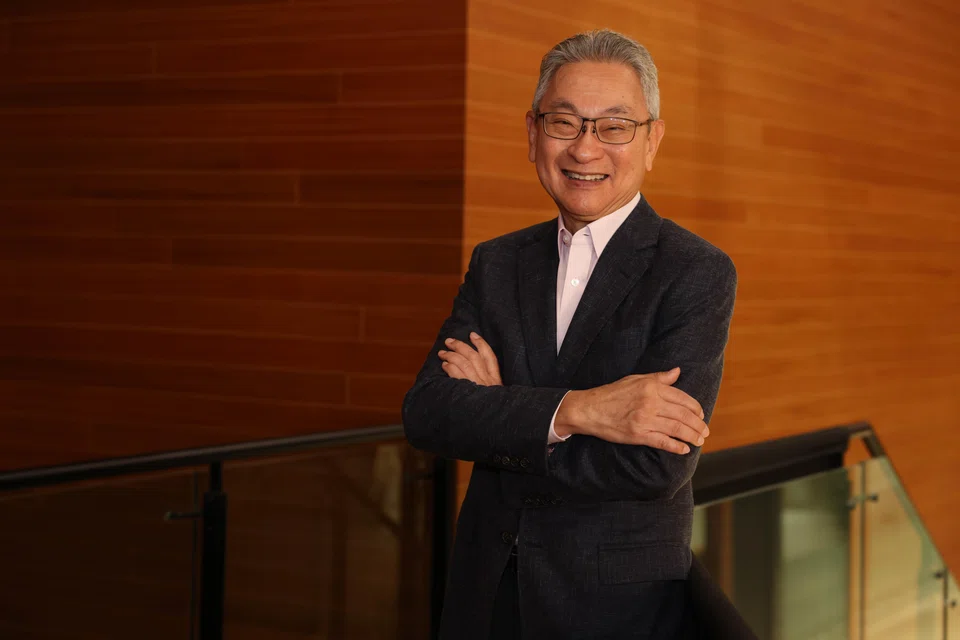
[SINGAPORE] Tech and investment veteran Koh Boon Hwee, perhaps best known for backing gaming and technology company Razer in its early days, declares that at least for now, investing in artificial intelligence infrastructure is off the table for him.
Speaking exclusively to The Business Times, he said with his signature candour: “Frankly, if you ask me whether I would put my money into AI infrastructure, my answer is ‘No, I won’t’, because it has the potential to be loss-making for investors.”
His reason? AI infrastructure requires billions of dollars to build and train large language models (LLMs), which means investors might not recoup much from what they put in.
One could describe Koh – the chairman of the Singapore Exchange and a director of the GIC board following a career chairing some of Singapore’s key companies from DBS to Singapore Airlines – as being among the country’s leading investors in the technology space.
However, Koh said companies that use the AI infrastructure and improve their operations as a result would likely be more valuable and investable, as would companies that develop specialised agentic AI – that is, systems that can gather and understand data, design a way to achieve a given objective, and execute the plan.
This is where he would focus his investment firepower, he added.
Koh, who is also the founder and chairman of privately held Sunningdale Tech, a global manufacturer of precision plastic components and tooling, keeps his finger firmly on the pulse of the AI and tech community with visits to Silicon Valley every other month.
Venture capital fund managers, startup founders, company executives, other investors and university professors are among those he has been meeting and talking to.
He described the US’ tech corridor as having “a unique combination of money, entrepreneurs, and most importantly, a risk-taking attitude”.

“It’s a very competitive market there and everyone’s paranoid that if they don’t move fast, they might be the one to be decimated,” he added.

Koh noted that even the traditional industries in the US are moving relatively fast in the AI space. For instance, supermarket giant Walmart, despite still operating a brick-and-mortar business, is tapping AI for e-commerce.
The Asia-Pacific region, he noted, is still largely reliant on technology from either the US or China. These markets, being relatively smaller, are also at a disadvantage because bigger markets which generate greater amounts of data will result in better validation for AI engines.
AI’s strength is in how it handles data
Koh is clear: The value of AI lies in its ability to process large amounts of data.
He lists telcos, airlines and healthcare players as sectors that would benefit the most from AI because they generate large amounts of data and need it processed or interpreted.
The insurance sector is another beneficiary, from its need to process thousands of claims and decide whether these are valid.
In healthcare, AI can cross-check drug interactions more quickly than human doctors can; in banks, AI can be used to undertake compliance checks more efficiently.
Koh said he is impressed with the level at which chatbots operate in the US. “I can tell you that there are instances of chatbots where the human being on the other end has absolutely no idea he or she is talking to a machine.”
Customer satisfaction scores have even gone up significantly because these chatbots are working so well – and they learn and become even better at their jobs the more they talk to their human customers.
Koh added, that the AI engine has to be smart enough where if the chatbot hits a roadblock, it will say “Let me refer this to a real human being, or a real engineer”.
A bot should be able to learn and take over again after 10 to 20 such roadblocks.
Workers’ fears of AI
Koh acknowledged workers’ apprehension that AI would steal their jobs, noting that although humans have come around to accepting that robots can take over the most repetitive, manual tasks, they are still nervous about AI.
While humans may be comfortable with robots assisting with manual tasks, “now, AI is the equivalent of a machine that can extend the way we think, and we don’t like that.”
Does he think that it means there is no longer any room for humans?
His view of is that the human touch is still needed. “If you were a company doing this, you must take into account that there will sometimes be edge (or extreme) cases, or... a new product or a new service that the AI engine might not be as familiar with because it doesn’t have enough data.”
“I think AI is going to change the way jobs are going to get done. There will be jobs that will be largely replaced, but there will be other jobs created in their place.”
Koh Boon Hwee
On the factory floor, for example, AI can aid in planning the production schedule and even adjust the schedule swiftly if an urgent order comes in.
“Does it mean that we go out and fire our (human) schedulers? The answer is no; we’ve just given them a tool to make them more efficient.”
Humans are still critically important, he argued, and AI is there to assist and value-add.
“It (AI) can crunch the routine paperwork of scheduling, ordering and pricing in a fraction of the time, but it cannot judge which customer is more important to us; it cannot judge whether the vendor is straight up or likely to cut corners,” he added.
“Our people will be able to spend more time face to face, and in the long run, that makes them better at their jobs.”
Koh cited an example of analysts who research a company’s performance. As they talk to the executives, they get additional insights to supplement the findings of the AI engine, which generates only facts and figures.
“It’s the ability of human analysts to generate analysis from face-to-face interactions (that is still valuable). We are not yet at the point where the AI engine can read body language.”
AI and job losses
Even amid the underlying unease about jobs being lost – tech giant Meta laying off some 8,000 staff worldwide, moving thousands to AI-focused roles and cancelling open positions is just one example – Koh holds a nuanced view on the job situation.
“I think AI is going to change the way jobs are going to get done,” he said. “There will be jobs that will be largely replaced, but there will be other jobs created in their place.”

How should workers respond to this?
“In the past,” Koh said, “a software engineer may have spent 20 per cent of his time talking to a user about his requirements, 60 per cent of the time coding, and 20 per cent at the end-stage, working with users to test the software before its release. That process might take 18 months.”
Coding today would likely take less than 5 per cent of an engineer’s time.
“If I were a software engineer, I’d go back to university and improve my user needs-testing skills and worry less about coding.”
Fundamentally, soft skills matter now. “You have to be good at talking to the users and understanding their requirements,” Koh pointed out. “The AI engine can code for you in less than a couple of days.”
The test for whether a software engineer is at the top of his game: It is no longer a case of “I can code better than you can”; it is going to be “I can think better than you can”.
The way Koh sees it, the key question will be the value the worker can bring to the table as the human in the loop.
“There is a quantum step up in the demands for what the human in the loop does. It’s no longer just showing up for work and filling in the time. We’re not going to be able to enhance our people’s standard of living just by doing the same things that we have done in the past.”
Being human and having empathy
As the use of AI becomes more widespread, humans can respond by being more creative and show their capacity for empathy; these are the soft skills that AI does not have, Koh said.
He said that AI would have major implications on what education should look like down the road: “How are we going to train (the soft skills)? Educating people will be more about getting people to understand how to collaborate, how to communicate.”
At the same time, there is the matter of examinations, which Koh described as the “bane of education”.
“Passing exams is probably the easiest way – and also the most erroneous way – of evaluating (future) skills. It may have worked for the last 50 years, but it won’t work for the next,” he said.
For humans, his bottom line is that it will be crucial for workers to show they have soft skills: the ideas, the creativity and the judgment. “For most jobs, AI will augment human skills, not replace them.”
Decoding Asia newsletter: your guide to navigating Asia in a new global order. Sign up here to get Decoding Asia newsletter. Delivered to your inbox. Free.
Copyright SPH Media. All rights reserved.
TRENDING NOW

LTA proposes combining car COE categories, adding rebate-surcharge system

StarHub to acquire MyRepublic’s mobile business amid ongoing telco consolidation

DBS, OCBC, UOB rout lops billions off STI as inflation, rate concerns spook investors

Grab CEO’s wife Chloe Tong on life with Anthony Tan and finding her purpose

