

Emotional dividends: The compounding return of staying calm
An exchange-traded fund pre-empts the fear of missing out

IT IS 11 o’clock on Monday morning and Jane, a sales manager at a multinational company, is finding it difficult to focus on the quarterly report she is preparing.
DBS , a stock that makes up a sizeable portion of her investment portfolio, has gained 2.6 per cent in the last two hours, and she cannot decide whether to lock in her gains or hold on for more.
Fifty metres away, her colleague Sherry is whizzing through her to-do list. Sherry owns shares of DBS too, but via an exchange-traded fund based on the Straits Times Index (STI).
The bulk of Sherry’s portfolio is built on ETFs, a few opportunistic holdings to generate alpha.
These two stories are representative of real client scenarios I see every day. The difference between the two characters is not knowledge or skill. It is emotional exposure.
Over an investing lifetime, that difference compounds into an emotional dividend: the return you earn by staying calm.
Many people know that an ETF diversifies returns. Fewer have heard that it also diversifies our emotions.
By pre-committing to owning a whole basket, an ETF minimises the three biases that do the most damage to individual investors: the fear of missing out (Fomo), the pain of loss and the urge to keep trading.
Managing Fomo
Fomo is really a fear of regret: the sting of watching others gain while you choose to sit out.
SEE ALSO

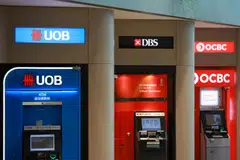

When a single stock rips 30 per cent and you own none of it, that regret can push you into buying high and hoping for a return of the rally you missed.
An ETF pre-empts this problem. If you hold an STI ETF, for instance, you already own DBS, OCBC and UOB stocks at their index weights.
When Singapore’s banks surge, your ETF does too (albeit to a lesser degree). You do not need to pick winners in advance and you never entirely miss out, because you bought participation when you invested in the ETF.
The calm works only if you know what you own, of course. But such information is easy to find. The STI constituents are listed on the Singapore Exchange’s website, and ETF managers all publish the top holdings and sector weights of their funds.
Knowing what you own silences Fomo.
Maths that mutes the pain
Behavioural researchers Daniel Kahneman and Amos Tversky showed that the pain of losing $100 is roughly twice as intense as the joy of winning $100.
This is loss aversion, and it is why a single stock down 40 per cent can ruin your week and prompt a panicked sale at the worst possible moment.
Now do the maths inside an ETF. A stock that falls 40 per cent but makes up just 3 per cent of the fund drags the whole portfolio down by little more than 1 per cent. You feel a ripple, not a blow.
A subtler mechanism is at work, too. When you hold 10 individual stocks, you keep 10 mental scoreboards – and you react to every one of them. The economist Richard Thaler called this narrow framing.
An ETF forces the opposite: one line item, one number. You see the forest, not 10 anxious trees. And because your portfolio collapses to a single figure, you check the price less often.
This matters because the more frequently you look, the more losses you notice and the more timid your decisions become.
Don’t confuse calm with boredom
Here is the honest twist, because none of this comes free. The same aggregation that removes the pain also removes the thrill.
An index fund is, by design, a little boring, and boredom can be dangerous. It tempts investors to abandon the calm, jump on single names and quietly reintroduce every bias they had just escaped – this time with trading costs attached.
The research is blunt on the consequences: finance professors Brad Barber and Terrance Odean found that overtrading diminishes returns.
The fix is not to suppress the urge, but to give it a fenced-off home. Let a broad ETF form the core of your portfolio, say 70 per cent, and let it do the emotional heavy lifting.
Then research and allocate a small sum to individual names in pursuit of higher returns. The reduced amount in single stocks means a loss would sting but never wound.
The dividend that never shows on your statement
Over the 10 years to Jun 30, the State Street SPDR STI ETF and the Amova Singapore STI ETF each returned close to 10 per cent annually. But that number is only half the story.
The other half is the decisions you did not make in a panic, the winners you did not sell too soon, and the losers that did not cause you any lost sleep.
The quiet edge of holding an ETF as your core is that it lets you feel less. And in investing, feeling less is often how you end up doing and making more.
The writer is associate director and trading representative at UOB Kay Hian
Decoding Asia newsletter: your guide to navigating Asia in a new global order. Sign up here to get Decoding Asia newsletter. Delivered to your inbox. Free.
Share with us your feedback on BT's products and services
TRENDING NOW

Once staunchly pro-China, Malaysian Chinese businesses are now distancing themselves from Beijing

Britain’s mansion tax shows the difficulty of targeting wealth

Three hats, one goal: How Ng Kian Swan runs sustainability at NUHS

COE review: The gap between luxury and mass-market cars isn’t the only one worth bridging

