

Singapore banks’ rout on new China scrutiny of wealth flows ‘overblown’: Maybank
The slides in DBS, OCBC, UOB shares offer buying opportunities, says the brokerage

[SINGAPORE] The recent dumping of Singapore bank shares on concerns of a possible slowdown in wealth management growth in North Asia was “overdone”, Maybank Securities said on Thursday (Jun 11).
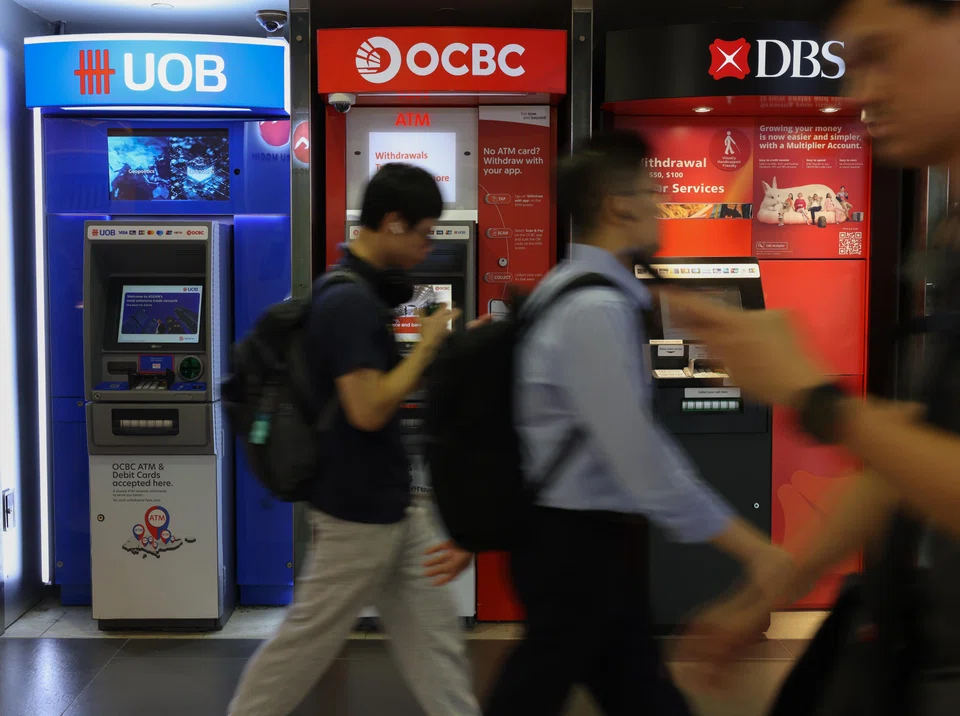
Over the past week, DBS fell 4.6 per cent, OCBC declined 5 per cent and UOB slid 2.3 per cent on news of China’s tightening of fund outflows and a broader artificial intelligence-linked pullback across global markets.
Given the Singapore banking trio’s focus on wealth management as a growth engine – for instance, DBS plans to open 18 new and 36 upgraded wealth centres across the Asia-Pacific by 2027 – some analysts fear the tighter framework could hinder the strategy.
In 2025, North Asia accounted for 22 per cent of profit before tax for DBS, 18 per cent for OCBC and 7 per cent for UOB, Maybank noted.
What is Order No 837?
China’s State Council Order No 837, which takes effect on Jul 1, could restrict North Asian wealth management pipelines.
The new regulations will for the first time bring resident individuals within mainland China under the official scope of outbound investment filings and security reviews.
The move prompted JPMorgan to downgrade DBS to “neutral” on Wednesday. However, Maybank analyst Thilan Wickramasinghe is maintaining a “positive” rating on Singapore banks, arguing that the direct impact should be limited.
“Onshore Chinese wealth is not a client segment for Singapore banks,” he said. “Offshore capital, which is the key segment in North Asia, should be unaffected by the new rules.”
Maybank said the regulations appear targeted at closing unregulated outbound flows from China, rather than stopping all outbound wealth movements.


The brokerage believes the key policy objective is to bring flows into approved and compliant channels, which is “supportive of China’s own ambition of internationalising the renminbi”.
The new rules are aimed mainly at China residents living in mainland China, it added – a segment Singapore banks are not licensed to serve.
The lenders’ focus remains on offshore Chinese wealth, including clients whose wealth is generated outside China, or who have businesses, assets or family offices in Hong Kong, Singapore or other overseas markets – not mainland residents.
Such residents already face restrictions on moving wealth out of China, making these rules “more an extension of existing controls, rather than a completely new restriction on a major client segment for Singapore banks”, Wickramasinghe said.
Furthermore, while local lenders have been expanding their North Asian wealth investments recently, Maybank understands that the larger proportion of assets under management is still from Singapore and South-east Asia.
Overall, the sector fundamentals remain solid, with “strong execution, asset quality and regional growth” in view. Maybank views the recent stock price weakness as an opportunity to accumulate shares.
“The fundamental drivers of strong execution, asset quality, fee growth, net interest margins bottoming and rising credit demand keep our positive outlook unchanged,” the brokerage said, naming DBS and OCBC as top picks in the report.
It highlighted OCBC for “delivering synergies under One OCBC” – the group’s unified strategy – and shifting its strategic focus to Asean, which the brokerage believes should further limit North Asia uncertainty.
Meanwhile, it favours DBS for continuing to offer “strong capital returns visibility and scale-led execution”.
Decoding Asia newsletter: your guide to navigating Asia in a new global order. Sign up here to get Decoding Asia newsletter. Delivered to your inbox. Free.
Copyright SPH Media. All rights reserved.
TRENDING NOW

DBS, OCBC, UOB rout lops billions off STI as inflation, rate concerns spook investors

Grab CEO’s wife Chloe Tong on life with Anthony Tan and finding her purpose

OCBC sheds S$8 billion in value as shares close nearly 6% down; analysts cautious on banks

Deal between tycoon friends sparks scrutiny of Philippine power sector

