China AI rally broadens as funds move past overvalued first-tier winners to indirect beneficiaries
Second-tier players are moving to the fore as share prices of direct players mature
Jermaine Fok
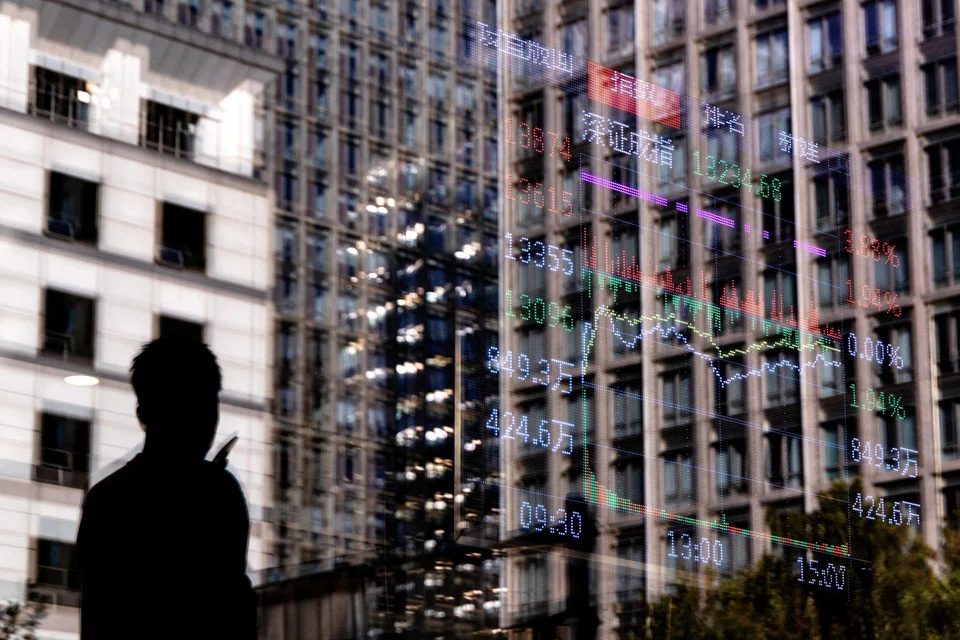
[SINGAPORE] While investor attention has been largely focused on the artificial intelligence-fuelled rally in the US, China has been experiencing a technology boom of its own.
The Shanghai Stock Exchange’s (SSE) Star 50 Index – which tracks the 50 largest and most liquid tech-focused companies on the bourse’s Science and Technology Innovation Board, or Star – is up 42.2 per cent in the year to date and reached an all-time high on Friday (Jun 19). In comparison, the SSE Composite Index – which follows the performance of all the stocks listed on SSE – has gained 3.1 per cent in the year to date.
Meanwhile, the CSI 300 Index – comprising the 300 largest and most liquid A-share stocks listed across the Shanghai and Shenzhen stock exchanges – has risen 6.7 per cent over the same period.
The Hang Seng Index, which tracks the largest and most liquid companies on the Hong Kong Stock Exchange, recorded a year-to-date loss of 6.7 per cent.
Estimates from the China Academy of Information and Communications Technology as well as Frost & Sullivan showed that China’s AI market grew from US$23 billion in 2024 to US$31 billion in 2025.
It is projected to reach US$142 billion by 2030, implying a compound annual growth rate of 35.5 per cent over the six-year period.
Hardware takes the lead
Hardware-linked names have led gains in the Chinese tech rally.
Domestic chip designer Cambricon Technologies, listed on SSE Star, surged more than 150 per cent between January 2025 and April this year. Hong Kong-listed Hua Hong Semiconductor jumped over 400 per cent across the same period.
Both outperformed the Morningstar China TME Index, which tracks the performance of large and mid-cap Chinese equities, and gained about 25 per cent over the period.




The wins have been driven by strong demand for computing power, graphics processing units, AI accelerators and advanced semiconductor infrastructure.
However, as valuations of semiconductor and hardware stocks climb ahead of earnings growth, some Chinese institutional investors are looking beyond the sector’s obvious winners.
Second-tier beneficiaries popping up on investors’ radar span cloud services, power infrastructure, Internet platforms and data centre supply chains. Fund managers believe these businesses are well-placed to capture value as AI usage spreads across the economy.
“We’ve seen portfolio managers become more selective and valuation-conscious when it comes to AI hardware names, noting that valuations for some companies have moved ahead of earnings delivery,” said Claire Liang, principal and manager of research at Morningstar.
Several China-focused funds have consequently pared back exposure to the sector.
For instance, in February, Schroders’ ISF China Opportunities Fund maintained an underweight position of about 4 per cent in the information technology sector, citing stretched valuations among AI hardware companies.
Looking beyond chipmakers
Against this backdrop, institutional investors are increasingly rotating into indirect beneficiaries of AI adoption.
Companies across the broader AI ecosystem – including equipment suppliers and infrastructure providers – are expected to benefit from improving order book visibility over the next few years, said Lorraine Tan, director of equity research at Morningstar.
For example, the JP Morgan Asset Management China Fund is positioned to benefit from rising electricity demand driven by AI workloads.
Its holdings include power infrastructure companies such as Sieyuan Electric, Anhui Yingliu and Huaming Power Equipment. The asset manager expects these businesses to grow faster than overall AI spending over the next two years.
The fund also maintains selective exposure to application-layer companies. These include e-commerce giant Alibaba, as well as content platforms Kuaishou and Meitu, which it believes could benefit from new monetisation opportunities.
Likewise, Schroders has been favouring Internet platform companies with high-quality proprietary data sets.
It believes opportunities to monetise AI through cloud services and personalised recommendations offer a better risk-reward profile than investments in hardware manufacturers.
Still bullish on hardware
Despite the rotation, not all managers are abandoning hardware.
Some continue to favour hardware-linked segments with stronger earnings visibility, Liang said.
These include advanced printed circuit board (PCB) makers, optics companies and power infrastructure providers. Rising AI workloads are increasing technical requirements and boosting value per unit across these segments.
JP Morgan Asset Management continues to prefer what it calls “AI enablers” and infrastructure-linked companies that can benefit regardless of which AI models or platforms eventually emerge as winners.
Among its holdings are PCB-related companies such as manufacturers Zhen Ding Technology and Suzhou Dongshan Precision.
The asset manager believes these firms will benefit from upgrades driven by increasingly complex AI server architectures.
Decoding Asia newsletter: your guide to navigating Asia in a new global order. Sign up here to get Decoding Asia newsletter. Delivered to your inbox. Free.
Share with us your feedback on BT's products and services