UOBKH nudges SIA target price up S$0.10 on second-quarter optimism
The brokerage, however, maintains a ‘hold’ call

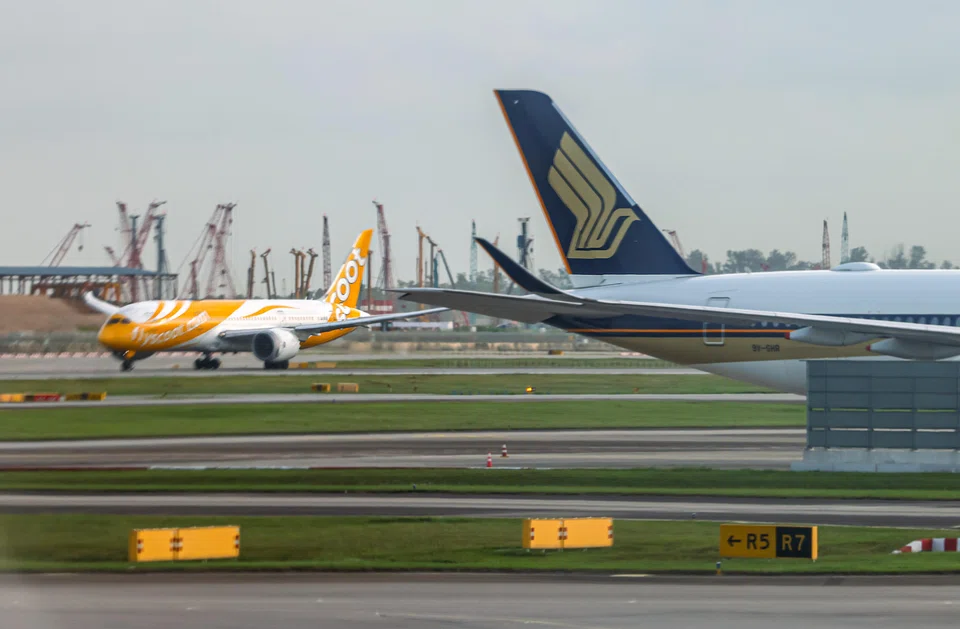
[SINGAPORE] UOB Kay Hian (UOBKH) on Thursday (Jul 16) marginally increased its target price for Singapore Airlines (SIA) on optimism of a rebound in the airline’s profitability in the second quarter.
This expected improvement was driven by “effective cost pass-throughs” and the flag carrier’s “comfortable fuel hedging position”. The brokerage, however, maintained a “hold” call.
Ahead of SIA’s first-quarter results, UOBKH also noted that the airline’s June 2026 operating data was “in line” with projections. Passenger and cargo loads rose 4.1 and 5.1 per cent, year on year, respectively.
UOBKH analyst Roy Chen said: “We now forecast SIA’s Q1 bottom line to be around breakeven, reflecting higher fuel costs amid the US-Iran war and a major drag from Air India.”
Chen’s optimism for a Q2 recovery in profitability was despite a rebound in fuel prices after the effective end of the US-Iran ceasefire led to more volatility in the Strait of Hormuz.
Moderated loss estimate for Air India
The brokerage’s updated estimate for Q1 FY2027 now ranges from a net loss of S$90 million to a net profit of S$110 million.
The midpoint of S$10 million implies a broadly breakeven quarter, a notable upward shift from the previously estimated net loss of S$20 million to S$300 million.
This revision was primarily due to a moderated loss estimate for Air India, said UOBKH, reflecting the Indian rupee’s slower depreciation against the US dollar during the quarter.
Still, this breakeven expectation marks a decline compared with the reported net profits of S$186 million in Q1 FY2026 and S$441 million in the fourth quarter of the same financial year.
SEE ALSO



SIA on Friday responded to questions from the Securities Investors Association (Singapore), saying that its investment in Air India gives it access to growth opportunities that cannot be fully realised through a single-hub model.
The association had asked the airline to elaborate on the role it expects to play in Air India’s turnaround.
Q2 rebound
Despite ongoing volatility in the Middle East, UOBKH expects a significant earnings rebound of around S$450 million in Q2. This represents a marked year-on-year improvement from the low base of S$52 million recorded in Q2 FY2026.
The recovery is expected to be supported by cost pass-throughs via higher airfares and freight rates, alongside SIA’s relatively advantageous fuel hedging positions compared with its regional peers.
The national carrier has secured its fuel needs to cushion upside risk to jet fuel prices. For Q2 FY2027, it has hedged 49 per cent of the projected consumption at favourable prices, noted UOBKH. It has also hedged 50 per cent of the third quarter’s estimated fuel use, and 32 per cent of what could be needed in Q4.
Valuation and risks
UOBKH raised its FY2027 earnings forecast for SIA by 22 per cent to about S$1.2 billion, representing a 3 per cent year-on-year growth.
Consequently, the target price was nudged up to S$6.76 from S$6.66, based on 1.28 times the forecast FY2027 price-to-book ratio.
The brokerage highlighted that SIA remains a preferred regional aviation pick due to its strong balance sheet, projected yield of 4.6 to 4.9 per cent in FY2027 to FY2028, and proven management track record.
However, it prefers a better entry point given the current market uncertainties and the expected Q1 earnings weakness.
UOBKH outlined several key risks that could have a negative impact on SIA’s near-term performance, including long-lasting unrest in the Middle East that keeps fuel prices elevated.
A weaker global economy could also reduce demand for air travel and cargo, while a prolonged financial drag from Air India operations – estimated by some experts to last as long as 2030 – could be a further risk.
Decoding Asia newsletter: your guide to navigating Asia in a new global order. Sign up here to get Decoding Asia newsletter. Delivered to your inbox. Free.
Copyright SPH Media. All rights reserved.