

Singapore’s first National Adaptation Plan to help firms assess climate risks: Grace Fu
It will also focus on identifying gaps in the country’s climate resilience efforts, says the minister

[SINGAPORE] The first iteration of Singapore’s upcoming National Adaptation Plan will focus on identifying gaps in the country’s climate resilience efforts, said Minister for Sustainability and the Environment Grace Fu on Tuesday (May 19).
Instead of prescribing solutions, this will also help businesses assess climate risks across their operations and supply chains.
Fu said the plan will mark the first time Singapore translates the United Nations Global Goal on Adaptation into a foundational national framework that can guide both government and businesses in assessing climate risks.
The Global Goal on Adaptation comprises 59 indicators spanning areas such as water, food and public health.
While not all the indicators are applicable to the Republic, the framework would still serve as a “useful checklist for businesses that are operating in Singapore”, including those with regional exposure, said Fu.
For example, she said businesses importing agricultural products such as rice from regional countries could use the framework to assess risks such as water security in their source markets, as well as the reliability of their supply chains.
“It also helps inform how to make your supply a lot more resilient through adaptation measures,” she added.
She was speaking at a panel discussion held on the sidelines of Ecosperity Week, Temasek’s flagship sustainability conference, on why climate adaptation matters.
Also on the panel was Climate Bonds Initiative (CBI) chief executive officer Sean Kidney, with DBS’ new chief sustainability officer Kelvin Wong moderating the session.
SEE ALSO



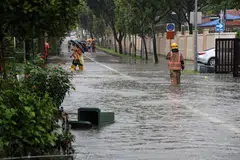
Fu noted that adaptation is becoming increasingly important as countries and businesses contend with the growing physical and economic impacts of climate change.
These impacts range from water and food security to disruptions caused by extreme heat and weather events.
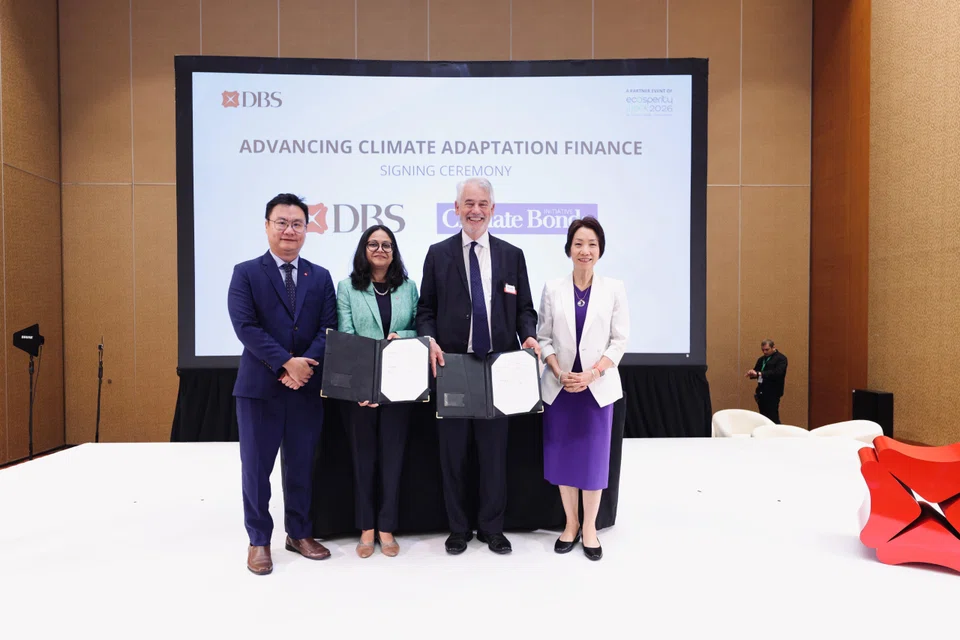
Prior to the panel, Fu witnessed the signing of an agreement between DBS and CBI to jointly develop a research paper on climate adaptation and resilience investment opportunities in the Asia-Pacific.
The paper will seek to identify investable opportunities across sectors such as energy and real estate, drawing on CBI’s assessment methodologies and DBS’ regional insights.
On the partnership, Wong said that as the effects of physical climate risks grow in scale and frequency, the need to help businesses and communities adapt to better withstand climate shocks becomes more urgent.
He added that this is especially true for Asia, which is one of the most climate vulnerable regions in the world.
“The transition to a low-carbon economy must go hand-in-hand with adaptation – and finance can be a lever that accelerates both,” said Wong.
Broader discussions needed
The National Adaptation Plan was first announced by Fu during her ministry’s Committee of Supply debate in March, and is scheduled for release in 2027.
She said the “issue of the adaptive capability of a country” goes beyond her ministry, making it important for gaps to first be identified so discussions can take place across government agencies, businesses and industries.
On why such discussions are important, she pointed to sectors such as telecommunications, where operators of critical infrastructure need to assess whether their equipment could continue functioning reliably under prolonged high-heat and dry-weather conditions.
She said such scenarios could include periods of extreme heat coupled with low rainfall, which may place additional stress on critical systems and infrastructure.
She added that broader societal discussions are also needed on issues such as protecting communities from heat stress, as well as managing disruptions to outdoor work during prolonged periods of extreme heat.
“We hope that this really will be the start of many conversations,” she said, adding that the first version of the National Adaptation Plan will lay the groundwork for ongoing discussions with businesses, including financial institutions.
“Ultimately, we are trying to reduce, avoid losses, avoid stoppages, avoid as much as possible productivity (drops) because of extreme weather events, or just because it’s a hotter world.
“But at the same time, we also need to think about how to keep Singapore going… as a trusted hub where business will go on as usual.”
Separately, Kidney said climate resilience was increasingly emerging as an investable theme for capital markets, although governments still need to play a leading role in setting standards and requirements for adaptation projects and critical infrastructure.
He pointed to a resilience bond issued by Tokyo last year as an example of growing investor appetite for projects aimed at strengthening climate adaptation and resilience infrastructure.
“Resilience is about how we get ourselves up the next morning and recover from crisis,” he said, also noting that it extends beyond physical infrastructure to encompass stronger communities and ecosystems.
“This is how we run our societies and our economies in the context of a world that is going to be very, very different over the course of this century than it has been over the course of the last century.”
Decoding Asia newsletter: your guide to navigating Asia in a new global order. Sign up here to get Decoding Asia newsletter. Delivered to your inbox. Free.
Copyright SPH Media. All rights reserved.
TRENDING NOW

LTA proposes combining car COE categories, adding rebate-surcharge system

StarHub to acquire MyRepublic’s mobile business amid ongoing telco consolidation

DBS, OCBC, UOB rout lops billions off STI as inflation, rate concerns spook investors

Grab CEO’s wife Chloe Tong on life with Anthony Tan and finding her purpose

