

Diverse AI solutions clinch top honours at Design AI and Tech Awards
The finalists spanned sectors from the public service to marketing and financial services
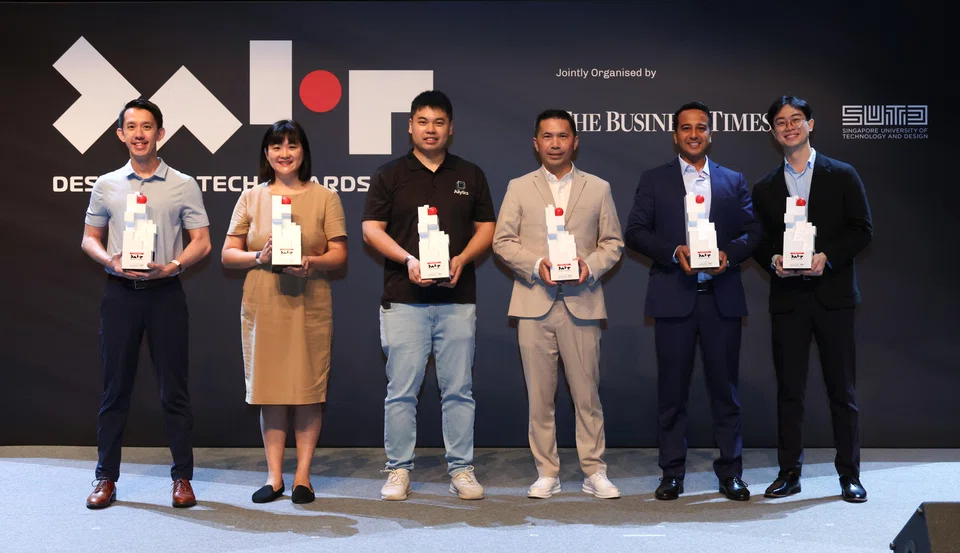
[SINGAPORE] Businesses making clinical guidelines easier for patients to follow and using artificial intelligence to evaluate construction tenders were among six companies that bagged awards at the annual Design AI and Tech Awards (Daita) on Wednesday (Apr 15).
Jointly organised by The Business Times and the Singapore University of Technology and Design (SUTD), the competition aims to spur innovators from startups and companies to harness design and technology to develop groundbreaking solutions that tackle real-life business challenges.
Now in its second edition, this year saw a diverse field of 10 contenders across two categories – startups and small and medium-sized enterprises (SMEs), and large enterprises.
The finalists spanned sectors from the public service to marketing and financial services.
On Wednesday, the 10 finalist teams each delivered a five-minute presentation to the judges, followed by a 10-minute question-and-answer session. Three companies were awarded in each category.
Startups and SMEs category
Under the startups and SMEs category, physician-founded healthtech company Milkiway AI, as well as built-environment software startups Ailytics and H3 Zoom clinched awards.
Shaun Koo, founder of H3 Zoom, whose proprietary technology detects building facade defects, told BT: “By being able to understand the pain points (of clients) in a very granular manner, we use AI to design the solutions that matter the most for them, which is highly critical,” he said.
“(We’re not) trying to push AI for the sake of pushing AI, but (it’s about) really understanding the conventional, traditional business workflows… and tapping the technologies that AI can offer to build; and to develop the solutions.”
Similarly, Milkiway AI uses its system, Clerical, to generate personalised health reports for wellness centres to facilitate preventive care.


“We put in a lot of thought in terms of how the content should be understandable by the patients, and also (how) to integrate it with the doctors’ workflow and processes so that it is very seamless,” noted co-founder Dr Petty Chen.
Dr Chen, a physician by training, told BT that the solution is currently being implemented by a private hospital group in Singapore, with plans to expand regionally.
Meanwhile, Ailytics helps companies improve operational safety by using AI-powered video analytics to tap existing surveillance cameras and highlight real-time insights regarding unsafe acts and security breaches.
The other finalists in the startup and SME category were Filipino technology company Synqbox, whose sensor-based kiosk engages communities to fight dengue transmission; and built-environment startup Primustech, which designed a large language model (LLM) specifically for facility management.
Large enterprise category
Under the large enterprise category, JTC Corporation’s AI tender evaluation solution, SBS Transit’s Sign Language Virtual Assistant (Silvia) and Thales’ AI-driven biometric passenger solution, bagged awards.
JTC’s Evaluation Virtual Assistant (EVA) uses LLMs to read, interpret and score construction tender submissions.
Adam Chern, project manager at JTC Corporation, told BT that while EVA currently evaluates quantitative data, future phases will incorporate qualitative criteria.
To achieve this, JTC plans to train the AI with more contextual knowledge and expand its use to sectors beyond construction, such as consultancy.
SBS Transit’s AI virtual assistant Silvia translates public service announcements into grammatically and contextually accurate sign language.
Thales’ touchless AI-driven biometric solution allows passengers to move through airports effortlessly without compromising security and personal data protection.
The other finalists were Hyundai Motor Group Innovation Center Singapore, which deployed an AI-orchestrated robotics ecosystem for manufacturing; and Aecom Singapore, which developed an AI-enabled suite of tools and workflows aimed at reshaping how design decisions are made.
Submissions were assessed across five criteria: design thinking process and strategies; originality, functionality and aesthetics; utilisation of AI and advanced technologies; ethical consideration and sustainability; and whether the design has made a quantitative and qualitative impact.
In a speech at the event, SUTD’s deputy president and chief innovation and enterprise officer, Professor Tai Lee Siang said: “It is a very meaningful and exciting time that we’re living in. AI is not scary, in fact, it is to be embraced and it is to be used meaningfully.”
He chaired the judging panel, which comprised BT editor Chen Huifen; DesignSingapore Council executive director Dawn Lim; Jenny Lee, senior managing partner of multiasset investment firm Granite Asia, and Dr Leslie Teo, the senior director of AI products at AI Singapore.
Minister of State for Digital Development and Information Rahayu Mahzam graced the event as the guest of honour.
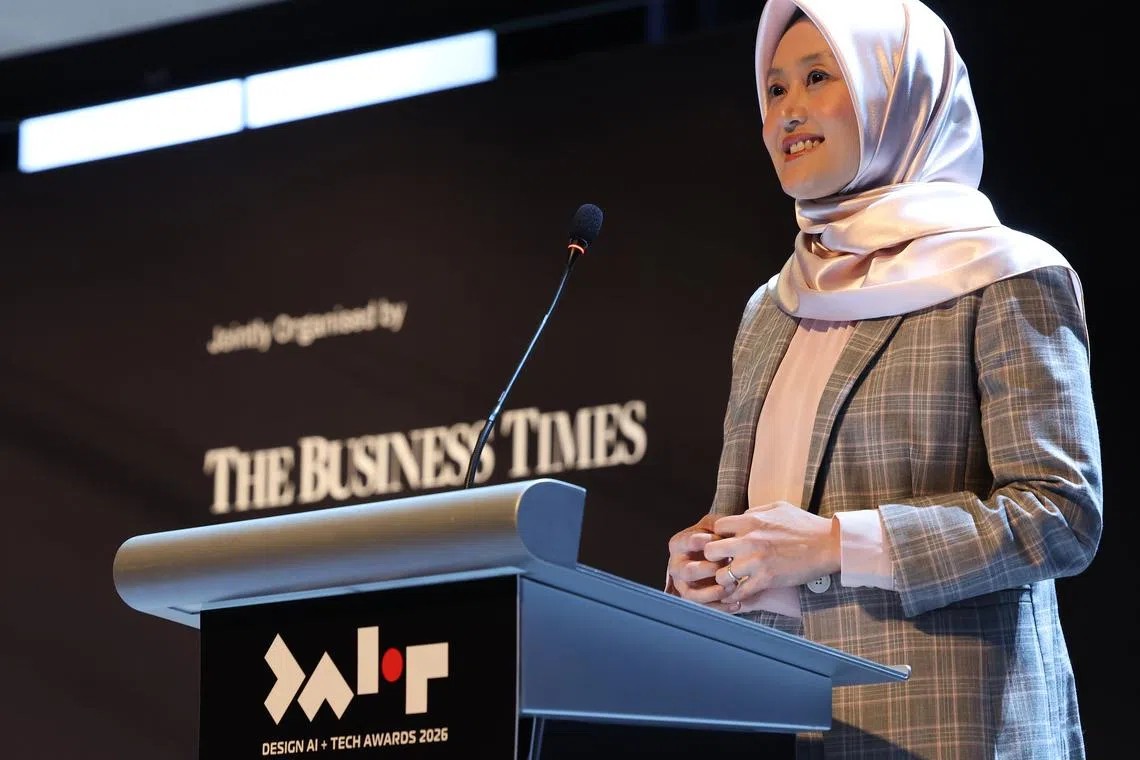
In her speech, she acknowledged that the changes brought about by AI in the design process can feel “disruptive, even unsettling”. However, she noted that even as AI takes on more technical and generative work, “the distinctly human aspects of design become more valuable, not less”.
“Designers bring vision and judgement shaped by lived experience. They understand context, including cultural, emotional and ethical. They make decisions and align stakeholders along shared goals,” she added.
“The strongest designers will be those who combine deep design expertise with AI fluency, to tackle harder problems and deliver solutions that truly serve people’s needs,” said Rahayu.
“This is what today’s awards demonstrate. The best solutions here did not start with a technology or algorithm in search of a problem. They started with a problem approached with curiosity, creativity and care.”
Daita was launched in October 2024 with multiasset investment firm Granite Asia as a supporting partner. More information about Daita is available here.
Decoding Asia newsletter: your guide to navigating Asia in a new global order. Sign up here to get Decoding Asia newsletter. Delivered to your inbox. Free.
Copyright SPH Media. All rights reserved.
TRENDING NOW

Once staunchly pro-China, Malaysian Chinese businesses are now distancing themselves from Beijing
Cliff Tan has 7 million followers and a 4-month waitlist. Why won’t he expand his business?

Grab CEO’s wife Chloe Tong on life with Anthony Tan and finding her purpose

Singapore F1 to proceed despite haze; no changes planned to outdoor entertainment

