Asean Summit: PM Wong urges swift conclusion of substantive South China Sea code
He also backs closer digital, trade and cybersecurity cooperation with Asean’s partners

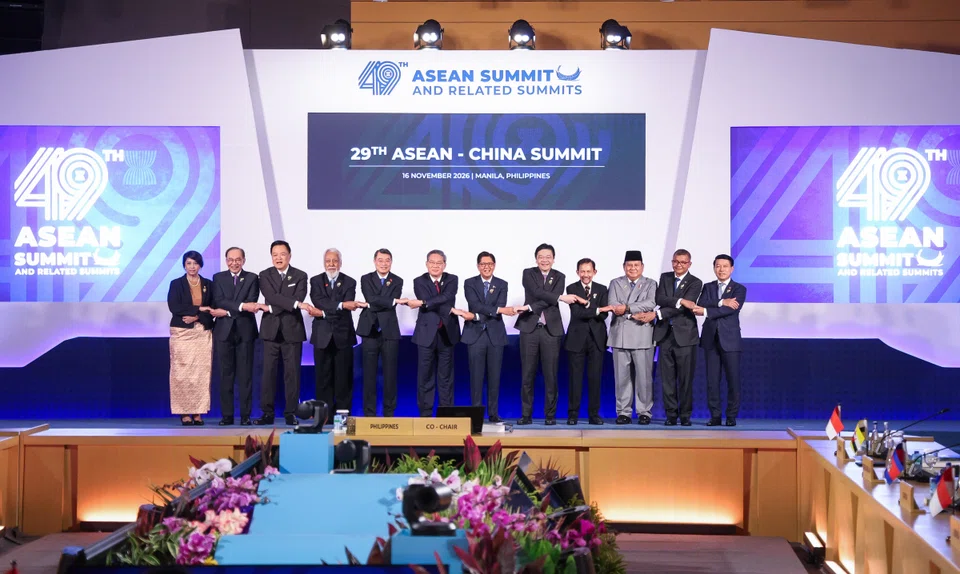
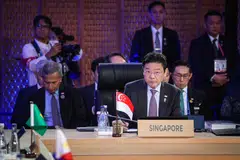
[MANILA] Singapore Prime Minister Lawrence Wong on Monday (Nov 16) urged the “expeditious conclusion” of a substantive South China Sea Code of Conduct consistent with international law, as Asean and China continue negotiations over the disputed waterway.
At the 29th Asean-China Summit in Manila, PM Wong said the code should comply with the 1982 United Nations Convention on the Law of the Sea (Unclos), which governs maritime rights and navigation, and safeguard the rights and interests of all parties using the waterway.
His remarks came during a series of meetings with Asean’s external partners, including China, South Korea, Australia and the UN, on the second day of the 49th Asean Summit.
A day earlier, Philippine Foreign Secretary Maria Theresa Lazaro said Asean and China had provisionally agreed on about 80 per cent of the draft code’s paragraphs, but contentious issues remained.
Only one of four major negotiating issues has been resolved, with whether the code should be legally binding among those outstanding.
Negotiations have lasted more than two decades. The Philippines had sought to conclude the code this year, but talks could continue under Singapore’s Asean chairmanship in 2027.

The proposed code is intended to prevent confrontations in the South China Sea, where China and several South-east Asian countries have competing territorial claims.
At the Asean-UN Summit, PM Wong also stressed the importance of international law, citing Asean’s position that transit through the Strait of Hormuz – a major route for global oil shipments – is a right and should not be subject to tolls.
“Upholding Unclos is both a matter of principle, and also in our collective interests,” he said.
SEE ALSO
Digital cooperation
Beyond security, the four meetings focused on digital integration, artificial intelligence and the risks accompanying greater connectivity.
PM Wong welcomed China’s proposal to designate 2027 as the Year of Asean-China AI Cooperation, saying Asean could harness China’s strengths in AI applications to raise productivity.
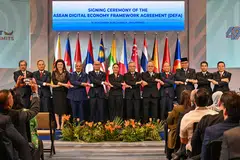
The proposal, previously raised in July, follows Saturday’s signing of the Digital Economy Framework Agreement (Defa). The pact aims to ease cross-border business by establishing common rules for electronic payments, digital identities and data flows.
Efforts to implement Defa are already drawing support from Asean’s external partners.
At the 27th Asean-South Korea Summit, PM Wong said both sides are working to launch a three-year capacity-building programme to support its implementation. Australia likewise announced an Asean-Australia Digital Cooperation package to support the region’s digital transformation and Defa’s implementation.
At the 6th Asean-Australia Summit, PM Wong backed practical cooperation on AI testing and safety standards, drawing on Australia’s National AI Plan and Asean’s Working Group on AI Governance, which Singapore chairs.
“Together, we can help businesses adopt AI with greater confidence and equip workers to harness these technologies well,” he said.
The push for greater digital connectivity has also been accompanied by efforts to address cybersecurity risks.
At the Asean-UN Summit, PM Wong welcomed the UN Global Mechanism on ICT Security, which was established after negotiations chaired by Singapore.
The mechanism, which began meeting in July, is a permanent forum for governments to discuss responsible behaviour in cyberspace, the application of international law to cyber activities and ways to strengthen cybersecurity capabilities.
Separately, PM Wong noted that Singapore and South Korea are co-proponents of the Korea-Asean Response and Enforcement against Scam-Related Crime initiative, which seeks to strengthen cooperation among police agencies to tackle cross-border online scams.
Trade and investment
On trade, PM Wong noted that the Asean-China Free Trade Area 3.0 Upgrade would enter into force in December.
The original agreement, which took effect in 2010, reduces tariffs and other trade barriers between China and Asean countries. Its latest upgrade, signed in October 2025, adds cooperation in the digital and green economies, supply chains and customs procedures.
Officials are also working to streamline customs processes and simplify certification requirements, PM Wong said. “These developments will give greater confidence to our businesses to invest and grow in our respective markets.”
At the South Korea summit, PM Wong backed the substantial conclusion of an upgrade to the Asean-Korea Free Trade Area by 2027.
The existing agreement covers goods, services and investment, with negotiations under way to modernise its rules, including in areas such as digital trade and supply chain connectivity.
PM Wong said the two sides should “resist the pressures to turn inward and instead deepen our economic linkages” amid growing protectionism.
At the Australia summit, he pointed to the upgraded Asean-Australia-New Zealand Free Trade Area, which aims to ease trade and investment among participating economies. Australia also announced a Regional Energy Security package to support cooperation on South-east Asia’s transition towards cleaner energy.
PM Wong backed further liberalisation of the Asean-China Air Transport Agreement to improve the movement of goods and people.
Concluded in 2010, the agreement allows airlines to operate unlimited passenger and cargo services between Asean countries and China. Later protocols expanded airlines’ rights to serve destinations beyond their home markets.
PM Wong said closer cooperation is particularly important amid geopolitical tensions and rising barriers to trade and investment, and reaffirmed Singapore’s commitment to advancing relations with Asean’s external partners as incoming chair.
He also stressed the importance of maintaining international cooperation despite growing divisions. “For Asean,” he said, “the answer is not to turn away from multilateralism, but to strengthen it and reinforce the work of the UN.”
Decoding Asia newsletter: your guide to navigating Asia in a new global order. Sign up here to get Decoding Asia newsletter. Delivered to your inbox. Free.
Copyright SPH Media. All rights reserved.