



Asean’s economic agenda gets big push as ministers seal concrete outcomes in digital and free trade
The Digital Economy Framework Agreement is due to enter into force 180 days after Saturday’s signing
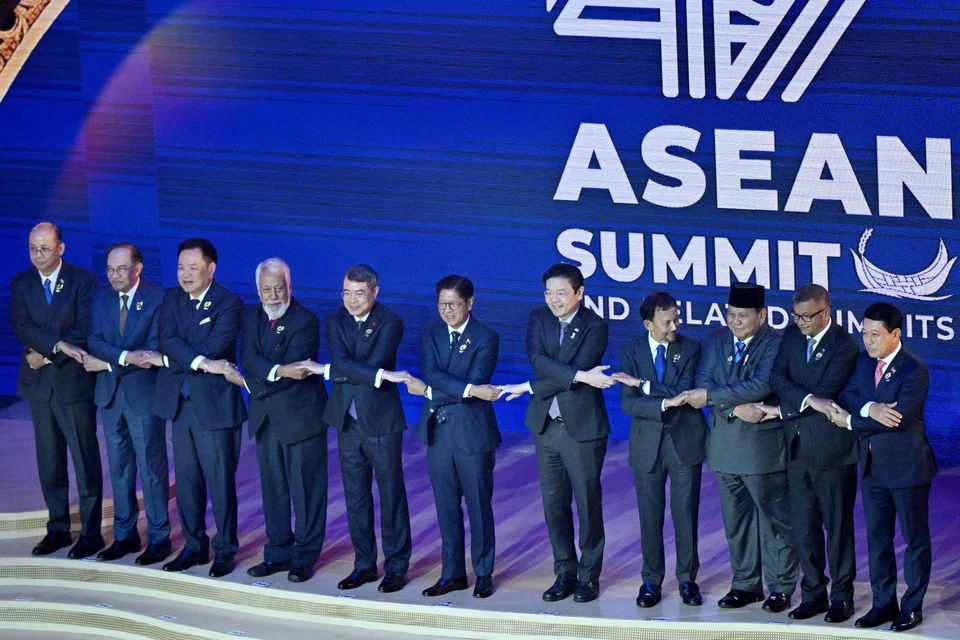

[MANILA] Ministers from South-east Asia made the most of their time on the eve of the 49th Asean Summit in Manila to advance a more practical economic agenda for the 11-member bloc.
These included signing a landmark digital trade pact, wrapping up negotiations for a free trade deal with Canada, and discussing financing plans for the infrastructure needed to make regional integration commercially meaningful.
While Asean leaders will gather from Sunday (Nov 15) to Tuesday to address pressing issues such as the Myanmar crisis and ongoing tensions in the South China Sea, the summit’s ministerial and business tracks on Saturday delivered some concrete economic outcomes.
Wiring the US$2 trillion digital economy
The centrepiece was the signing of the Digital Economy Framework Agreement (Defa), Asean’s first standalone, legally binding digital economy agreement. It covers digital trade, cross-border data flows, electronic payments, cybersecurity and artificial intelligence.
Policymakers are betting that successful implementation will help lift the region’s digital economy to as much as US$2 trillion by 2030, roughly double the level projected on current trends.
The prize is not simply a larger online market: Harmonised rules could also lower compliance costs, make cross-border data transfers more predictable and allow smaller businesses to plug into regional supply chains.

Philippine Secretary of Trade and Industry Cristina Aldeguer-Roque said that while Defa creates opportunities for regional cooperation in digital transformation and economic development, the immediate test is whether governments can turn a common rulebook into working payment systems, trusted data flows and recognised electronic trade documents.
“Our task now is to ensure that they move beyond commitments and translate into practical support and opportunities for businesses, especially MSMEs (micro, small and medium-sized enterprises) and our people,” she said.
Defa is due to enter into force 180 days after Saturday’s signing.

For businesses, however, the more important timetable will be domestic implementation: updating regulations, building interoperable payment and identity systems, and ensuring that companies of different sizes can comply without prohibitive cost.
The Asian Development Bank (ADB) has positioned itself as a central financier of this digital push. “Capital is not the binding constraint. Investable projects are,” ADB president Masato Kanda told executives at the Asean Business and Investment Summit (ABIS) on Saturday.
ADB will pledge up to US$5 billion by 2030 to help Asean set Defa into action. The commitment forms part of a broader ADB pledge of up to US$30 billion for Asean priorities by 2030.
“Bring us your projects. We will help prepare them and we will invest alongside you,” said Kanda, adding that the next phase of integration will be built through physical and digital networks, not trade agreements alone.
“It will be built in power grids, transport corridors, and digital networks,” he said, before cautioning business leaders that Defa will deliver only if that infrastructure is in place.
ADB estimates that Asean needs US$7.1 trillion of infrastructure investment through 2040 – roughly US$476 billion a year, or 8.7 per cent of regional gross domestic product – more than double its previous estimate.
Most of the sum required is for power and transport; electricity alone accounts for half.
Kanda said that, at current spending levels, governments will finance less than half of that need, leaving an annual gap of about US$261 billion. The constraint, therefore, is less the availability of capital than the shortage of prepared, commercially viable projects.
Hedging against tariff friction
Asean also substantially concluded negotiations on a free-trade agreement (FTA) with Canada, while Manila and Ottawa concluded negotiations on a separate bilateral deal. The formal signatures are targeted for 2027.
Canadian Prime Minister Mark Carney announced more than C$15.9 million (US$11.1 million) in investments to support the completion of the Asean-Canada FTA and related work on public safety, ocean protection, nuclear security and clean energy.
This amount includes C$5 million in Canada’s announcement of technical assistance to help eligible Asean members finalise, ratify and implement the agreement.
Philippine President Ferdinand Marcos Jr met Carney on the sidelines of the summit to discuss the agreement and wider cooperation. “Two agreements in one year: that is the speed and ambition this moment demands,” the Canadian leader said.
The deals broaden Asean’s commercial options as businesses seek to diversify supply chains amid tariff uncertainty and geopolitical rivalry. But their value will depend on ratification, tariff schedules, rules-of-origin provisions and the removal of non-tariff barriers – details that remain subject to finalisation.
Philippine Executive Secretary Ralph Recto, who previously served as the country’s finance chief, urged companies to treat the agreements as platforms for growth. “The value of these agreements will be seen in the enterprises that reach new customers, the investments they attract and the jobs they create.”
Resilience under pressure
The push for deeper integration comes against a mixed macroeconomic backdrop, with Roque warning that food and energy prices and Middle East tensions remain risks.
Still, despite an “increasingly challenging global environment, Asean’s economic outlook remains relatively resilient”, she said during the Asean Coordinating Council meeting.
Asean raised its 2026 growth forecast to 4.7 per cent from 4.5 per cent. Roque said the region is expected to grow by 4.7 per cent in 2027 as well.
The council’s discussion centred on how high food and energy prices, the prolonged Middle East conflict, disruption to energy markets and critical shipping routes, and the prospect of a strong El Nino continue to threaten households, businesses and agriculture.
Roque also said the Asean’s Economic Community pillar had completed 87 per cent of activities under its Blueprint 2025, equivalent to 3,379 activities, and asked members to ensure the remaining commitments benefit businesses, workers and communities.
Buffers against shock
The Asean Food Security Alliance has also launched a policy framework to counter food security pressures from climate volatility, supply disruptions and rising costs.
The blueprint targets investment for small producers, smoother regional trade and agricultural infrastructure financing. It seeks to boost crisis coordination and climate innovation, while safeguarding land rights and environmental sustainability.
Energy security is also expected to feature prominently when leaders meet, with officials urging ratification of the updated Asean Petroleum Security Agreement, a mechanism under which members can supply fuel to neighbours facing severe shortages.
The agreement, signed in October 2025, will replace a 2009 accord and take effect 90 days after the member states formally deposit their instruments of ratification with the Asean secretary-general.
A proposal for a shared regional oil stockpile remains under study. The size of a possible reserve has yet to be determined.
The bloc sought a coordinated response to surging energy costs, security tensions and a potential El Nino episode. ADB, meanwhile, linked the issue directly to investment.
“This year has shown how quickly disruptions to energy supplies and shipping routes become economic shocks,” Kanda said, adding that “stronger grids, more storage, and reliable logistics are how Asean protects itself from the next shock”.
Decoding Asia newsletter: your guide to navigating Asia in a new global order. Sign up here to get Decoding Asia newsletter. Delivered to your inbox. Free.
Share with us your feedback on BT's products and services
TRENDING NOW

Demand, tech capabilities position Apac and AI as Skyscanner’s next growth frontiers: CEO Bryan Batista
As Indonesia picks new vice-president to succeed Gibran, investors see risks and opportunities

Higher rates, weaker spending: Is the Philippines entering stagflation?
Malaysia’s BN and ally PN declare victory in Melaka state polls in a blow to PM Anwar

