



‘Asean’s gift to the world’: Hormuz crisis sharpens Philippines’ push for South China Sea code
Manila’s goal is to conclude the long-delayed South China Sea Code of Conduct in 2026

[MANILA] As the Philippines chairs Asean amid geopolitical tensions half a world away, Foreign Secretary Ma. Theresa Lazaro makes a clear case for why concluding the South China Sea Code of Conduct (COC) matters beyond the disputed waters themselves.
“We don’t want to have a situation such as the Strait of Hormuz – (with) those choke points,” Lazaro told The Straits Times in an exclusive interview in Manila on Jun 22. “I think the whole world will appreciate it if we can come up with this Code of Conduct. This is Asean’s gift to the world.”
Her reference to the Strait of Hormuz highlights a broader concern within Asean: that disruptions far beyond South-east Asia can quickly threaten the region’s trade and energy security.
The remarks underscore both the urgency and difficulty of the task facing the Philippines as Asean chair in 2026. Manila has set an ambitious goal of concluding the long-delayed South China Sea code in 2026, while also grappling with lessons from the recent Middle East energy crisis and Asean’s continuing struggle to address Myanmar’s civil conflict.
Asean and China have been working towards a COC, meant to establish rules governing conduct in the South China Sea, for more than two decades. Four Asean member states – Brunei, Malaysia, the Philippines and Vietnam – have overlapping claims against China in these waters.
Completing the COC in 2026 has been a priority of the Philippines since it took over the chairmanship in January. Lazaro has also reiterated several times that the COC must be legally binding, explicitly referencing the United Nations Convention on the Law of the Sea.
The urgency intensified after conflict in the Middle East involving Iran erupted in February and, with it, repeated disruptions to shipping through the Strait of Hormuz – pushing oil prices above US$100 a barrel for an extended period and exposing how vulnerable South-east Asia is to maritime crises it cannot control.
The situation gave Asean leaders fresh impetus to push for greater maritime cooperation in the region to ensure safety and freedom of navigation.
The crisis appears to have injected fresh urgency into negotiations.
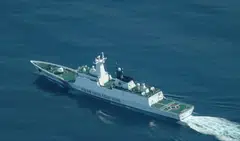

“There is also the desire or the aspiration that (the COC) be concluded, and I wouldn’t say that only with Asean, but also with China,” Lazaro told ST. “So that’s where it is right now – to the point that every month, the negotiators meet, and this has not been done in the past.”
Yet, even basic definitions are still being contested. At a forum in Washington earlier in June, Lazaro said the definition of “self-restraint” in the COC still has not been resolved after nearly a decade of talks.
Lazaro declined to name the Philippines’ non-negotiables or detail what compromises Manila would accept, citing the sensitivity of ongoing negotiations. But she rejected the notion that Asean and China fundamentally disagree on what the code is meant to achieve.
“I don’t think there’s any fundamental interpretation. It’s really more of the provisions,” Lazaro said. She cited the four core issues that remain unresolved: whether the agreement will be legally binding, its geographic scope, the connection between the COC and the 2002 Declaration on the Conduct of Parties in the South China Sea (a non-binding framework agreed between Asean and China), and the terms of reference.
Nonetheless, Lazaro reaffirmed the Philippines’ target to conclude the COC in 2026.
Pressed on her confidence that it will be done by December, she said: “I am an optimist; at the same time, a pragmatist.”
Asean’s energy stress test
The COC push comes as Asean takes stock of its response to the worst energy shock the region has faced in decades.
At the Asean Summit in Cebu in May, leaders renewed calls to ratify the Asean Petroleum Security Agreement (APSA), build a regional fuel stockpile, and accelerate the Asean Power Grid project.
Analysts remain unconvinced that an APSA ratification would significantly strengthen regional energy resilience, given that fuel sharing under the scheme would be on a voluntary or commercial basis.
Philippine President Ferdinand Marcos Jr himself acknowledged afterwards that many operational details still needed to be resolved, including how fuel reserves would be stored and shared, and who would get priority during shortages.
A month on, Lazaro acknowledged that there has been little progress: There are still no timelines and no ratification updates across the grouping’s 11 member states, though APSA has been placed in the Philippine Senate’s agenda.
Even so, she pushed back against criticisms that Asean failed to deliver in a time of crisis.
“It’s a little bit unfair perhaps,” she said, noting that bilateral assistance between member states happens quietly and is not always publicised.
Lazaro notes a clear case of Asean solidarity in action in March, when a Republic of Singapore Air Force flight that had spare seats after evacuating Singaporeans offered them to Filipinos stranded in the Middle East.
“So, it’s that kind of camaraderie also and the trust among the Asean countries that have sort of taken over a number of these situations,” she said.
Myanmar: Asean’s unfinished business
Five years after Myanmar’s military coup plunged the country into civil conflict, Asean is still searching for an approach to the South-east Asian country that works.
Lazaro, who has served as the Asean chair’s special envoy to Myanmar since January, visited the capital Naypyitaw later that month as the first Asean foreign minister to do so, meeting various groups, including the National Unity Government. She has since engaged humanitarian organisations, including Medecins Sans Frontieres and the World Food Programme, to assist Myanmar.
The Five-Point Consensus, Asean’s five-year-old peace framework, remains the regional grouping’s reference point, with cessation of hostilities still the first and most basic demand regarding Myanmar.
“We’re still asking... how they can really adhere to the Five-Point Consensus that they have also been part of it during the meeting in Indonesia five years ago,” Lazaro said.
But some analysts have questioned whether Asean’s posture may be shifting, especially after recent visits to Naypyitaw by the foreign ministers of Malaysia and Indonesia – two countries that had previously taken harder stances against the junta.
“There has been some kind of statements from the other Asean member states on the recalibration of relations with Myanmar. Now, I cannot speculate,” said Lazaro.
“I do not know how Malaysia and Indonesia are thinking, but perhaps it’s also their way of finding out what the situation is. So it is also in their interest to be able to look at what’s happening in Naypyitaw with this new government,” she added.
A national election in Myanmar held between last December and January, which many countries did not consider free or fair, resulted in a landslide victory for the military-aligned Union Solidarity and Development Party.
Lazaro declined to set conditions for deeper engagement between Asean and Myanmar.
“I will only respond to that when we have a notion of how this new government will tackle certain issues,” she said. “It’s still an exploratory stage.”
Diplomacy v deterrence
The ST interview also surfaced the sharpest tension in Philippine foreign policy right now: how the Department of Foreign Affairs’ diplomacy-first approach to Beijing squares with the more combative posture of Defence Secretary Gilberto Teodoro Jr.
At the Shangri-La Dialogue in Singapore in May, Teodoro criticised Beijing’s activities in the disputed waters, and warned that negotiations risk giving Beijing strategic advantages rather than resolving disputes.
Lazaro did not deny the divergence.
“My position that diplomacy and dialogue are very important is emanating from the architect of foreign policy. The architect of foreign policy is the president of the Republic of the Philippines,” she said. “(Defence) Secretary Teodoro might have another way of dealing with things. As I said, security agencies have their own mandate.”
Asked whether such differences in Manila’s approach complicate talks with her Chinese counterparts, Lazaro said bilateral discussions remain “issue-focused” and centred on “possible solutions to the basic problems”.
The tension mirrors the broader challenge facing the Philippines as Asean chair: balancing competing priorities on China, Myanmar and energy security while still delivering on its promises before the year is out.
For Lazaro, success by year-end rests on these outcomes: a credible Asean response to the Middle East crisis and a concluded South China Sea code. The Philippines hopes to demonstrate that progress when Asean leaders meet in Manila in November. THE STRAITS TIMES
Decoding Asia newsletter: your guide to navigating Asia in a new global order. Sign up here to get Decoding Asia newsletter. Delivered to your inbox. Free.
Share with us your feedback on BT's products and services
TRENDING NOW

DBS, OCBC, UOB rout lops billions off STI as inflation, rate concerns spook investors

Grab CEO’s wife Chloe Tong on life with Anthony Tan and finding her purpose

OCBC sheds S$8 billion in value as shares close nearly 6% down; analysts cautious on banks

Deal between tycoon friends sparks scrutiny of Philippine power sector

