



Vietnam formalises new state leadership, redefining ‘four pillars’ power balance
A reshaped structure is emerging in the country as To Lam consolidates top two posts
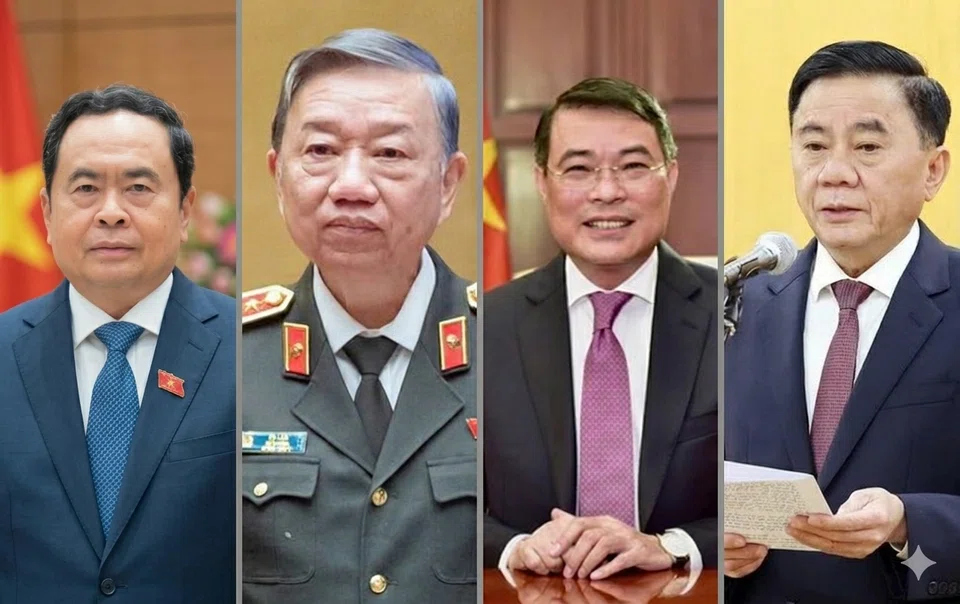
VIETNAM’S newly seated National Assembly has confirmed a new slate of top state leaders, formalising a leadership structure that effectively reshapes the country’s long-standing “four pillars” model of collective power-sharing.
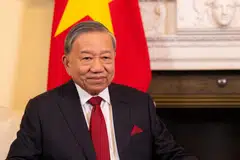
At the centre is To Lam, who was elected state president on Tuesday (Apr 7), while also serving a second term as general secretary following his re-election by the ruling Communist Party in January.
The rare consolidation places him in charge of both the party and the state – the two most powerful positions in Vietnam’s political system.
“This is clearly a consolidation of power, but it is also best understood as a strong mandate for To Lam’s agenda rather than simply a personal power grab,” said Nguyen Khac Giang, visiting fellow at the Vietnam Studies Programme of the Iseas-Yusof Ishak Institute.
“The system (is still described) as collective leadership, but in a more asymmetrical form,” he added.
On Tuesday, former State Bank of Vietnam governor Le Minh Hung was appointed prime minister, succeeding Pham Minh Chinh as the country’s second-most powerful leader.
Meanwhile, Tran Thanh Man was re-elected as chairman of the National Assembly, securing a second term as head of the legislature, and now the third-ranking official in Vietnam’s leadership hierarchy.
The appointments, endorsed during the first session of the 500-member legislature following March national elections, had been pre-nominated by the Communist Party as a standard process in the one-party state.
Vietnam’s new leadership faces a delicate balancing act between ambitious growth targets and a more uncertain global backdrop.
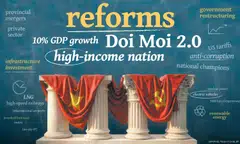
Delivering double-digit expansion will require faster productivity gains, infrastructure upgrades and deeper private-sector development, while addressing constraints such as energy shortages and bureaucratic bottlenecks.
At the same time, external risks -– from geopolitical conflicts to potential tariff pressures from key trading partners – threaten the country’s export-driven model.
“The market has been waiting a long time for stability in the top,” said Dinh Quang Hinh, head of macro and market strategy at VNDirect Securities.
“Finalising the leadership line-up is necessary to accelerate policy implementation and return the business environment and corporate operations to normal after some slowdown during the ‘twilight’ of the previous term,” he added.
Shift in the “four pillars”
Vietnam’s governance model has traditionally rested on a delicate balance among four posts: the party chief, state president, prime minister and National Assembly chair.
The structure is designed to prevent excessive concentration of power, with decisions shaped by consensus within the Politburo and the Party Central Committee – Vietnam’s most powerful decision-making organs.
Last September, the Politburo issued updated regulations redefining the hierarchy of leadership posts across the political system. Under the changes, the standing member of the Party’s Secretariat – now held by Tran Cam Tu as the guardian of party rules and discipline – was elevated to the senior leadership tier.
With Lam holding both the party chief and state president roles, the expanded “five-pillar” structure effectively operates within the traditional “four pillars” framework, though the overlap between party and state leadership signals a tighter consolidation at the top.
“The top structure of four pillars remains in place, yet the first pillar is now much stronger than the others, so the balance has shifted rather than disappeared,” Giang said.
“That should bring more stability than the turbulence of the previous term,” he added, while noting that true stability in Vietnam depends not only on formal titles but also on the leadership’s ability to secure support across key factions and power networks.
To Lam consolidates authority
This is not Lam’s first stint holding both roles.
The 68-year-old former security chief briefly combined the positions in 2024 during a period of leadership reshuffles following a wave of high-level departures tied to unspecified “violations and shortcomings”, including two state presidents and a parliament head.
He was first elected president in May 2024, shortly before assuming the party’s top post in August after the death of long-time leader Nguyen Phu Trong due to a prolonged illness at the age of 80.
This marked Lam’s first stint holding both roles, until he relinquished the presidency and was succeeded by Luong Cuong on Oct 21 in the same year.
Cuong, a senior military figure, stepped down at this election as he has concluded his term, with Lam now returning to the post.
Despite his background in the security apparatus and intensified anti-corruption efforts, Lam is widely seen as a pro-business reformer, with a stated ambition to make Vietnam a rich, developed country by 2045.
In the lead-up to his second term, he has overseen a sweeping overhaul of the state apparatus – streamlining bureaucracy, merging administrative units and accelerating policy execution.
His agenda has also emphasised private-sector development and industrial upgrading to move Vietnam beyond its reliance on low-cost manufacturing.
Lam’s reappointment has reinforced market confidence in policy continuity, underpinned by a series of major party resolutions spanning science and technology, international integration, legal reform and private-sector-led growth.
“The dual role gives him much greater authority to push reforms at a pivotal moment,” Giang said.
The rise of a technocrat
Newly elected Prime Minister Le Minh Hung, 55, hails from the central province of Ha Tinh – also the hometown of the fourth-ranking official Tu.
Holding a master’s degree in economics from Japan’s Saitama University and having served at international institutions including the International Monetary Fund and Asian Development Bank, Hung is expected to bring his extensive expertise in finance to his role as head of the Cabinet.
Hung also served as governor of the State Bank of Vietnam from 2016 to 2020 under former prime minister Nguyen Xuan Phuc, becoming the youngest to hold the post.
In recent years, market watchers have highlighted the pivotal role of the State Bank of Vietnam -– the country’s central bank – especially following the bond market crisis and banking fraud linked to imprisoned tycoon Truong My Lan.
The regulator today face the challenge of stabilising the macroeconomy, including containing exchange rate volatility and controlling inflation amid high oil prices – while still supporting the economic expansion towards a double-digit growth target.
“Alongside the decisive and hands-on approach seen under his predecessor Chinh, the next Cabinet leader is expected to be more technocratic, with deeper knowledge of market economics in order to limit ad hoc policy steering in an increasingly complex economy,” Hinh noted.
Iseas’ Giang added that the new prime minister also needs to act as a brake on any over-ambitious plans that could risk macroeconomic stability, navigating a delicate balance “between ambition and prudence”. THE BUSINESS TIMES
Decoding Asia newsletter: your guide to navigating Asia in a new global order. Sign up here to get Decoding Asia newsletter. Delivered to your inbox. Free.
Share with us your feedback on BT's products and services
TRENDING NOW

DBS, OCBC, UOB rout lops billions off STI as inflation, rate concerns spook investors

Grab CEO’s wife Chloe Tong on life with Anthony Tan and finding her purpose

OCBC sheds S$8 billion in value as shares close nearly 6% down; analysts cautious on banks

Deal between tycoon friends sparks scrutiny of Philippine power sector

