



Malaysia, Singapore can win bigger deals together: Economy Minister Akmal
Beyond attracting investments, businesses have room to expand and diversify their supply chains

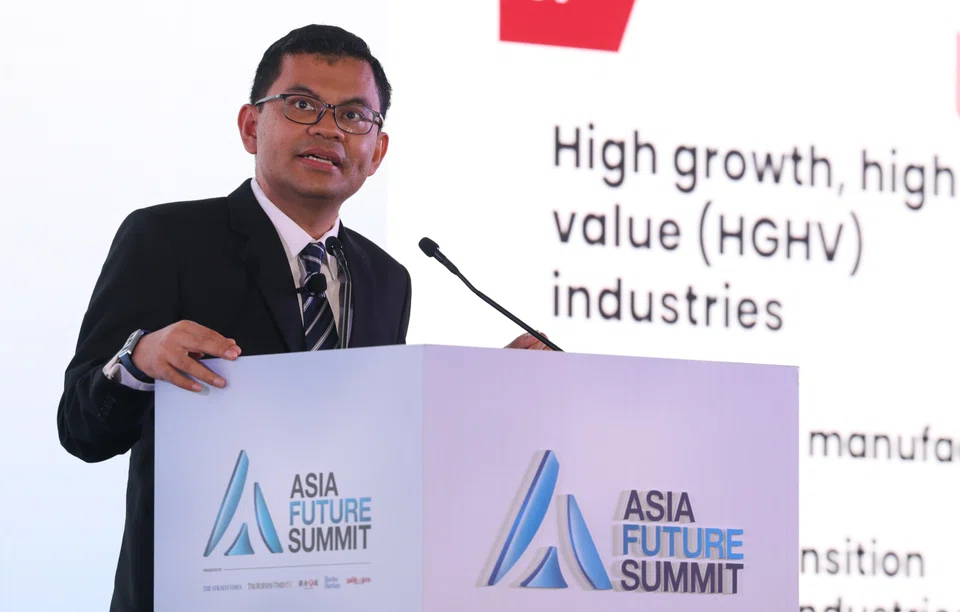
[SINGAPORE] Malaysia and Singapore can win investments that neither could attract as effectively on its own by helping companies operate across the border, Malaysia’s Economy Minister Akmal Nasir said. This comes as businesses reassess where to expand amid rising trade uncertainty.
He pointed to the Johor-Singapore Special Economic Zone (JS-SEZ) as a way for companies to run complementary operations on both sides of the border.
Covering 3,588 square km across Iskandar Malaysia and Pengerang, JS-SEZ is a cross-border economic initiative that pairs Singapore’s capital, connectivity and global business links with Johor’s land, industrial base and lower operating costs.
Formalised on Jan 7, 2025, the zone also aims to make it easier to move workers, goods and capital across the border, and to reduce the regulatory and administrative hurdles of operating in two countries.
“The test of this partnership is about the delivery,” Akmal said on Friday (Nov 27), pointing to early investment figures as a measure of how the two countries were turning cooperation into projects.
Akmal was delivering a keynote speech at SPH Media’s Asia Future Summit 2026, jointly presented by The Straits Times, The Business Times, Lianhe Zaobao, Berita Harian and Tamil Murasu.

The annual event gathered policymakers, business leaders and industry experts, with OCBC as the presenting sponsor, Marina Bay Sands as the official venue partner and Amazon Web Services as the official cloud partner.
The Malaysian and Singaporean governments are also working on a blueprint that will serve as the joint operational road map for both countries in translating the earlier framework agreement into concrete policies, agency workflows and infrastructure timelines.
They initially aimed at launching the blueprint next week, but it has been deferred to early 2027, according to Akmal in an interview with ST, as both governments need more time to finalise the details to ensure a smooth roll-out.
SEE ALSO


He also mentioned that a special pass for workers commuting across the border could be finalised as part of the blueprint.
More than half of approved investment implemented
JS-SEZ recorded RM88.8 billion (US$21.6 billion) in approved investments between January 2025 and June 2026, of which about RM40.3 billion, or nearly 62 per cent, had been implemented.
The figures, first disclosed by a bilateral ministerial committee on Nov 2, showed that the approved projects could create 28,755 jobs. Projects already implemented accounted for 12,796 of those jobs.
Akmal said for Singapore, the zone gives businesses room to expand and diversify their supply chains, while for Malaysia, it is a way to attract higher-value investment, bring more local firms into supply chains and give workers opportunities to develop technical skills.
The investment pitch comes as companies weigh how tariffs affect their access to customers, how geopolitical tensions could disrupt shipping routes and energy supplies, and how much it will cost to power new operations.
Akmal noted that these pressures can compound one another, giving economies with dependable infrastructure and trade links an advantage when businesses decide where to expand.
Malaysia’s focus
For Malaysia, Akmal noted that the current focus is on four areas under the 13th Malaysia Plan: high-value industries and advanced manufacturing; semiconductor design and advanced packaging; artificial intelligence adoption and digital transformation; and clean energy and green industries.
As the plan enters its second year in 2027, he said the country aims to sustain momentum by making local participation, technology transfer and skills development integral to investment.
“Success will be measured by stronger local suppliers, higher productivity and better jobs. The partnership with Singapore is an early example of this approach,” he added.
Malaysia’s economy expanded 5.6 per cent in the first nine months of 2026, supported by domestic demand and the external sector. Unemployment stood at 3 per cent in the third quarter.
Akmal expects full-year economic growth to exceed 5 per cent, aligned with an earlier forecast by Malaysia’s central bank.
Time to diversify supply chains
He pointed out that Asia’s faster growth gave it time to diversify supply chains and invest in skills and technology before the next shock.
The International Monetary Fund’s October outlook projected that emerging and developing Asia would grow 5.1 per cent in 2026 and the Asean-5 by 4.4 per cent, both above its global forecast of 3.1 per cent.
He urged Asian economies to keep trade and investment open as companies diversify their supply chains.
The Johor-Singapore partnership showed how neighbours could use their different strengths to draw investment and widen opportunities for businesses and workers on both sides of a border, he added.
“Our future cannot be shaped in isolation… We cannot work in silos,” said Akmal.
Decoding Asia newsletter: your guide to navigating Asia in a new global order. Sign up here to get Decoding Asia newsletter. Delivered to your inbox. Free.
Copyright SPH Media. All rights reserved.
TRENDING NOW

New rules on gross floor area to free up building space for developers

JPMorgan, BlackRock, Endowus frontrunners in scheme to lift returns on S$700 billion of CPF savings

As Indonesia picks new vice-president to succeed Gibran, investors see risks and opportunities
Real income growth slows, non-PMET unemployment up: MOM sees signs of Singapore’s labour market moderating

