



Rare red carpet in KL for Myanmar’s leader sparks outrage, but signals shifting Asean stance
Myanmar could test whether the South-east Asian block can distinguish necessary diplomatic engagement from full political normalisation
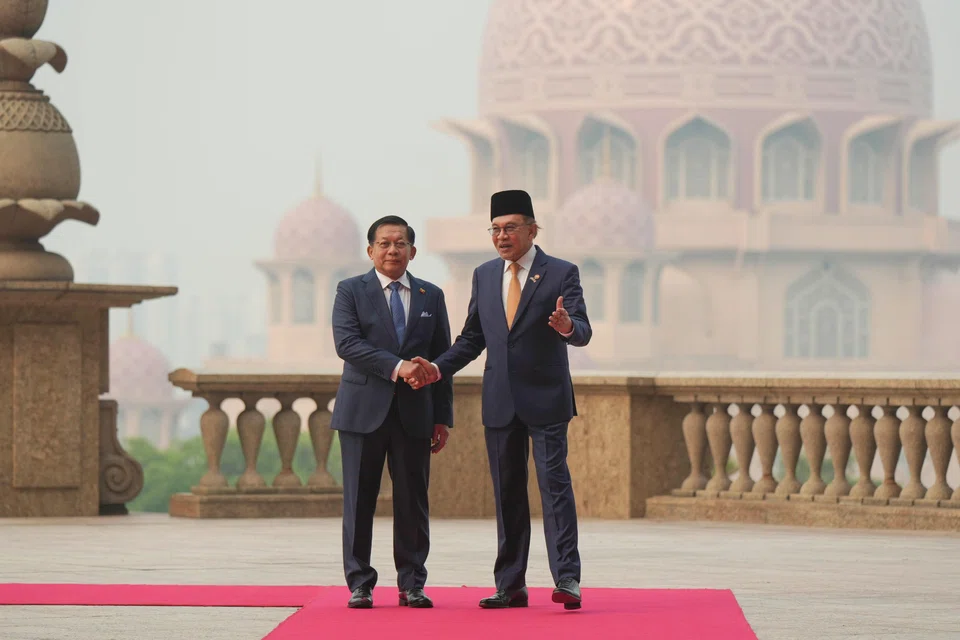
[BANGKOK] Myanmar’s Min Aung Hlaing has wrapped up an official two-day visit to Malaysia – his fifth to a regional country in 2026 – amid outcry against Putrajaya for welcoming him without extracting commitments on ending violence.
During his visit that wrapped up on Thursday (Oct 8), he met Malaysian Prime Minister Anwar Ibrahim and both agreed on advancing cooperation in sectors like education, energy and healthcare. However, no pacts were inked.
“I firmly believe that enhancing our bilateral economic cooperation will bring highly practical economic benefits and joint opportunities for the people of both countries,” Min Aung Hlaing said in a joint press conference on Thursday.
“I also wish to invite Malaysian business leaders from various sectors to come and invest in Myanmar, a country that has excellent investment opportunities,” he added.
Since Min Aung Hlaing assumed the presidency in April after a carefully orchestrated election held from December to January 2026, he has visited Asean states Laos, Thailand, Vietnam and Cambodia.
But the visit to Malaysia has raised eyebrows especially given that Putrajaya used to be one of the harshest critics of the coup carried out by the Myanmar military regime in 2021.
Since the February 2021 coup which Min Aung Hlaing staged, Asean has barred him from all leaders’ summits. However, half of the 11-member Asean group have now laid out the red carpet for him, normalising ties with the former junta leader.
Repatriation high on the agenda
In Kuala Lumpur though, the repatriation of Myanmar nationals was high on the agenda with more expected to be sent back.
During the same press conference, Anwar praised Min Aung Hlaing for being “very cooperative” on the matter.

“Many of us do not realise that hardly any country in my experience are willing to accept this repatriation in large numbers at their own expense as you have shown,” Anwar said.
But to Rohingya activist and former Myanmar political prisoner Wai Wai Nu, “the plan is not just morally bankrupt but it makes no practical sense”.
“Deporting refugees to Myanmar under an agreement with Min Aung Hlaing is a violation of international law and against the fundamental principle of non-refoulement,” she said.
Currently, the western Rakhine state where most of the Rohingya refugees are from is largely under the control of ethnic Arakan Army and not the military regime.
“The (repatriation) plan will fail while emboldening Min Aung Hlaing and fuelling instability, making a lasting solution harder to reach,” Wai Wai Nu added.
Matthew Smith, chief executive officer and founder of civil society Fortify Rights, said that welcoming Min Aung Hlaing while returning Myanmar nationals “sends a devastating and wrong message”.
According to the Institute for Strategy and Policy-Myanmar, an independent think-tank based in Thailand, the military conducted at least 1,583 aerial attacks in just five months from Mar 31 to Aug 31 in 2026.
Rights groups chastise the visit
Malaysia’s engagement with Min Aung Hlaing has outraged rights activists, with Charles Santiago, co-chair of Asean Parliamentarians for Human Rights saying the visit “has legitimised” the Myanmar leader’s political status and was “a win” for him.
“Diplomacy is not merely about having a conversation. It is about leverage, accountability, consequences and outcomes. Why should we believe that another bilateral conversation will succeed where years of Asean engagement have failed?” Santiago asked.
Debbie Stothard, founder and coordinator of ALTSEAN-Burma, an advocacy and rights non-government organisation based in Thailand called the visit “a significant sell-out by Malaysia”.
This came after Malaysian Foreign Minister Mohamad Hasan told the Parliament on Jun 25 that Kuala Lumpur does not recognise Myanmar’s post-election administration.
“I have already stated that we do not recognise them. When we do not recognise them, the term ‘government’ does not apply from Malaysia’s perspective,” he had insisted.
However, on Thursday, Malaysia’s Anwar changed his tone.
“We, of course, are reminded of the Asean mechanism but we also understand that the President and your government have made a lot of efforts in order to enhance better relations but to have the necessary reform, policy changes, adjustments in your own country,” Anwar said.
“We, on our part in Malaysia, will do whatever is possible to make sure that we enhance this collaboration and ultimately take Myanmar as part of our community of nations without prejudice and particularly in the context of Asean,” he added.
Stothard added that repatriating Myanmar citizens boycotting tax payments to the junta, and replacing them with the regime’s approved batch of documented Myanmar workers to Malaysia, is another way the military-linked government seeks to earn tax revenue.
Focus on repatriation scale
The repatriation of almost 200,000 Myanmar nationals living in Malaysia including Rohingya Muslims, a stateless minority, is a major topic between the two nations.
During the press conference, both leaders said their respective ministries will coordinate the deportation process.
“We will expedite the process to bring them back and we are sending one naval ship to Malaysia for their repatriation,” said Min Aung Hlaing.
The Rohingya have long been discriminated against in Myanmar and a brutal military crackdown in 2017 forced at least 700,000 to flee to neighbouring Bangladesh, where they now live in the world’s largest refugee camp.
Anwar previously said no Rohingya Muslims have been repatriated so far, even as he informed the Malaysian Parliament on Tuesday that more than 10,000 Myanmar nationals have been sent home since January 2026.
And just a week before Min Aung Hlaing’s visit, Malaysia deported almost 2,000 Myanmar nationals on Sep 29.
Analysts said this move serves Anwar’s political survival, as Malaysians’ resentment towards this group swells.
“Anwar’s metric at this stage is how to win Malay votes because he has been losing popularity ahead of Malaysia’s expected general election,” said Stothard.
Meanwhile, Khoo Ying Hooi, an associate professor of international relations and human rights at Universiti Malaya’s Department of International and Strategic Studies, described the deportation as problematic.
Though Myanmar has given the assurance that the returnees will be safe and protected, she said sending them back to a country that is still engaged in active violent conflicts is worrying.
Armed Conflict Location & Event Data, an independent global conflict monitor, reported that since the coup, at least 100,000 people have died. The deportees also risk being subjected to forced conscription by the junta.
Khoo said Malaysia needs to extract more tangible commitments from Myanmar such as allowing independent monitoring and clear procedures for identifying people who require international protection.
“Malaysia could also use the meeting to press for humanitarian access and some demonstrable movement on the broader Asean agenda,” she suggested.
Asean peace plan weakens
Asean maintains its ban on Min Aung Hlaing and expects him to substantially implement the 2021 Five-Point Consensus (5PC), which includes ending violence and allowing greater humanitarian aid delivery access among other conditions before reinstating his participation.
But Min Aung Hlaing has largely disregarded the peace plan, claiming Myanmar’s pro-military parliamentarians have rejected it.
The two leaders made no mention of the 5PC when making statements at the joint press conference.
As recently as Sep 28, the Myanmar military reportedly conducted an air strike on a market in western Rakhine state, killing some 50 civilians.
“When relatively limited concessions receive prominent diplomatic recognition while mass civilian casualties produce a much weaker collective political response, Asean risks appearing to lower its own benchmark for progress,” Khoo said.
“That is particularly problematic because cessation of violence is at the heart of the Five-Point Consensus,” she added.
Independent Myanmar analyst Wai Yan Phyo Naing said the bilateral visits also send a wrong message to the wider global community. He said nations may use political justification as an excuse to restore diplomatic contact without requiring meaningful concessions from the junta.
“Such engagement would further legitimise Min Aung Hlaing, weaken international pressure, and marginalise Myanmar’s democratic forces. It is particularly dangerous because the junta may interpret normalisation as evidence that violence and repression have no serious diplomatic consequences,” said Wai Yan Phyo Naing.
Myanmar, Khoo said, will be a major test for Asean on whether the grouping can distinguish between necessary diplomatic engagement and full political normalisation.
“One visit becomes several visits, and eventually the argument shifts from whether governments should engage Min Aung Hlaing to why they should continue isolating him when his own neighbours no longer do so,” she said. THE STRAITS TIMES
Decoding Asia newsletter: your guide to navigating Asia in a new global order. Sign up here to get Decoding Asia newsletter. Delivered to your inbox. Free.
Share with us your feedback on BT's products and services
TRENDING NOW

Once staunchly pro-China, Malaysian Chinese businesses are now distancing themselves from Beijing

New launch or resale unit? Here’s a guide for homebuyers
The lesser-known prospects in the Asian chipmaking supply chain

Cliff Tan has 7 million followers and a 4-month waitlist. Why won’t he expand his business?

