



Vinhomes lets homebuyers pay with gold, tapping Vietnam’s vast private hoards
The country’s largest residential developer also offers 110% buyback options after five years


[HO CHI MINH CITY] Vietnam’s largest residential developer, Vinhomes, has rolled out a five-year programme that allows homebuyers to use gold holdings to fund property purchases and later choose between keeping real estate or redeeming value in gold-linked cash terms.
On Monday (May 25), the company – the property arm of the country’s biggest conglomerate, Vingroup – described the scheme as a way to channel “idle gold” hoarded by households into “active capital” supporting Vietnam’s strong economic growth momentum.
At the same time, it offers a “sure-win dual-return” proposition: preserving wealth while also providing potential investment upside.
The initiative is being positioned as a financial bridge between the country’s formal real estate market and large informal bullion holdings. They continue to serve as preferred stores of household wealth in one of Asia’s largest gold markets.
Quan Trong Thanh, head of research at Maybank Securities Vietnam, said that the initiative could attract more homebuyers to Vinhomes’ projects by opening up a new payment option.
He also noted that it aligns with a broader policy push to mobilise domestic gold savings for economic development and a nation-building agenda. “If implemented successfully, it implicitly strengthens the policy-support shield for Vinhomes,” he added.
Under the developer’s scheme, eligible customers must have gold held before Apr 25. The value of gold converted into cash must cover at least 80 per cent of a property’s purchase price.
The remaining balance can be paid in cash and converted into an equivalent gold value at the time of transaction.
The programme also allows buyers to transfer their purchase contracts or completed units, with incoming buyers inheriting the same gold-linked participation terms.
SEE ALSO




Vinhomes and its gold trading partners – gold and jewellery companies – will handle all conversion processes between gold and cash to ensure valuation transparency and legal compliance.
Ahead of the announcement, market speculation pointed to the involvement of state-owned lender Vietnam Joint Stock Commercial Bank for Industry and Trade, or VietinBank, as a partner to store and trade homebuyers’ gold under the Vinhomes scheme.
It was a factor seen as strengthening confidence in the programme, but this was not mentioned in a statement released on Monday.
“I think only if VietinBank acts as a partner to manage and hold the gold, and serves as an intermediary institution, can the programme build trust,” Thanh said. “Without that confidence factor, I’m not sure it will succeed.”
Weighing price upside potential
Under Vinhomes’ scheme, after five years, participants may either retain their property or opt for a cash buyback equivalent to 110 per cent of the gold’s value at the point of redemption, implying a 10 per cent gold yield.
Given their “ongoing project locations and infrastructure connectivity”, Vinhomes’ products are more likely to have “better appreciation” than gold, Thanh noted. “There is more chance that homebuyers will keep the houses, not getting back gold.”
Based on data from Vietnam’s National Statistics Office, the domestic gold price index rose by an average of 47.7 per cent in 2025 compared with the previous year.
Over the first four months of 2026, the index was up at an average of about 75 per cent year on year.
In 2025, Vietnam was South-east Asia’s second-largest gold bullion consumer after Thailand, with bar and coin demand reaching 36.1 tonnes, indicated data compiled by the World Gold Council. However, this marked the lowest level since 2022.
Total consumption including jewellery reached 46.7 tonnes, indicating a 15 per cent decline from 55.3 tonnes in 2024, when the country led the region in gold consumption.
Lawmakers and industry groups have estimated that Vietnam’s household gold stockpile amounts to 400 to 500 tonnes, with gold widely regarded as a symbol of luck and commonly hoarded as protection against economic uncertainty.
This stockpile is estimated to be worth up to about US$76 billion today – comparable with Vietnam’s current foreign exchange reserves of US$83 billion to US$85 billion.
It is also equivalent to nearly 15 per cent of the country’s 2025 gross domestic product.
Despite moves in 2025 to end a 13-year state monopoly on gold bar production, continued gold import quotas and supply constraints have sustained a 10 to 15 per cent premium between domestic and global prices.
This, in turn, is fuelling a parallel black market and contributing to distortions in currency markets.
Property absorption cools
The Vinhomes programme also comes as Vietnam’s housing market shows signs of softening, amid elevated property prices and higher mortgage rates.
The Ministry of Construction said that total real estate transactions in the first quarter of 2026 reached about 140,000 deals, slightly higher than the same period in 2025 but 7.6 per cent slower than the previous quarter.
Real estate advisory Savills pointed to cooling momentum in both primary and secondary apartment markets in Vietnam’s two metropolises: Hanoi and Ho Chi Minh City.
Hanoi’s new launches of more than 6,100 condo units in Q1 recorded a 55 per cent absorption rate, sharply lower than 84 per cent the year before.
Overall market absorption was also weaker at 43 per cent in the first three months of the year, while Ho Chi Minh City posted an even lower rate of 40 per cent.
Troy Griffiths, senior adviser at Savills Vietnam, said that rising interest rates are “squeezing market liquidity”. “Buyers are becoming increasingly cautious, prioritising products with realistic pricing.”
Vietnam Investors Service and Credit Rating Agency (VIS Rating) expects new condo supply in 2026 to remain substantial.
Meanwhile, average mortgage rates could be three to four percentage points higher than in 2025, driven by rising deposit rates and tightening credit availability for real estate.
“As a result, prices and transaction volumes will weaken in 2026, prompting developers to shift towards lower-priced segments,” VIS Rating noted.
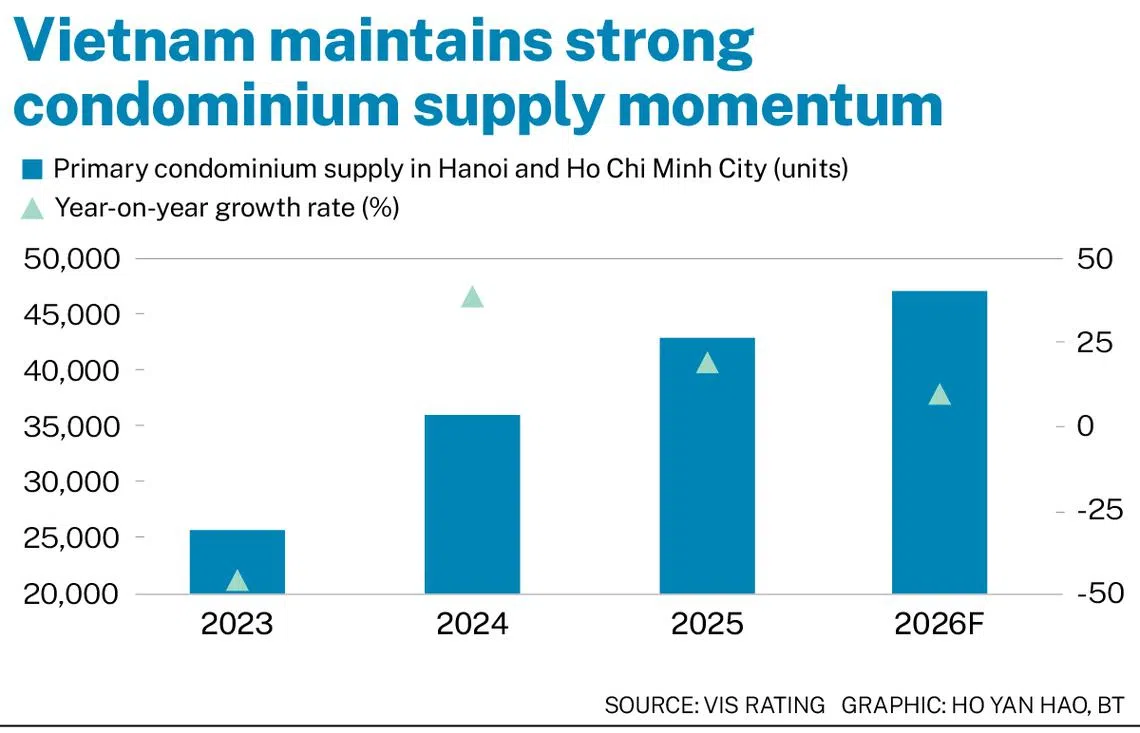
Despite the market slowdown, Vinhomes has ambitious targets for 2026.
It is aiming for revenue of 285 trillion dong (S$13.8 billion) and record after-tax profit of 60 trillion dong – increases of around 86 per cent and 38 per cent, respectively, from 2025.
It currently controls the largest land bank in Vietnam’s property market – spanning 29,500 hectares – along with more than 30 active large-scale residential townships nationwide.
As of end-2025, the Vingroup subsidiary has sold 309,000 property products – including apartments, villas and town houses – equivalent to more than 1,000 trillion dong in cumulative sales.
Vinhomes’ shares closed Monday up 3.2 per cent on the Ho Chi Minh City Stock Exchange; shares of its parent company, Vingroup, rose 1.1 per cent.
Decoding Asia newsletter: your guide to navigating Asia in a new global order. Sign up here to get Decoding Asia newsletter. Delivered to your inbox. Free.
Copyright SPH Media. All rights reserved.
TRENDING NOW

Once staunchly pro-China, Malaysian Chinese businesses are now distancing themselves from Beijing

Looking beyond looming CEO succession, should UOB potentially pursue a transformative merger?

Could stablecoins be the future of money?

Grab CEO’s wife Chloe Tong on life with Anthony Tan and finding her purpose

