

Hong Kong’s ‘ambitious’ 5-year plan to boost role as global financial hub wins industry backing
Translating these high-level ambitions into reality may not be straightforward, experts say

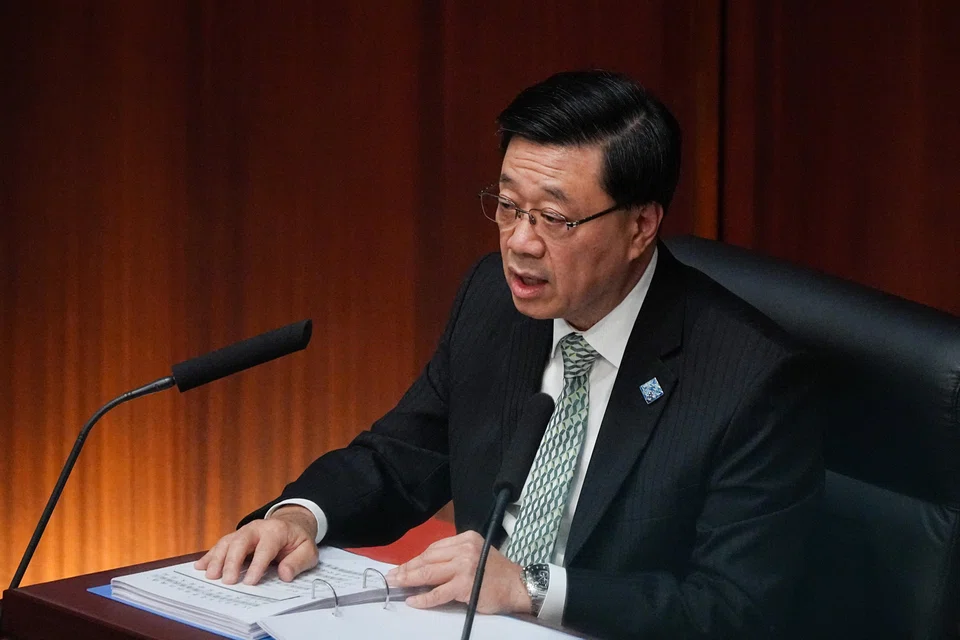
[HONG KONG] Hong Kong rolled out its first five-year strategic blueprint on Wednesday (Sep 16), anchoring its economic future in the financial sector, which is described as the city’s “pivotal and crowning strength”.
The plan received strong early praise from industry leaders, though observers stressed its success hinges on overcoming practical delivery risks.
Bonnie Chan, CEO of Hong Kong Exchanges and Clearing (HKEX), told The Business Times: “Hong Kong’s first five-year plan and the 2026 policy address set out an ambitious vision that will strengthen our contribution to the country’s high-quality development.”
Candise Tang, senior director of H/Advisors, said the plan provides greater policy continuity through the change of government in 2027, helping to maintain strategic direction in transitions with the inclusion of clear targets and performance indicators.
Betty Wang, lead economist at Oxford Economics, noted that the plan largely formalises and coordinates policy initiatives already discussed or implemented locally, addressing criticism that policymaking has been too focused on near-term priorities.
Strategic direction
Industry participants regarded the five-year plan as broadening the range of products available, and strengthening Hong Kong’s role as an international financial centre.
Tang noted that with this combination of institutional stability and national development momentum, Hong Kong is well-positioned to strengthen its competitive edge.
HKEX’s Chan outlined the four strategic directions that result for the exchange: expanding its offshore renminbi, fixed income and currency, and commodities ecosystem; deepening its secondary market; enhancing its fundraising platform for international issuers; and future-proofing market infrastructure.
Cindy Keung, economist, macro research at OCBC, noted that on offshore renminbi, Hong Kong already handles around 75 per cent of global renminbi clearing and holds the world’s largest pool of offshore liquidity.
She added that the five-year plan also includes a half-rate tax concession for qualified commodity trading activities, and preparations for the new renminbi-denominated and physically settled gold futures contracts.
“Aside from the tax advantages, Hong Kong’s key edges lie in proximity to Asian demand, a renminbi-denominated gold market and closer integration with the mainland’s commodity trading ecosystem,” she said.
Byron Lam, economist and market strategist, group research at DBS Bank (Hong Kong), said that Hong Kong remains the central pillar of renminbi internationalisation, backed by roughly 1.1 trillion yuan (US$164 billion) in deposits and financing quotas.
“Further progress will require broader institutional participation, deeper repo and collateral markets, additional dim sum bond issuance and more effective hedging instruments,” he added.
Kher Sheng Lee, co-head of the Asia-Pacific at the Alternative Investment Management Association, said international managers would run mainland exposure at scale only where renminbi fixed income has depth, and hedging tools exist. “Liquidity follows usable products, so the execution test is product creation and channel breadth across asset classes,” he added.
On commodities, he said that institutional investors hold metal where they can trade, finance and settle it with legal certainty, so custody follows the market. He further noted that the plan puts the clearing, storage and insurance first, which is the “right order”.
DBS’ Lam said that gold imports into China through Hong Kong increased by 92.4 per cent year on year to 499 tonnes in August, reinforcing the city’s gateway role.
Jamie Turnough, CEO of Hong Kong-based precious metals retailer Bullion Beasts, welcomed the concrete gold-market initiatives, including a planned central gold clearing system in early 2027 and expanded airport depository capacity.
“Hong Kong’s practical advantages for those seeking diversification are straightforward: proximity to the largest physical gold demand centres in Asia, expanding high-security vault capacity, a forthcoming central clearing system, free capital movement and a legal framework that continues to support allocated physical ownership,” he said.
Another key strategic direction involves deepening the secondary market and enhancing its fundraising platform for international issuers.
The policy address on Wednesday outlined plans for the HKEX to promote dual primary and secondary listings of overseas enterprises, including from South-east Asia and countries participating in China’s Belt and Road Initiative.
Steps are already being taken to advance this.
In a July interview with BT, Johnson Chui, HKEX’s head of global issuer services, said the exchange aims to position itself as a gateway to deeper international capital pools, citing memorandums of understanding signed with regional exchanges, including Malaysia and Kazakhstan.
Oxford Economics’ Wang noted that supporting mainland Chinese companies in their global expansion is another key priority, which could broaden opportunities for Hong Kong’s institutions in cross-border financing, asset management and renminbi-related business.
However, the scale will depend on mainland China’s pace of financial opening.
The plan’s wealth-management ambitions are also drawing attention from family offices positioning Hong Kong as a wealth hub.
“For those families, wealth is never a single asset class,” said Chi Man Kwan, group CEO of Raffles Family Office.
“Broadening the range of available products and deepening Hong Kong’s role as a ‘super connector’ between mainland China and global markets will be essential, as an estimated US$5.8 trillion in wealth passes to the next generation in Apac by 2030.”
Impact on Singapore
As geopolitical tensions escalate, investors are increasingly on the lookout for safe and trusted jurisdictions and financial hubs, including Hong Kong and Singapore.
“Hong Kong’s listing market is strong right now,” said Kenneth Goh, director of private wealth management at UOB Kay Hian. “The next step is for that strength in financial markets to spread to the rest of the economy.”
He said that the plan leans into Hong Kong’s edge to access mainland China’s companies, capital and deal flow, helping companies go global and building their offshore renminbi role.
Singapore’s role remains focused on international families and businesses using it as a South-east Asia base, and to spread assets in markets.
Neil Synnott, regional chief commercial officer for Apac at IQ-EQ, noted that the next phase of competition among financial centres may be less about attracting the greatest number of companies, and more about attracting the highest-value activities.
“The winners will be those that create the most efficient pathways for capital, talent and innovation,” he said.
“If Hong Kong can execute effectively, its future strength may come not from being bigger than its peers, but from being more differentiated.”
However, experts warned that translating these high-level ambitions into reality may not be seamless.
“It is relatively easy to allocate capital. It is far harder to change how businesses and markets operate,” he added.
Wang noted that Hong Kong’s market-oriented economy means delivery will depend not just on government, but also on coordination in departments and civil service – in addition to broad private-sector participation – which could complicate translating long-term objectives into working-level initiatives.
Lam agreed: “Delivery will depend on timely land and infrastructure development, effective cross-border regulatory coordination, talent retention and sufficient private-sector participation. “Overall, the plan is a great strategic road map, but its success should be assessed through measurable implementation.”
Decoding Asia newsletter: your guide to navigating Asia in a new global order. Sign up here to get Decoding Asia newsletter. Delivered to your inbox. Free.
Copyright SPH Media. All rights reserved.






