



Beefed up: Prabowo births fattest Cabinet, Anwar dishes out record Budget

This week in Asean:
- Indonesia: Fintech lender loses licence
- Thailand: Teases Nvidia investment plan
- Malaysia: Q3 growth slows; inflation moderates
Dear BT reader,
How many politicians does it take to build a Cabinet? Quite a few, it seems.
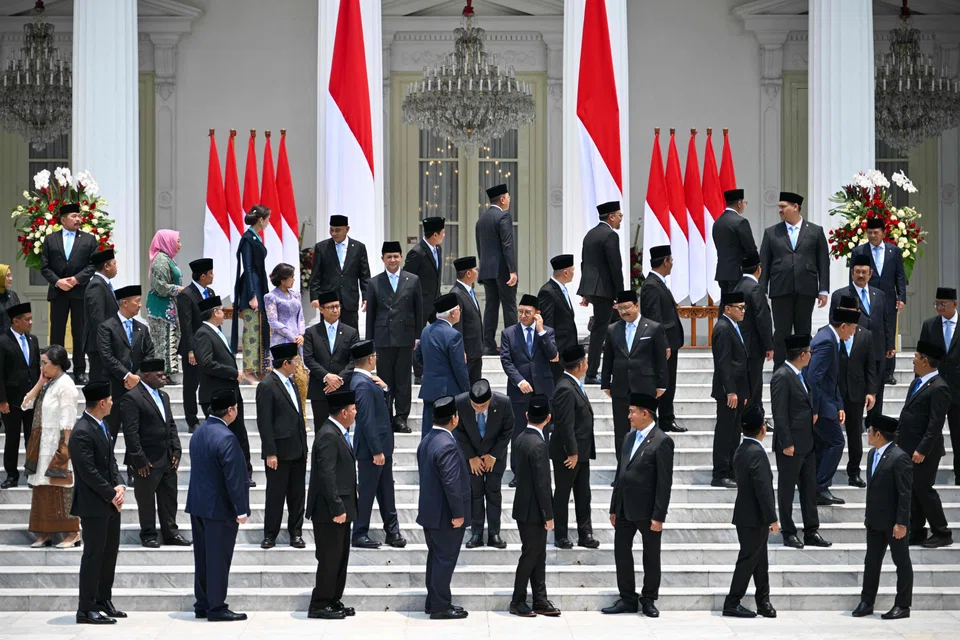
The magic number for newly minted Indonesian President Prabowo Subianto is 109. Armed with 48 ministers, 56 deputy ministers and five key officials, the former military general has assembled the nation’s largest Cabinet in almost 60 years. And he did so on the evening of Oct 20, the same day he was sworn in.
However, business leaders and investors tell our Indonesia correspondent Elisa Valenta that a bloated Cabinet could lead to inefficiencies and slower policymaking. Elisa further points out that the country’s 48 ministerial posts – up from his predecessor’s 34 – contrast sharply with the US’ 15 executive departments and China’s 21 ministries. Read her piece for a further visual breakdown comparing the Cabinets of Prabowo and his predecessor Joko Widodo.
It’s been a week of records for South-east Asia. Neighbouring Malaysia saw Prime Minister Anwar Ibrahim dish out on Oct 18 its fattest Budget ever at RM421 billion (S$127.8 billion).
A key ambition is a shift to targeted subsidies, in an attempt to funnel support directly to lower-income groups while phasing out benefits for higher-income earners. The government also intends to bump up taxes to address its fiscal deficit. This is a flashpoint for the country as public spending has historically been driven by large-scale development projects and subsidy programmes, explains our Malaysia correspondent Tan Ai Leng. Market watchers tell her they anticipate rising inflationary pressures despite still maintaining optimism about Malaysia’s economic outlook in this piece.
In other political developments, Vietnam elected on Monday (Oct 21) military general Luong Cuong as its new President. His predecessor, Communist Party chief To Lam, had been straddling two roles after the passing of Vietnam’s late leader Nguyen Phu Trong in July. Our Vietnam correspondent Jamille Tran speaks with analysts who reveal what the new appointment means for the socialist republic and if political stability will last in a country that has been rocked by political upheaval and the ruling party’s anti-graft crackdown.
We’ve got a strong lineup of stories this week from other regional correspondents below; be sure to give them a scroll. Let me know what you’d like to see more of in my subsequent pieces too. Have a good weekend.
Trending
What I’m watching: While doing research for this newsletter issue, I chanced upon information on X that several Asean member states were invited to join Brics as partner countries. The five-member alliance comprising Brazil, Russia, India, China and South Africa was formed as a counterbalance to the West’s political and economic power.
Why you should care: Malaysian Prime Minister Anwar Ibrahim has been rubbing shoulders with Russia’s Vladimir Putin, and ties between Asean and Russia look set to grow even tighter. Definitely a development to keep your eyes on.
Asean in brief
- As Johor’s data centre scene sizzles, new projects face stricter criteria The state government is re-evaluating its approach to approving new data centre projects as global investor interest continues to grow, Invest Johor chief executive Natazha Harris tells BT. Read more
- Vietnam permits sales of excess self-use rooftop solar power to national grid Vietnam has issued a new decree that allows excess rooftop solar power to be sold at up to 20 per cent of the installed capacity to the state-owned utility Vietnam Electricity. Read more
- Temasek-backed Indonesian unicorn eFishery treads carefully about going public Indonesian agritech giant, eFishery, is taking a measured approach to its much-anticipated public listing, even though it has been considering going public since last year. Read more
- South-east Asia rises as proptech hotbed, but funding and talent hurdles remain, say experts As the region’s real estate market continues to expand, investors and startups are eyeing the potential of proptech – a field that uses technology to improve real estate services – but face hurdles in securing sector-specific funding. Read more
- Export-led growth will be limited in scope for China; dual circulation is ‘right direction’: DPM Heng Bridgewater Associates founder Ray Dalio also spoke at the 15th edition of the FutureChina Global Forum, noting that China needs to get its debt restructuring done. Read more
- GIC, Macquarie explore US$2 billion stake sale in Philippines’ EDC: sources EDC is the Philippines’ biggest renewable energy firm that accounts for about a fifth of the country’s total installed renewable energy capacity. Read more
- Singapore to import low-carbon electricity from Australia’s SunCable mega solar project The Energy Market Authority has awarded conditional approval to the project developer to supply 1.75 Gigawatts of solar-generated electricity to Singapore via subsea cables. Read more
- Why the green, digital economies are a strategic focus for Singapore and Asean Singapore is well positioned to be a leader in these fields for the bloc, and is expected to continue its push to enhance regional economic connectivity with efforts to accelerate Asean’s digital integration and energy transition as it gears up for its 2027 chairmanship. Read more






