

Issue 189: Carbon tax in an energy crisis; Singapore good timing on green bonds
This week in ESG: Singapore’s carbon tax may have room for relief; Reopened 30-year Singapore green bonds yield 2.57 per cent

Carbon pricing
Exploring relief options in Singapore’s carbon tax
ESG Insights will take a break on Apr 10 and return on Apr 17.
As the Middle East conflict continues to disrupt global oil and gas supply chains, Singapore may have to weigh the possibility of providing relief from its carbon tax.
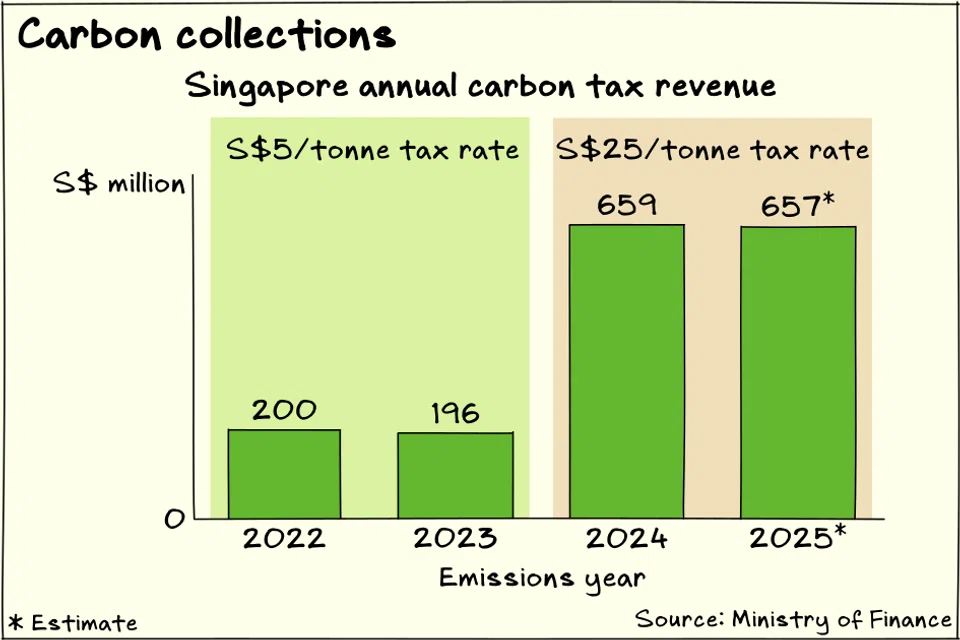
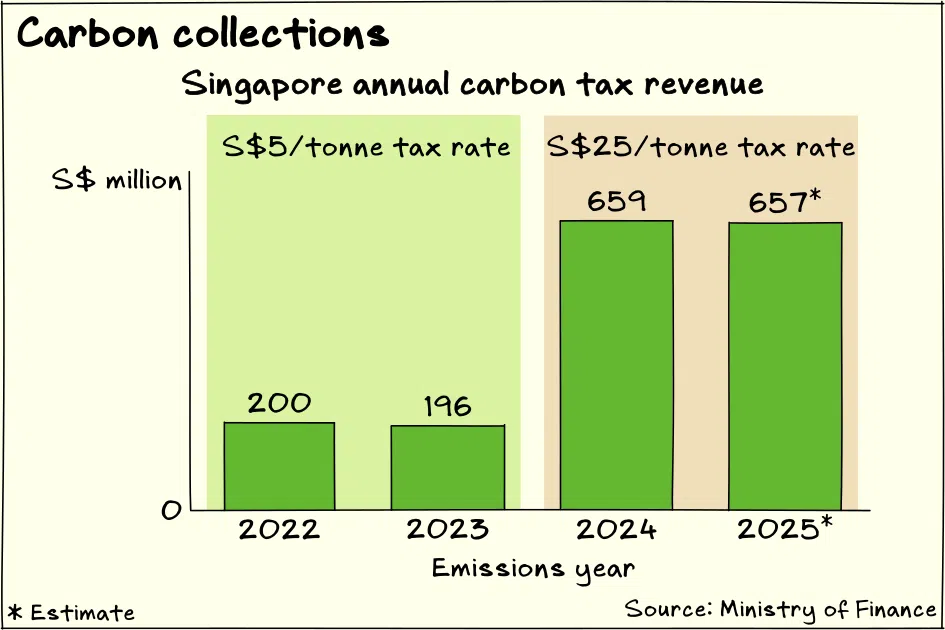
Singapore’s carbon tax applies to all industrial facilities with annual greenhouse gas emissions of at least 25,000 tonnes of carbon dioxide equivalent. The tax was first imposed at S$5 per tonne of emissions in 2019, and the rate has been ratcheted up with a view to reach between S$50 and S$80 per tonne by 2030. The tax rate was first raised to S$25 per tonne for 2024 and 2025, and is currently set at S$45 per tonne for 2026 and 2027.
Singapore is set to collect the carbon tax for 2025 emissions in September this year, an amount that the 2026 fiscal budget estimates to be about S$657.3 million. While the estimated amount to be collected roughly matches the carbon tax revenue collected in 2025 for 2024 emissions, the current oil and gas supply shock could make this year’s carbon tax payment extra painful for taxed entities.
The question for Singapore is whether it should cut those carbon taxpayers some slack.
The carbon tax, broadly, has two key objectives. The first is to send an economic signal to shift consumption and investment decisions away from higher-carbon choices towards lower-carbon options. The second is to support decarbonisation efforts, the transition to a green economy and to cushion the impact on businesses and households with carbon tax revenue.
In the short term, that economic signal has become less important because there is already a market-based signal in place. Oil and gas prices have risen sharply due to the supply shortage from the Middle East conflict, giving buyers a rather strong economic incentive to find alternatives. It’s even possible that this market signal is more effective because fossil fuel prices affect a much larger range of goods and services, whereas Singapore’s tax regime focuses on major upstream emitters that account for only about 70 per cent of Singapore’s emissions.
To be clear, just because oil and gas prices are high now does not mean that carbon is properly priced. Today’s high prices reflect risks and disruptions in the oil and gas supply chain, but the environmental impact of carbon emissions remain mostly externalised. However, it could be argued that adding a carbon tax on top of the market-based inflation shock would be excessive, because it could lead to a loss of business and jobs at a time when they are hurting, creating economic pain instead of spurring the desired green transition. It’s not about keeping oil and gas affordable, but about managing the shock from the rapid pace of the price increase.
The carbon tax revenue can be used to help offset the costs of decarbonisation. For example, the government’s various sources of revenue and income – including the carbon tax – have helped to pay for U-Save rebates over the past few fiscal budgets. The U-Save rebates return cash to households in Housing & Development Board flats to help offset the costs of utilities; Budget 2026 included 1.5 times the regular amount, or up to S$570 per eligible household.
But with carbon tax revenue expected to be only S$657.3 million in the government’s fiscal 2026 – which ends March 31, 2027 – the emissions levy accounts for less than half a per cent of the government’s operating revenue. If some relief on the carbon tax is granted, the government coffers are unlikely to take such a big hit that these forms of transition support have to be meaningfully cut back.
The diminished need for the carbon tax’s economic signal and its still relatively small contribution to the government’s operating revenue suggest that there is room for Singapore to provide some relief. Furthermore, Singapore’s carbon pricing is already one of the highest in Asia, which suggests that some tax relief will not damage Singapore’s standing in climate terms.
But there’s a limit to how much relief Singapore can provide on its carbon tax before it becomes meaningless. Singapore currently uses transitory allowances that confer discounts on the carbon tax rates for certain trade-exposed emitters so that they can remain competitive. Singapore has said that the taxed facilities account for about 70 per cent of national emissions, and the country’s Biennial Transparency Report projects 62.21 million tonnes of emissions for 2025, which implies that expected carbon tax revenue for 2025 emissions should be in the ballpark of S$1.1 billion. The actual estimate of S$657.3 million of carbon tax revenue suggests an effective tax rate that’s closer to S$15 per tonne of emissions than the headline rate of S$25 per tonne.
One possible form of relief is to allow carbon taxpayers to defer payment for their 2025 emissions, which would otherwise be collected in September this year. This preserves the carbon tax and its signalling and revenue, but delays its impact by the length of the deferment.
If Singapore decides to provide some relief to carbon taxpayers, it is important that the relief comes with conditions to ensure that the relief won’t go straight into corporate profits and stay there. Facilities that receive relief shouldn’t be laying off workers, for example. Those that are able to pass the higher oil and gas costs through to customers may not need any relief, but if they do receive it, that support should be passed through as well, to ensure that the relief measures ultimately benefit businesses, workers and households.
Sustainable finance
Singapore 30-year green bond’s blended yield now below 3 per cent
Who knows how the Monetary Authority of Singapore is doing it, but here’s a crazy stat: Reopenings of Singapore’s 30-year sovereign green bonds have a perfect record in predicting when US President Donald Trump will unleash chaos unto the world.
It’s a very small sample size, yes, but the reopenings have hit a perfect two out of two so far.
Singapore reopened the 30-year 3.25 per cent Green Singapore Government Securities (Infrastructure) bonds via an auction in March, pricing on March 27 at a cut-off yield of 2.57 per cent. It was the first sale of government bonds since the US and Israel attacked Iran, and the low yield reflects a general flight to safety as Singapore government bond prices rose across the board.
The latest auction sets a new low yield for offerings of this series of bonds, which was first launched in 2024 and reopened once before in 2025.
That 2025 reopening took place in April, and came just after the US announcement of global trade tariffs. That deal also benefited from worldwide anxiety stemming from turmoil caused by the tariffs. The 2025 reopening priced at a yield of 2.62 per cent, which was significantly lower than the original 3.3 per cent yield when the bond series was newly minted in 2024.
The impeccable divinations have helped to lower the blended yield of the 30-year green bonds to about 2.9 per cent over the S$5.8 billion of 30-year bonds now in issue. That relatively cheap cost of borrowing allows Singapore to fund its green strategy rather inexpensively. Proceeds from the 30-year bonds are earmarked for supporting Singapore’s Green Plan 2030, including two new MRT lines.
The bond auction calendar for 2027 has not been published yet, but watch that space. Just in case, right?
Other ESG reads
- Are CEOs paid too much? An NUS study offers insights that hopefully changes more than rules
- Singapore, Thailand launch applications for carbon credit projects: MTI
- Coal tycoon Samin Tan arrested as Indonesia deepens illegal mining crackdown
- Killing ‘zombie’ projects: Philippines bets big on offshore wind
- AI and gender inequality: DBS’ Tan Su Shan and former Singapore president Halimah Yacob look at rising risks
- With Iran war’s cost impact just beginning, Singapore must take energy saving seriously
TRENDING NOW

Once staunchly pro-China, Malaysian Chinese businesses are now distancing themselves from Beijing

Britain’s mansion tax shows the difficulty of targeting wealth
Three hats, one goal: How Ng Kian Swan runs sustainability at NUHS
COE review: The gap between luxury and mass-market cars isn’t the only one worth bridging

