

Issue 208: Sembcorp’s turbulent week; nuclear financing’s green acceptance
This week in ESG: Renewables group’s first-half underlying profit falls 25%; global nuclear-related sustainable financing hits US$4.1 billion in H1 2026

Sustainable investing
Sembcorp’s diversified portfolio saves the day
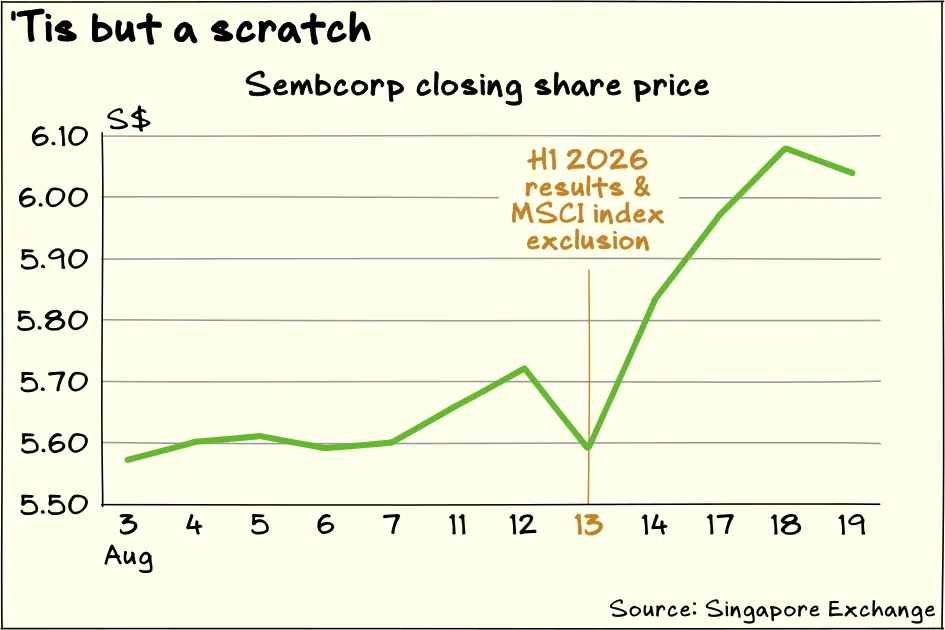
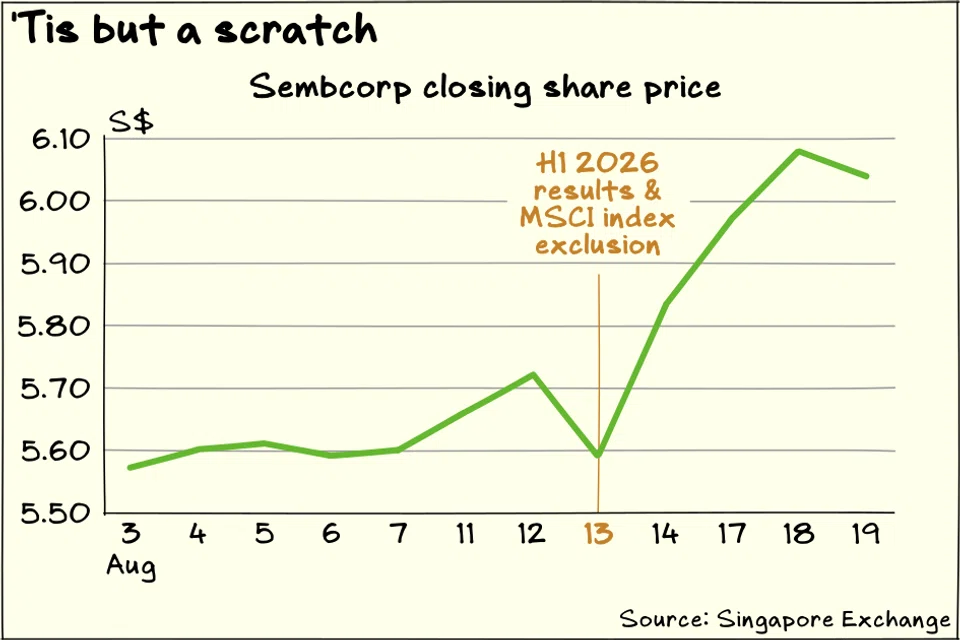
A diversified portfolio may have helped Sembcorp Industries to emerge from a roller-coaster week with a tailwind.
Shares of the renewable energy company took a beating before the Aug 15 weekend as a major index dropped the stock and lacklustre earnings reflected persistent weakness in China. However, the counter has bounced back even higher as an Australian acquisition and a potential spin-off in India give analysts and investors a positive story to buy.
Aug 13 was an unlucky Thursday for Sembcorp investors.
Before the market opened, Sembcorp reported that first-half 2026 underlying net profit fell 25 per cent to S$369 million from S$491 million a year ago. When exceptional items – including transaction costs in 2026 for the acquisition of Alinta Energy in Australia and gains from its 2025 sale of waste management unit Sembcorp Environment – and other one-offs are counted, net profit attributable to shareholders fell 72 per cent to S$150 million from the year-ago period’s S$536 million.
As if rubbing salt in the wound, MSCI announced on the same day that it was deleting Sembcorp from its Global Standard Indexes, a reflection that Sembcorp’s market capitalisation is no longer large enough to be considered a large or mid-cap stock by a leading global index provider. Sembcorp will however remain in the MSCI global index universe, and will be added to the relevant MSCI small-cap indexes.
Even though Sembcorp declared an interim dividend of S$0.11 per share with its results – a S$0.02 increase from the mid-2025 payout – Sembcorp’s shares slipped 2.3 per cent, or S$0.13, to close at S$5.59 on Aug 13. They did not linger in that trough, gaining 4.3 per cent, or S$0.24, one day later to end Aug 14 at S$5.83. The counter rose for two more days, hitting S$6.08 on Aug 18 before easing to S$6.04 on Aug 19.
A few factors may have helped to fuel the rebound.
The first is that analysts are generally sanguine about the earnings decline, with the optimism linked to expectations of earnings contributions from Alinta in future reporting periods. DBS analyst Pei Hwa Ho expects a “strong sequential improvement” from the second half of 2026 onwards, noting that Sembcorp management is maintaining expectations of about S$100 million of profit contribution from Alinta in the second half of 2026. Ho has a “buy” call on the stock with a 12-month target price of S$7.30.
CIMB’s Meghana Kande and Lim Siew Khee lift their expected dividend per share for the year to S$0.30. With an implied yield of 5.4 per cent, the pair view Sembcorp “turning into a yield play”. Gas and related services profits should also improve in the latter half of 2026 on the back of management guidance for stronger and firm spark spreads. Spark spreads measure the difference between Sembcorp’s production costs and electricity rates. CIMB is keeping its “add” call on the counter with a S$7.15 target price.
OCBC’s Chu Peng says the company could be well-placed to capture long-term demand from artificial intelligence and data centres. The analyst notes that the exclusion from the MSCI Global Standard Indexes could lead to selling from passive funds, but any price decline from such rebalancing presents “potential buying opportunity for long-term investors”. OCBC rates Sembcorp a “buy” with a fair value of S$7.20.
Another factor helping to support Sembcorp’s shares is news from Bloomberg that the company could be close to launching an initial public offering for its India renewables business, Sembcorp Green Infra. As at Aug 20, Sembcorp’s stance is that “no definitive decision has been made”.
Nevertheless, a successful spin-off of the Indian assets could allow Sembcorp to reap some profits from a stake sale, raising the potential for capital recycling and dividend payouts. Bloomberg reports that the offering could raise as much as US$500 million.
The analysts are bullish despite persistent challenges in Sembcorp’s China renewables business, which has been dragging the group’s profits due to high curtailment and lower tariff rates. In the first half of 2026, Sembcorp’s renewables net profit halved to S$69 million. For the second half of the year, Sembcorp expects renewables earnings to be “seasonally lower”.
Sembcorp’s ability to attract “buy” calls from analysts and to bounce back from bad news stems from a diversified portfolio across geographies and technologies. China renewables are a weak segment, but Sembcorp also has a natural gas business, and its renewables business as substantial assets in Singapore, South-east Asia, Australia and India.
Consider Concord New Energy Group, Sembcorp’s Hong Kong-based peer with a secondary listing in Singapore and a portfolio that is almost entirely based in China. On Aug 10, Concord New Energy warned that profit for the first half of 2026 will drop 66 to 69 per cent, due to the same system-wide issues that Sembcorp faces in the country.
Since the profit warning, Concord New Energy’s share price has declined by about 10 per cent, to S$0.05 from S$0.055 before the announcement. Unlike Sembcorp, Concord New Energy’s portfolio does not have buffers.
Still, a well-performing portfolio needs to be more than just diversified. Despite the recovery from its week-ago turbulence, Sembcorp’s shares remain significantly below their April high of around S$7.10. A year ago the stock was trading around S$7.80. That is a severe underperformance against the market as measured by the Straits Times Index, which has climbed about 35 per cent over the past year. Sembcorp needs to improve the return on equity it generates from its renewables business.
Alinta and the potential listing in India will give Sembcorp some firepower to pursue more projects and acquisition targets. The company’s challenge is to deploy these resources well. Dividends and spin-offs might keep shareholders happy in the short term, but putting capital to good use matters more in the long term.
Sustainable finance
Growing green inclusion for nuclear
A promising sign for the nuclear energy industry is that the technology is increasingly accepted as a low-carbon alternative to fossil fuels.
Sustainable debt raised for nuclear energy-related activities was worth about US$2.7 billion in 2023, shows an analysis by Sustainable Fitch. It reached a peak of US$10.5 billion in 2024, and stands at US$4.1 billion for the first half of 2026.
The researchers explain the growth as a growing sign of nuclear energy representing “a forward-looking investment category linked to energy security, technology development and long-term decarbonisation strategies”.
Indeed, the increasing willingness of issuers and investors to accept nuclear-related activities as eligible for sustainable financing marks a shift in the market towards greater openness to nuclear technology. That acceptance has not always been present. For instance, nuclear energy faced significant opposition during the early development of the European Union’s sustainable finance taxonomy, although nuclear energy is now eligible for sustainable finance on the continent subject to certain conditions.
This is a positive trajectory for a small island nation like Singapore, which is severely limited in its access to domestic renewable energy. Singapore has determined four “switches” of its energy transition: solar, regional power grids, emerging low-carbon alternatives and natural gas.
The emerging low-carbon alternatives include four key technologies, namely hydrogen, nuclear, carbon capture and sequestration, and geothermal. Of the four, nuclear energy could well be the most promising given the maturity of the underlying technology and the energy and spatial density of the fuel.
Singapore is still studying the feasibility of deploying nuclear energy. If nuclear is greenlit, a sustainable finance channel will probably be available to help fund the project.
Other ESG reads
- EGP Energy H1 net profit rises 179.7% to S$6.1 million on strong revenue growth
- DayOne secures S$530 million green loan from DBS, OCBC and UOB for Singapore data centre
- AI, energy security needs are driving surge in South-east Asia’s energy infrastructure deals
- South-east Asia may be ready for this El Nino – but tackling climate risk is still urgent
- Europe’s rising heatwave bill: Businesses face mounting losses as insurance gap widens
TRENDING NOW

Ex-Nvidia CEO Jensen Huang carried a secret for more than a year. It led to his downfall

South-east Asia has lost Nvidia’s best salesman

Demand, tech capabilities position Apac and AI as Skyscanner’s next growth frontiers: CEO Bryan Batista

Jensen Huang discusses comeback as Nvidia CEO with allies: report

