

Issue 209: Climate Impact X, Carbonplace to merge; Singapore’s future island faces conflicting needs
This week in ESG: Merging carbon players aim for fourth-quarter completion; planned reclamation impacts key marine habitats

Carbon markets
The gravity of a Climate Impact X-Carbonplace merger
At the heart of the planned merger between Singapore’s Climate Impact X (CIX) and London’s Carbonplace is the creation of heft.
The thesis is that with a more global group of stakeholders, an expanded presence on the carbon value chain and a combined base of suppliers and customers, the merged group will be well-equipped to capture growing demand for carbon credits.
The CIX-Carbonplace merger, slated for completion in the fourth quarter subject to regulatory approvals, is complementary in a couple of key dimensions.
In terms of the carbon value chain, CIX operates a carbon exchange, while Carbonplace provides carbon portfolio management and trading services. A carbon buyer might get a price, bid and execute a trade for a carbon credit on CIX, and settle and register the trade and any subsequent disposal or retirement of the credit through Carbonplace. For a buyer, the combined entity would be somewhat of a one-stop shop. Sellers will still have to look elsewhere for verification and registration, but CIX-Carbonplace could cover most of everything else.
Just as important is that the merger creates an enlarged consortium of stakeholders stretching across five continents. CIX is chiefly anchored in Asia, being jointly owned by DBS, Singapore Exchange, Standard Chartered, Mizuho and Temasek-owned investment platform GenZero. Carbonplace is stronger in North and South America, Europe and Australia, with a shareholder table comprising BBVA, BNP Paribas, CIBC, Itau Unibanco, National Australia Bank, NatWest, SMBC, StanChart and UBS.
The strength of the consortium goes beyond geographies. The shareholders consist of major banks and institutions, and a single platform backed by all of them is immediately a significant player in the carbon sector.
But what’s the point of accumulating all that heft?
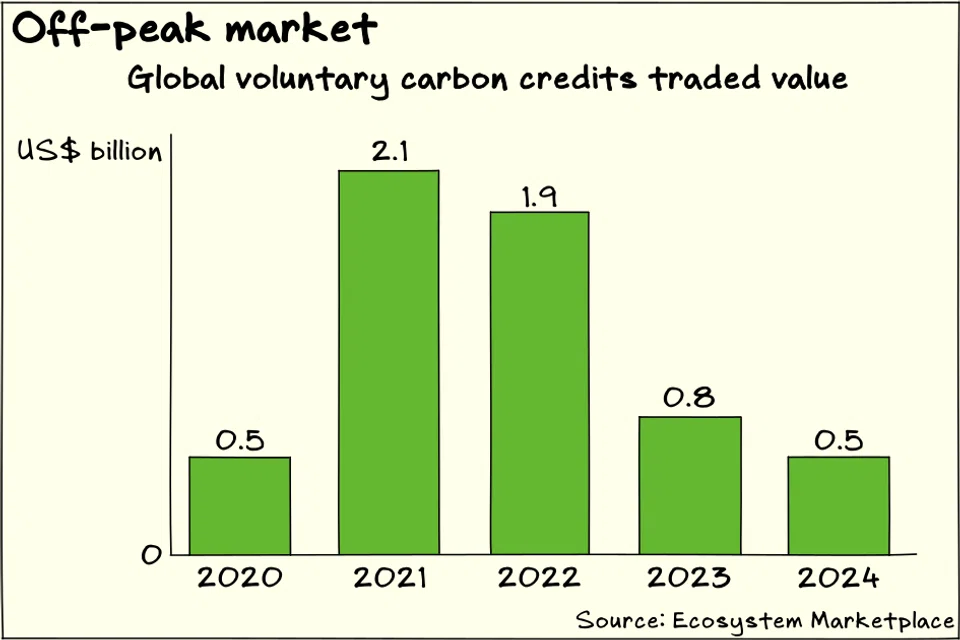
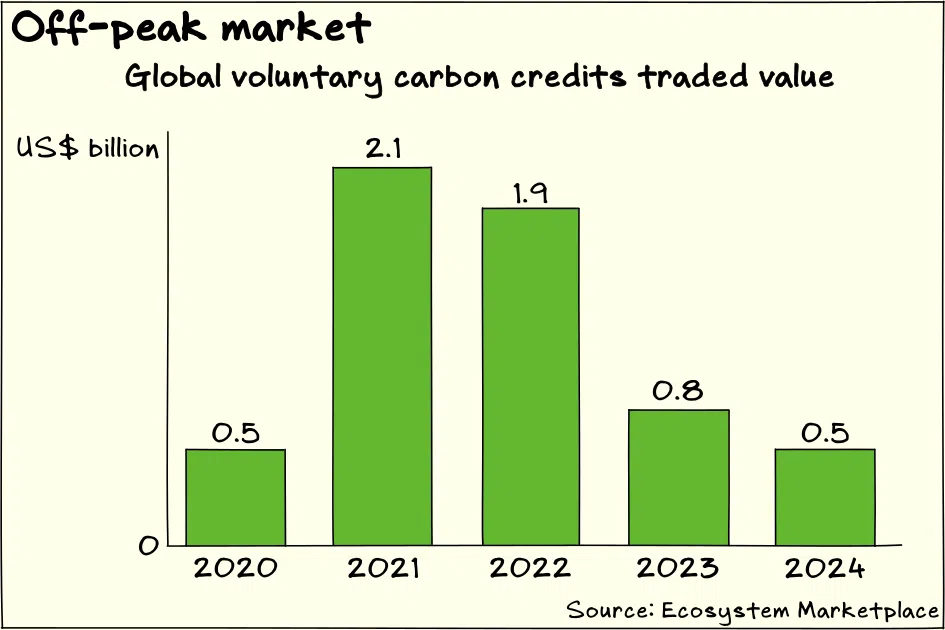
At first glance, the carbon market – especially the voluntary market – may not seem healthy. The size of the voluntary carbon market has been shrinking since 2021, dragged by concerns about carbon credit integrity following reports that found significant over-claiming by carbon projects. The latest data compiled by Ecosystem Marketplace estimates the value of traded carbon credits in 2024 at US$535 million, about 30 per cent less than the US$754.5 million traded in 2023.
But the carbon market appears to be at a pivotal moment with a number of developments that could potentially fuel a recovery.
The first is the development and maturation of carbon standards that are gradually restoring confidence in the market. Ecosystem Marketplace finds that landfill gas carbon credits aligned with the Core Carbon Principles established by Integrity Council for the Voluntary Carbon Market (ICVCM) are seeing a 35 per cent increase in price, for example.
In the compliance market, countries are signing a growing number of cross-border carbon trading agreements aligned with safeguards contained in Article 6 of the Paris Agreement. The global aviation industry also faces a looming deadline in 2027 to begin offsetting excess emissions.
Ecosystem Marketplace observes that while voluntary carbon markets and compliance carbon markets have historically been distinct, the aviation industry and many Article 6 regimes are now embracing interoperability with voluntary markets.
The view is that carbon markets face a dynamic outlook driven by fundamental changes in the way that carbon markets work.
Under these circumstances, large, integrated players could have an advantage over smaller ones. Market participants might appreciate one-stop shops that can help them to navigate complex and shifting landscapes. Furthermore, a large portfolio of projects and clients is a strong hedge amid the uncertainty of the changes that lie ahead.
Nevertheless, there is a risk of the thesis being invalidated. For example, the hope placed on the Core Carbon Principles to address integrity issues may prove to be misplaced, or verification under the principles could be so onerous that it stifles supply or raises prices too high for buyers. If integrity issues return, the Article 6 and aviation markets could dry up.
But the good thing about being a dominant market player is that you do not have to be a mere taker of external developments. A large market stakeholder mitigates the risk of market fragmentation just by its existence, because said stakeholder can better influence standards and industry conventions. You can shape the landscape with enough gravity, and gravity comes from heft.
Natural capital
Future Western island faces conflicting needs
Singapore’s plans to develop a new Western island off its southwestern coastline will challenge the land-scarce nation to strike a balance between opposing needs.
In his National Day Rally speech, Prime Minister Lawrence Wong announced plans to merge a cluster of islands to support advanced manufacturing facilities and accommodate new power generation infrastructure. The biggest islands in that cluster are Semakau, the site of an offshore landfill; Bukom, where an oil refinery still stands; and Sudong, where the Singapore military runs an emergency airstrip.
The economic and security objectives are clear. Energy security and decarbonisation are top national priorities that are better served with additional real estate close to Singapore’s heavy industries. For example, the new island could accommodate a small nuclear reactor if Singapore decides to pursue nuclear energy.
However, the environmental objectives are more complicated. The Western island could enable development that helps Singapore to decarbonise its energy network and green its economy. However, building the island could well mean serious and irreversible damage to a rich marine ecosystem with coral reefs and sea grass that is popular with divers.
Singapore law requires detailed environmental impact assessments for developments close to sensitive nature areas, and the Western island project is expected to undergo that scrutiny. The regulator assesses the development against its potential impact, and developers are required to ensure mitigation measures and monitoring plans are in place before any works commence.
In an ideal scenario, Singapore will be able to build its land while protecting the marine ecosystem. But that outcome could be exceedingly challenging to achieve, given how fragile coral and seagrass ecosystems are. Some compromise seems unavoidable to protect the natural areas. That could mean substantially higher development costs, significant changes to locations and layouts, or both.
The challenge is also an opportunity for Singapore to develop greater sophistication in how it navigates the boundaries between environmental and economic and social needs. The test doesn’t lie in whether environmental impact exists; that is already a given. The more important task is to find a good way forward when no option is ideal.
Other ESG reads
- Sembcorp’s Indian renewables unit files draft IPO papers
- The reality check awaiting Singapore’s aspiring board directors
- Data centres expected to add pressure on Singapore’s energy supply: survey
- Singapore’s new data centres must use renewables. Can they overcome the hurdles?
- South-east Asia’s top EV startups draw US$622 million in funding since 2016: report
TRENDING NOW

Once staunchly pro-China, Malaysian Chinese businesses are now distancing themselves from Beijing

Looking beyond looming CEO succession, should UOB potentially pursue a transformative merger?

Could stablecoins be the future of money?

Grab CEO’s wife Chloe Tong on life with Anthony Tan and finding her purpose

