

Issue 222: Asia Pacific’s sustainability disclosure gaps; COP31’s failed talks
This week in ESG: Asia Pacific Sustainability Index assesses region’s top listed companies; climate negotiations end without deal in Turkey

Sustainability reporting
Time to raise sustainability capability in Asian firms
As the world faces growing climate risks, Asia’s listed companies must not only strengthen their climate governance and strategy, but also assure increasingly discerning stakeholders that they are doing so.
A new analysis by The Business Times and the National University of Singapore’s Centre for Governance and Sustainability finds that while Asia Pacific’s leading companies are mostly meeting the base requirements on sustainability reporting, significant gaps remain in the quality of their disclosures.
The Asia Pacific Sustainability Index (APSI) scores the 50 largest listed companies in 14 regional markets – a total of 700 companies – on six aspects of sustainability reporting.
The findings suggest that the region’s leading companies have reached a baseline standard when it comes to sustainability reporting. For example, almost all the companies identified material environmental, social and governance (ESG) issues and their approach to selecting those issues. Almost all of the companies explain the channels through which they engage with stakeholder groups. Almost all companies report on their Scope 1 and 2 greenhouse gas emissions, which are emissions directly generated from their operations and indirectly from purchased energy, heating and cooling.
These are encouraging. Some of these standards are relatively easy to achieve, no doubt, but at least the companies are picking the low-hanging fruit instead of ignoring them.
The next challenge for the companies is naturally to reach higher. Now that most of the companies understand how to identify material ESG matters and how to measure their exposure to these issues, they need to ensure that they are able to extend these insights into robust strategies.
The journey should start with ensuring that leadership is equipped and motivated to chart the path ahead. Although 92 per cent of the assessed companies disclose that the board is responsible for sustainability, only 41 per cent describe directors’ sustainability-related skills or competencies, and only 37 per cent reported that board members received sustainability training in the past three years.
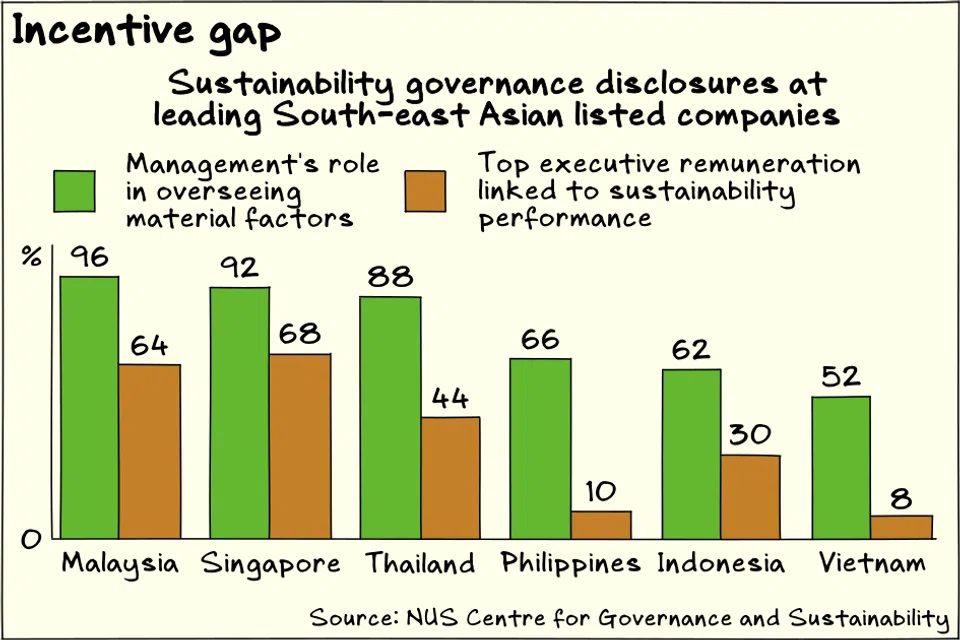
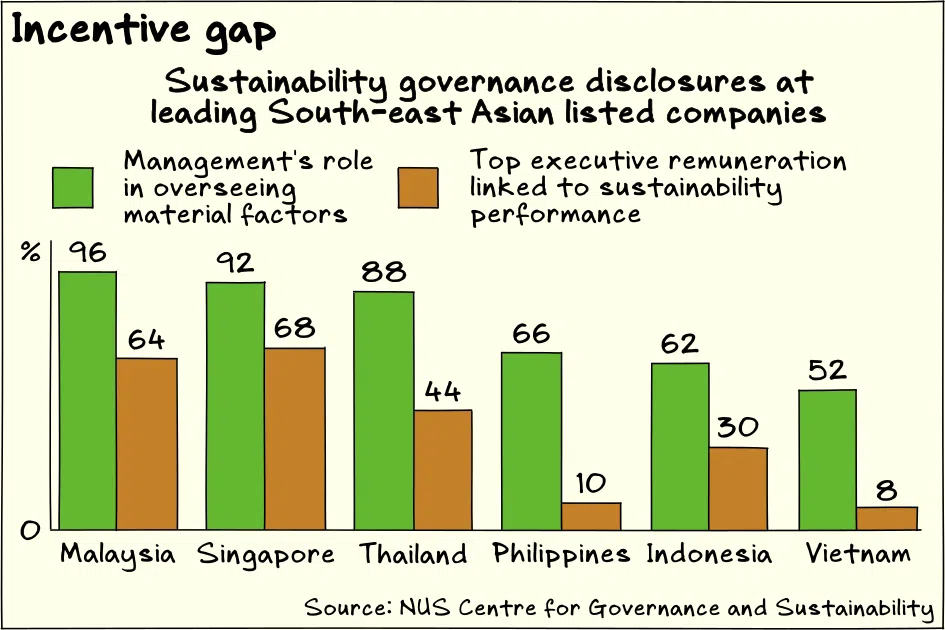
Furthermore, while 80 per cent of companies say that management is involved in overseeing material ESG factors, only 55 per cent of companies link top-executive remuneration to sustainability performance, and only 21 per cent disclose the specific weighting of sustainability-related factors in remuneration.
The numbers suggest that many companies’ leadership may shoulder responsibility and oversight of ESG matters on paper, but they are not delivering as well as they should in practice. That is because they are not proficient on such matters, or they are not properly incentivised to produce sustainability-related results.
The APSI study finds more than 80 per cent of companies identify climate-related risks and opportunities, explain their impacts on the business, strategy and financial planning, and describe response strategies. However, only 64 per cent of the companies provided climate-related scenario analysis, and only 28 per cent provided quantitative climate scenario analysis.
The quality of the disclosures is further weakened by poor assurance. In South-east Asia, especially, internal assurance tends to be the norm, with the use of internal assurance significantly surpassing the use of external assurance. For Asia Pacific as a whole, only two-thirds of companies obtain external assurance, most of which is at a limited assurance level as opposed to the more rigorous reasonable assurance threshold.
The result is that many climate strategies are inadequate or lack rigour. For instance, disclosure about physical climate risks is generally lower among companies listed in developing South-east Asia, which ironically is one of the more vulnerable regions in the world to physical climate damage and loss.
Companies will find the need to better address sustainability goes beyond fulfilling regulatory requirements or doing well on sustainability scoring indices.
The world is almost certainly going to fail at limiting global warming to 1.5 degrees Celsius above pre-Industrial level, which means that greater climate-related turmoil is in the forecast for the years ahead. The insurance industry is already acutely aware that climate-related catastrophes are occurring more frequently and at greater severity. In 2026 alone, the world has experienced heat waves in Europe and parts of Asia, and massive floods in Nepal and Thailand.
More recently, climate negotiators in Turkey for the annual United Nations climate conference known as COP31 failed to reach a deal because countries failed to reach consensus, the first failure since 2009. The war in Iran is disrupting energy supply chains, while artificial intelligence sparks a ravenous need for electricity and water. As a result, climate cooperation is being strained, and climate transition risks are elevated in such a fragmented world.
Companies need to raise their climate capabilities to match the trajectory of the disruption.
Just as importantly, companies need to assure their stakeholders that they are able to weather the figurative and literal storms that lie ahead. This means improving the quality of sustainability disclosures and providing enough details to demonstrate that the company isn’t merely paying lip service to sustainability. As climate-related risks increase, stakeholders will also become more discerning and demanding about which companies are worth supporting.
In a world where everyone is already reporting Scope 1 and 2 emissions, setting decarbonisation targets, giving their directors oversight over sustainability and identifying material issues, a company that merely skims the surface will not stand out. But appoint sustainability experts to the board, provide robust scenario analyses about the business, subject sustainability disclosures to rigorous audits, and tie leadership compensation to sustainability outcomes using meaningful indicators, and a company will set itself apart from the rest of the field.
COP31
Failed talks whisper of fragmented future
Businesses and investors should contend with heightened physical and transition climate risks, as failed climate talks in Turkey suggest that the world remains on a trajectory towards a fragmented climate policy landscape.
Negotiators at the annual United Nations climate conference – this year’s edition is called COP31 – failed to agree on key commitments despite more than two weeks of talks. The major rift centred on fossil fuels, with a major bloc of countries objecting to the final proposal because it did not address the role of fossil fuels in global warming.
The last time that the COP meetings failed to reach a deal was in Copenhagen in 2009.
The incremental impact of the failed COP is probably minor.
Given that previous years’ agreements had mentioned fossil fuels, opponents of the proposed text in Turkey argue that no deal is better than a pact that represents backsliding on a critical aspect of climate change. While COP deals send important signals that help to nudge capital and policy towards priority areas – this year’s would have launched an electrification pledge – the actual translation of deal to action can take a long time, and previous years’ commitments are still in place.
But COP31 represents a new and important data point in understanding where global climate action is headed, and it’s not a great direction.
The Network for Greening the Financial System, an initiative run by central banks and financial-sector regulators, maintains a set of climate scenarios that represent different combinations of physical and transition climate risks. The quadrant where both physical risk and transition risk are high is named “Too Little, Too Late”, and it is in this quadrant where the “Fragmented World” scenario sits.
This scenario assumes a “delayed and divergent climate policy response” among countries globally. In this scenario, countries with net-zero targets only make it 80 per cent of the way there, while other countries stick with current policies. Global warming reaches 2.4 degrees Celsius above pre-Industrial levels. It’s essentially a high-chaos scenario.
The trajectory could yet shift. A large driver of the current strain in international climate cooperation is the Iran war, which has led to countries prioritising the economy and defence above climate action. When and if those pressures ease up, and if climate-related loss and damage become significant enough to shape policy, countries may find themselves pulling in directions that are more aligned than they are now.
In any case, businesses and investors must be prepared for a more turbulent climate policy landscape, with significant variation in rules from market to market. The physical risk landscape could be considerably more uneven as well, with certain areas more exposed to climate-related damage than others on the basis of geography and investments in adaptation and resilience.
But messy situations can also be opportunities. Those that can figure out how to deal with the mess will be well rewarded.
Other ESG reads
- RGE’s Indonesian pulp and paper unit defends operations after revocation of forestry licence
- Singapore takes ‘prosper thy neighbour’ approach to Asean energy trade: Tan See Leng
- Singapore unveils green shipping, AI governance initiatives with China after PM Wong meets Premier Li Qiang
- Boards need to come clean on directors’ sustainability vision
- AI’s hunger for turbines is sucking in entire industries
TRENDING NOW

JPMorgan, BlackRock among those making bid to manage CPF savings

GIC in talks to lease bulk of 88,000 sq ft CapitaSky space to be vacated by Allianz

BN-PN’s Melaka election landslide puts spotlight on jobs, investments and political divides
Why Singapore, Johor and Riau Islands should build a cross-border ecosystem for AI

