Issue 92: Singapore readies for climate auditing; Indonesia’s methane numbers under question

In this issue: Sustainability and Environment Minister Grace Fu is surprised some accountants are resistant to climate reporting, while think tank Ember says Indonesia’s methane emissions could be eight times what is reported.
Singapore
Assurance anxiety
Singapore’s plan to mandate climate reporting among listed companies and large non-listed companies will mark one of the biggest changes to the nation’s corporate disclosure requirements in recent history.
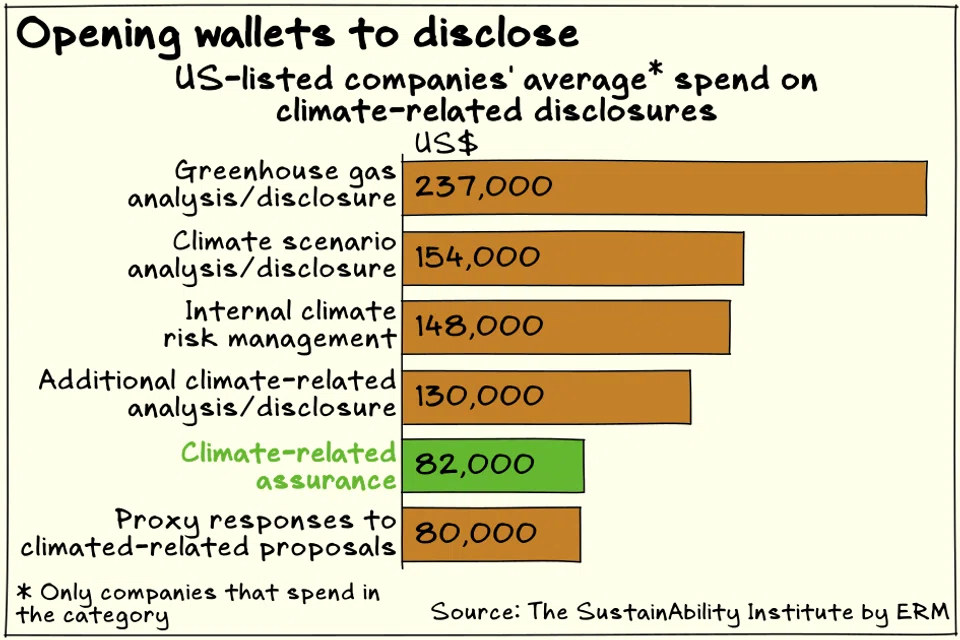
The change is consequential not just because the nature of climate reporting is drastically different from financial accounting, but also because of the requirement to perform external assurance – from fiscal 2027 for listed companies, and FY2029 onwards for large non-listed companies.
At a dialogue session with business and accounting professionals this week, Singapore Sustainability and Environment Minister Grace Fu said some accountants are resistant to the new expectations.
“I was a little bit surprised when I heard from some friends that accountants are fighting this,” she said.
“Accountants are saying: ‘I’m not trained to do this… Why are you giving more work? I already have enough with accounting.’”
Fu’s message to accountants was to embrace the opportunity to enhance their value. If you listened carefully, you might have also heard chief financial officers across the nation mutter under their breaths: “Sure, but who’s going to pay for that extra value?”
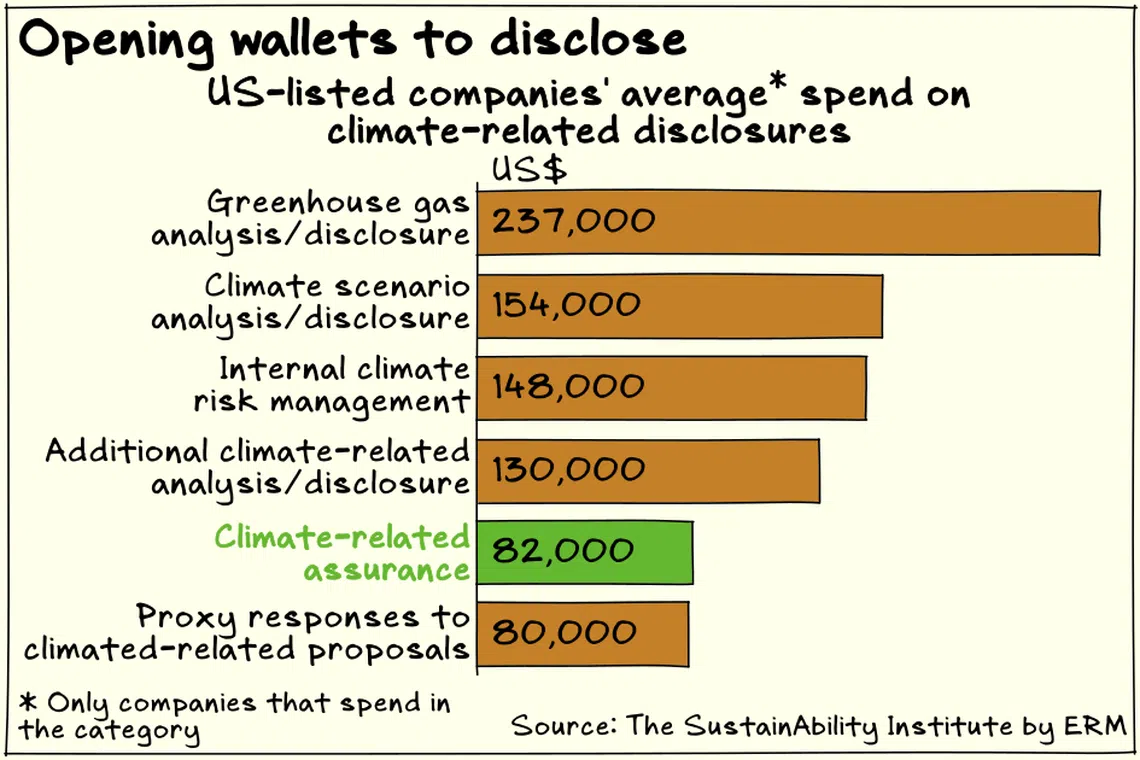
Putting the cost aside, the prospect of mandatory external assurance is understandably causing anxiety among some accountants and auditors.
Some of the challenges have been acknowledged by the Accounting and Corporate Regulatory Authority (Acra) and Singapore Exchange (SGX) in their joint response to the proposed climate reporting changes:
- Supply of climate auditors: The provision of external assurance for climate-related disclosures may be done by “climate auditors”, which have to be registered as audit firms or as testing, inspection and certification (TIC) firms. The regulators accepted suggestions to broaden the pool of climate auditors by allowing consultants, industry-specific certifiers and foreign audit firms to register as audit firms or as TIC firms. The joint response also noted ongoing green skills development initiatives.
- Standards alignment: Singapore will require that assurance be conducted using either of two standards. The first is ISSA 5000, which is being written by the International Standard on Sustainable Assurance (ISSA); and the second is the SS ISO 14064-3 standard, which is identical to one under the international ISO standards. Some feedback through the public consultation was that the ISSA standard was more focused on overarching principles, whereas the SS ISO standard was more prescriptive. The regulators said they will seek to “bridge critical gaps” between the standards.
The climate challenge for the accounting profession goes beyond Singapore, as other jurisdictions also move towards mandatory reporting.
Not surprisingly, one response within companies has been to move sustainability data under the purview of the finance department. It’s telling that when EY contemplated splitting its consultancy and audit arms, the sustainability practice would have stayed with the auditors. Mixing accounting experts and technical subject matter experts, however, can raise new operational challenges for companies as they attempt to integrate different approaches to evidence and data.
There are also foundational questions, such as what exactly constitutes ‘limited’ assurance – the minimum level of assurance that will be required. The ‘reasonable’ assurance required for financial audits is a high level of confidence that the information presented is true and fair, and requires thorough testing of assumptions and controls.
Limited assurance provides a lower level of confidence, but how much lower can be a wide band. In a blog post in February, KPMG global ESG assurance head Mike Shannon wrote about the risk of an “expectation gap”.
“The requirements for limited assurance are quite broad and the assurance provider has some latitude over how much testing they do and at what level of detail,” he said. “Lack of uniformity here could add to the expectation gap.”
Shannon’s proposed solution is that the assurance report for a limited-assurance engagement should provide sufficient information so that a user of the report can obtain a clear understanding of the work and testing done. This would be more detailed than needed in a reasonable-assurance engagement, since in that instance the auditor is already giving assurance that the information is materially correct.
The coming rules on climate reporting might be a big change for the companies that have to obtain external assurance, but there will be quite a transition as well for the ones providing that assurance.
Other Singapore reads
- Share of funding for women-led startups rises, but challenges for equality remain
- Vopak, Air Liquide partner to study ammonia-to-hydrogen infrastructure on Jurong Island
South-east Asia
Methane rises
The world’s already struggling to keep carbon dioxide emissions down; now, it has to worry about methane too?
A report this week by UK-based think tank Ember said that the Indonesian coal mining industry is severely under-reporting methane emissions.
Ember attributed the discrepancy to outdated and inaccurate measurement methods. Indonesia last reported 128 kilotonnes of methane emissions from surface coal-mining activities for 2019. Ember estimated that methane emissions in 2024 could be more than 1,000 kilotonnes.
The report came as the International Energy Agency (IEA) said this week that fossil fuel production and use around the world generated almost 120 million tonnes of methane emissions in 2023.
While methane emissions have fallen in some areas, IEA said “overall emissions remain far too high to meet the world’s climate goals”.
IEA also noted that large methane emissions events detected by satellites increased by more than 50 per cent in 2023, with more than 5 million tonnes detected from major fossil fuel leaks around the world.
Methane is just behind carbon in terms of its contribution to global warming, and countries have begun to pay more attention to this greenhouse gas. At COP28, the 2023 edition of the annual United Nations climate conference, countries made a push for the Global Methane Pledge, which aims to reduce global methane emissions by at least 30 per cent below 2020 levels by 2030.
IEA estimates that US$170 billion of spending by 2030 is required to bring methane emissions by the fossil fuel industry into alignment with the IEA’s net zero scenario.
Other South-east Asia reads
- Sembcorp enters utility-scale solar development in Indonesia through JV with local unit
- Indonesia’s new capital city Nusantara progressing well as efforts to attract foreign investment continue