A chastened Trump after US midterms? Don’t bet on it
Democrats gaining the upper hand will create more friction, but may not alter trajectory of foreign policies
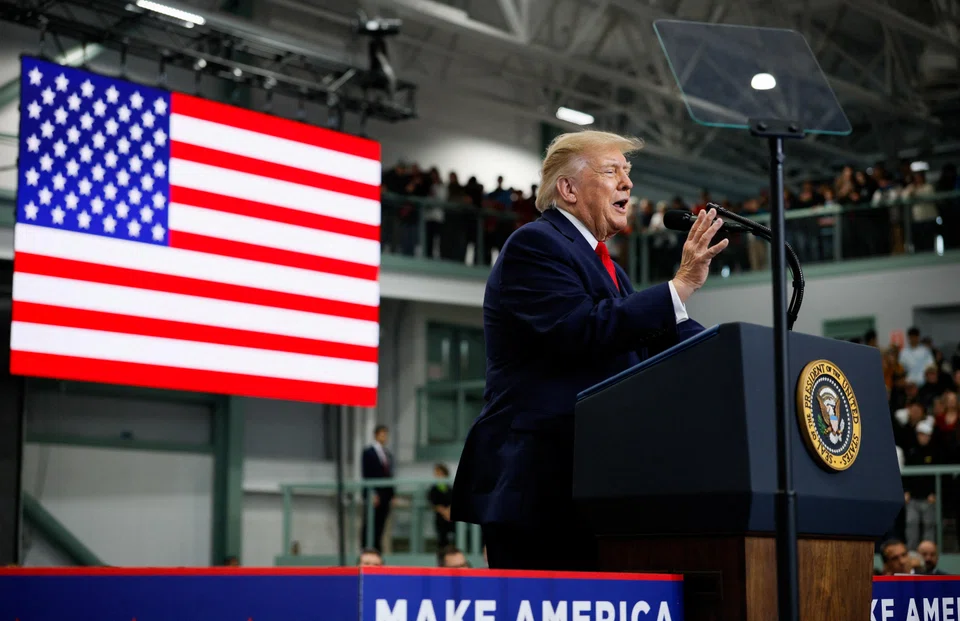
IT’S always surprising how captivating US midterm elections are for people around the world. The elections won’t decide who sits in the White House; that remains a given until 2028.
Yet, strategists around the world debate the finer points of potential wins and losses in various US congressional districts and states, and governments continue to speculate on whether US President Donald Trump will lose control of only the House of Representatives, or whether the opposition Democrats may also capture the US Senate.
Traditionally, foreign policy questions seldom figure highly in the priorities of US voters. Nonetheless, foreign ministries around the world treat Nov 3, the date of the US midterms, as a potential inflexion point.
And for good reason, since this is the first US election in decades in which a war fought abroad is the proximate cause of the domestic economic ills, and the US electorate appears to be pricing this into its decisions.
Lots of thunder, little light
The outgoing US Congress spent two years voting on Trump’s foreign policy adventures, yet never once succeeded in binding the president. This is ironic, since the outgoing 119th Congress leaves behind the most sustained burst of activity on the presidential exercise of foreign and security policies since 1973, at the height of the Vietnam War.
In this outgoing Congress, Senate Democrats forced through more than a dozen votes on the presidency’s war-powers and foreign policy initiatives, and no fewer than 10 such legislative challenges since Trump unleashed the Iran war in February 2026.
The high-water mark in this effort came on Jun 23, when the Senate adopted a House-passed concurrent resolution against the Iran war by 50 votes in favour to 48 against, after four Republican senators crossed the floor and sided with the opposition Democrats. But the White House ignored it, and no consequences followed.
On trade, the pattern of congressional failure is even starker. The two houses of the US Congress tried hard to limit the president’s powers to impose tariffs.
Still, no resolution ever carried the sort of majority that can override a potential presidential veto, and none became law. The Supreme Court did more to hamper Trump’s ability to interfere with trade than all the congressional resolutions put together.

Congress also asserted its exclusive powers to approve budgets; it specified that Trump could not cut US forces in Europe below 76,000 for more than 45 days without certification from Congress and proof that America’s allies were consulted in this procedure. But to no immediate avail: Trump is still planning withdrawals from Europe.
Congress also passed the so-called Graham Act, named after the late senator Lindsey Graham, and mandated tougher sanctions on Russia for its invasion of Ukraine. But the Act preserved sweeping presidential implementation and waiver powers, and on Oct 16, Trump duly waived these sanctions against Russia.
The institutional record is unflattering but clear: Congress’ powers to declare war – enshrined in the US Constitution – survived in the outgoing legislature more as rhetoric than reality. And Congress’ tariff powers – also explicitly mentioned in the Constitution – were affirmed by US Chief Justice John Roberts, not by lawmakers.
Given this abysmal record, why should anyone expect that the next Congress will be more inclined to restrict Trump’s foreign policy adventures?
Two alternative scenarios are currently being discussed by foreign governments, and both are considered equally plausible.
First scenario: Congress in ascendancy
It is always easier for a White House to ignore congressional pressure when both the presidency and the two legislative chambers are held by the same party, as is the case now.
If the House of Representatives were to be taken over by the Democrats – something that most opinion polls now claim is a near-certainty – the power balance will tilt, especially when Trump is in the “lame duck” phase of a president’s last two years in office.
Furthermore, should the Democrats also gain control of the Senate, it will be extremely difficult for Trump to seek confirmation for any new top government nomination.
Where a new Congress can bite hard is on money and on primary legislation, and that is where the midterms acquire genuine international significance.
Consider trade. On Feb 20, the Supreme Court ruled that Trump did not have the power to impose tariffs according to the legislation the White House invoked. The administration moved within hours to use other powers, which permit a temporary surcharge of up to 15 per cent for a maximum of 150 days. Then, it resorted to yet other legal justifications built around alleged forced labour.
The lesson for any government that has signed something with Washington since 2025 is not that tariffs are coming down; it is that nothing agreed with this administration is either durable or predictable.
A Democrat-controlled Congress won’t dismantle this web of US trade legislation, and no one in Brussels, Beijing or Tokyo should imagine otherwise. But what a new Congress will do is make the ratification of any trade settlement impossible before 2029, thereby forcing the Trump administration to find new and increasingly fewer justifications for its actions.
A second potent congressional lever is the National Defense Authorization Act, and it matters most to Europe.
The Pentagon ordered 5,000 troops out of Germany on May 1; a 2nd Armored Brigade Combat Team rotation to Poland was cancelled with equipment already in transit; in June, the number of Nato-committed combat aircraft in Europe was cut from 150 to 100, and every aerial refuelling tanker withdrawn from the continent.
General Alexus Grynkewich, America’s top military commander in Nato, the US-led military alliance in Europe, delivered the first tranche of a six-month US force posture review to Defence Secretary Pete Hegseth on Sep 18, hinting at the withdrawal of up to 40,000 US personnel – the largest drawdown since the Cold War.
Congress has historically constrained exactly such activities, and Republican members of the Senate Armed Services Committee were already on record in May objecting to the German withdrawal and demanding coordination with Congress and allies. This is the one topic where a change in Congress control could plausibly slow the clock.
And then, there is the biggest elephant in the room: the war against Iran.
If hostilities continue when the newly elected Congress convenes in January 2027, a Democrat-controlled legislature will immediately stop any funding for a conflict that is deeply unpopular with US voters, as well as being a burden for any Republican hoping to inherit the presidency from Trump.
Second scenario: The rampaging presidency
Yet, there is also another scenario, which at least at this stage remains equally plausible: that, faced with a hostile Congress, Trump doubles down on his foreign policy adventures because that’s where he continues to enjoy great power.
Far from being restricted by the midterms, a loss at the ballot boxes next week may usher in an untrammelled and even more irresponsible Trump presidency.
Ukraine supplies the clearest illustration of this possibility. Largely because he wishes to escape responsibility for high energy prices, which are the result of his war against Iran, Trump has made his Ukraine policy subordinate to the American pump price.
Trump now claims that Ukrainian attacks on Russian oil refiners are the main drivers of high energy prices. This is pure nonsense.
Still, if the President reads the Nov 3 results as a verdict on the cost of living, the pressure to deliver cheaper energy intensifies rather than abates, and the fastest available route to cheaper energy runs through sanctions relief for Moscow and an awful territorial settlement imposed on Ukraine.
So, a Democratic wave in the midterms does not automatically protect Ukraine; it may well make Kyiv’s position worse.
China presents a similar logical inversion. Trump met China President Xi Jinping in May, and in Washington in September, with further meetings mooted for November and December; the trade truce has been extended only to January 2027.
A Democratic House will demand to know why the US arms package to Taiwan is stalled, what was discussed with Xi about it, and on what authority Nvidia export licensing decisions have been made.
The conventional reading is that a weakened US president will be a more cautious one, on questions such as trade wars with China, or US weapon supplies to Taiwan.
Yet, an equally plausible reading is the reverse: a president with a hostile Congress, two years of lame-duck authority and a legacy to secure has every incentive to seek a deliverable from China, and the only commodity Beijing genuinely wants is a change in American declaratory policy on Taiwan – which costs nothing to deliver in the short term and is precisely the sort of thing a president can do alone.
The same applies to the Europeans. Europe’s expectation that a Democratic-controlled Congress may oppose further US troop withdrawals from the “old continent” is almost certainly exaggerated. For the drawdown is not a Trumpian caprice awaiting correction by a better Congress; it is doctrine shared by many Washington decision-makers.
In short, a Democrat-controlled House will change the tone and the rhetoric at the Munich Security Conference, the annual European security get-together. It may quite possibly also change the pace of the US withdrawal.
Yet, it won’t change the overall direction because the direction has bipartisan intellectual support in Washington, and has had this since former president Barack Obama’s first “pivot”.
Nor should one forget the Democrats’ remarkable ability to shoot themselves in the foot. When they last controlled the House during the first Trump presidency, Democratic lawmakers pushed for two impeachments of the president.
This proved to be a monumental waste of time, and the Democrats are quite capable of repeating the same experience now, with equally disastrous results.
More of the same?
So, what will Nov 3 change for the world? Less than the current media coverage suggests and more than the cynics allow.
The serious answer is that the midterms won’t end the Iran war, restore US aid to Ukraine, reverse the troop drawdown from Germany, or unwind Trump’s love for Russian President Vladimir Putin.
But a power shift to the Democrats will make the next Trump war harder to pay for, the current one more expensive to defend, and the administration’s conduct more thoroughly documented. It will also put a more China-hawkish legislature behind a president pursuing a Chinese trade truce.
And the midterms will probably deliver one more piece of evidence to every capital: that the American political system is so polarised as to become dysfunctional in critical areas.
The only reliable things in American statecraft are that electoral schedules are being observed, and that the next US military adventure is always just around the corner. Middle East capitals have already been told to expect another round of air strikes against Iran soon after the midterm votes are counted. THE STRAITS TIMES
Decoding Asia newsletter: your guide to navigating Asia in a new global order. Sign up here to get Decoding Asia newsletter. Delivered to your inbox. Free.
Share with us your feedback on BT's products and services