Singapore’s S$2.32 billion ‘haze bill’: Can prevention cost less?
The sheer scale of damage strengthens the case for funding prevention alongside tougher penalties
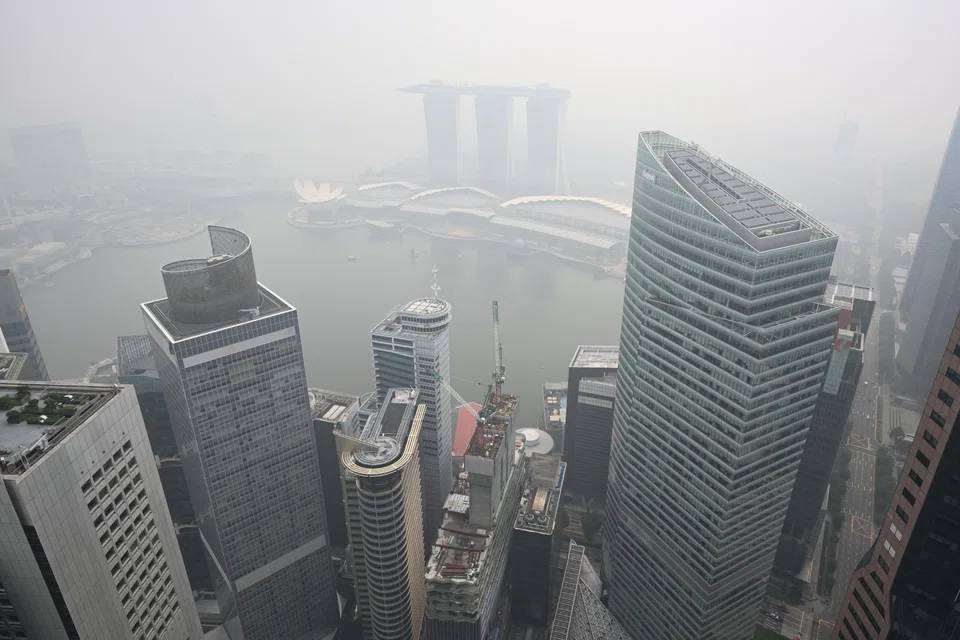
A TOUGHER haze law raises the price of polluting.
Measuring the damage should guide action and help Singapore decide what else is worth doing. Understanding which parts of the economy and society bear the costs, and to what extent, helps us target protection and plan adaptations.
Singapore should also use this evidence to pursue cost-sharing with Indonesia and other affected countries to prevent burning at its source.
Our preliminary estimate puts Singapore’s haze burden through Oct 31 at S$2.32 billion at September 2026 prices.
The sheer scale of this damage strengthens the case for funding prevention alongside tougher penalties.
On the enforcement side, Parliament passed amendments to the Transboundary Haze Pollution Act on Nov 4. These provide for fines of up to S$1 million a day, up from S$100,000, for causing or contributing to fires that risk bringing haze to Singapore. Those fines are capped at S$20 million.
Businesses must face consequences for imposing harm on others. This is the polluter-pays principle: Those responsible should bear the costs of preventing and addressing pollution, rather than leaving households, workers and other businesses to absorb the damage.
A complementary measure is for affected countries to help finance prevention.
If supporting fire-free practices costs less than the damage avoided, contributing can leave these countries better off. This “victim-pays” approach complements enforcement while preserving polluters’ responsibility.
Each proposal still requires a thorough cost-benefit analysis: comparing the damage it can realistically prevent with its full costs, testing uncertain assumptions and weighing alternative uses of public funds.
Measuring haze losses provides a starting point for these decisions.
Why penalties need a partner
A large fine deters only if an offender believes there is a real chance of being held accountable.
For haze originating abroad, investigators need evidence from other countries and must establish responsibility, sometimes through layers of companies and suppliers.
Minister for Sustainability and the Environment Grace Fu acknowledged these constraints in Parliament. Four investigations arising from the 2015 haze remain open.
The amendments strengthen evidence-gathering powers and allow restrictions on business dealings, but as Fu stressed, legislation alone cannot solve the problem.
The law can help prevent fires by changing what businesses stand to lose. Financial assistance can work alongside it by making alternatives to burning more affordable.
Even a successful prosecution cannot restore a worker’s lost time or a child’s illness-free days. The case for preventing that harm deserves attention too.
The 2026 haze bill
Haze exacts a toll that no air-quality reading can capture. We update the 2015 estimates with newer pollution, population, health and economic figures.
The total includes spending on treatment and protection, lost business and time as well as the value people place on avoiding harm. Lost well-being also affects national productivity and justifies tangible public spending on prevention.
For the 2015 haze, Euston Quah and Chia Wai Mun from Nanyang Technological University and Tan Tsiat Siong from the Singapore University of Social Sciences estimated costs of S$1.83 billion, equivalent to S$2.23 billion in September 2026 prices.
Our estimate for the 2026 haze is about 4 per cent higher at S$2.32 billion.
“Measuring haze damage helps Singapore decide where action could make the greatest difference.”
Dividing these bills by the number of qualifying days (70 in 2015; 53 in 2026) gives an average cost of S$31.8 million a day in 2015 and S$43.7 million in 2026, both in September 2026 prices.
The estimated cost for 2026 is higher than for 2015 – in spite of fewer hazy days and lower average Pollution Standards Index (PSI) readings (101.93 in 2026; 108 in 2015).
A larger population, higher incomes and visitor spending help explain the difference. Updated health data and assumptions matter too.
Breaking down the S$2.32 billion
Health remains the largest burden1: about S$1.03 billion this year, compared with S$986.36 million in 2015.
Treatment bills capture only part of this. People also value reducing their risk of illness and premature death.
The effects on businesses are visible too. In Parliament on Nov 3, Member of Parliament Charlene Chen raised concerns about hawkers’ earnings. The government acknowledged reduced footfall at hawker centres and markets, while noting that takeaway orders often offset some of the decline.
This matters for policy: Support should reflect losses after allowing for how businesses adapt.
Tourism shows how losses can spread beyond the businesses first affected. We estimate S$221.62 million in direct tourism losses2 and S$198.57 million in additional business losses3, against S$199.36 million and S$193.38 million, respectively, in 2015.
Each dollar of lost visitor spending results in roughly another 90 cents of lost output elsewhere. For example, a hotel with fewer bookings may order less from local suppliers and laundries. Workers earning less may spend less at neighbourhood shops.
Illness also takes away time – at work and outside it. We estimate this loss4 at S$254.66 million, down from S$322.49 million in 2015. Fewer hazy days and lower pollution outweigh higher earnings and population growth in this calculation.
Protection costs5 fall from S$81.65 million to S$74.86 million. Although it is the smallest component of the haze bill, it plays an important protective role. Masks, air filtration and public responses safeguard health, productivity and well-being.
Finally, cleaner air lets people enjoy life outdoors. We value lost well-being6 at S$539.91 million, up from S$442.69 million in 2015, drawing on an earlier survey asking how much people would pay for cleaner air.
Together, these estimates identify what prevention could protect and where support may be needed, from safer working arrangements to help for vulnerable residents.
Make prevention worthwhile across borders
For a farmer, burning can be the cheapest available way to clear land. Financial support could provide equipment, shared land-clearing services, training and maintenance, tied to verified fire-free practices.
The arrangement becomes win-win when switching makes financial sense for farmers and affected countries avoid losses greater than their contributions.
Indonesia benefits too: Communities closest to the fires suffer damage to health and livelihoods. Prevention serves shared interests across borders.
Cooperation is already under way. Singapore and Indonesia have established a . This cooperation could help identify prevention projects and assess their results.
A regional fund could share costs among Singapore, Indonesia and other affected countries, with contributions reflecting expected benefits and agreed responsibilities.
Without an agreement, each may wait for others to pay, leaving worthwhile projects unfunded.
Pay for results, preserve accountability
Asking victims to contribute raises concerns about fairness.
Public money should fund measurable reductions in fire risk. It should not pay fines, excuse illegal burning or reward threats to pollute. Farmers already using responsible practices should be eligible for support to sustain them.
Large plantation companies and buyers should contribute their own resources. Public assistance should address gaps, such as equipment access for smallholders, rather than finance obligations businesses should already fulfil.
Projects need transparent accounts and independent monitoring. Fewer fires in wetter weather would not, by themselves, prove that a project worked.
Governments should compare their full costs, from equipment and maintenance to checking results, with the losses they can realistically prevent over their lifetimes.
A S$2.32 billion haze bill does not automatically justify a S$2.32 billion prevention budget. Funding could be released in stages against verified results, with support withdrawn if commitments are breached.
Measuring haze damage helps Singapore decide where action could make the greatest difference.
Enforcement makes irresponsible conduct more costly while well-designed assistance makes cleaner practices more attainable.
Both should serve the same purpose: fewer illnesses, livelihoods protected and more ordinary days undisturbed by smoke.
We already pay for haze; prevention offers a chance to pay less.
Euston Quah, president of the Economic Society of Singapore (ESS), is the Albert Winsemius chair professor of economics and director of the Economic Growth Centre at Nanyang Technological University. Eugene Or, honorary assistant secretary of ESS, is a lecturer at the Singapore University of Social Sciences.
Notes: 1. Based on published estimates of how pollution affects illness and death, together with updated population and health data. 2. Calculated from the estimated loss of visitors and Singapore Tourism Board’s spending data. 3. Derived from the output multiplier of about 1.9, estimated from Singapore Department of Statistics tables and visitor spending patterns. 4. Earnings are used to value the estimated days affected; a lower value is assigned to time outside work. 5. Updated historical spending for prices and household numbers, then adjusted for the shorter episode. 6. Updated for population, prices and income.