

Three tests after the Trump-Xi-Putin meeting
The Shenzhen summit has created a format, not a result. Whether that brings change the world will soon know
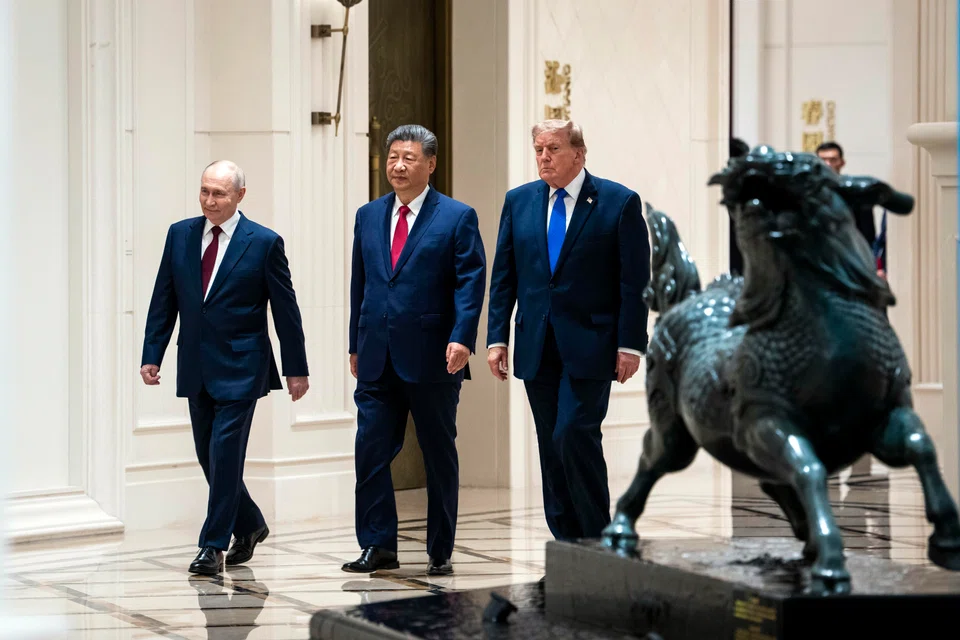
THE first meeting of the American, Chinese and Russian presidents produced a photograph and a thin declaration. The next six weeks will show whether it produced anything more.
When Donald Trump, Xi Jinping and Vladimir Putin met at Kylin Villa in Shenzhen on Nov 19 (Thursday), on the sidelines of the Asia-Pacific Economic Cooperation summit, the main achievement was getting all three into the same room.
The talks lasted about 90 minutes. The four-point “Declaration towards peace” that followed sets no figures, timetables or mechanisms, and it does not mention Ukraine or Iran. Trump rated the meeting “12 out of 10”. German Chancellor Friedrich Merz called it a “photo op”.
Both verdicts come too early. Shenzhen created a format, not a result, and what matters now is whether the format leads to anything. Three tests are coming and one clause in the declaration will matter whichever way they go.
Test one: Does the nuclear dialogue become a process?
The declaration’s strongest point on paper is its commitment to a dialogue on reducing nuclear risks and preventing proliferation.
Against the background, that is not nothing. The last major US-Russia arms control framework has lapsed, and China has so far refused any trilateral process. In arms control, getting the parties into one process has often been the hardest step.
Still, the wording is modest. The declaration promises dialogue, not negotiations, and certainly not reductions.
Xi did not commit Beijing to the three-way arms reduction talks Trump has long pressed for.
In the coming weeks, watch for a date, a venue and named negotiators. If none of them appears, the pledge will end up like similar ones before it: a sentence in a communique and nothing more.
Test two: Does Ukraine policy move, with Kyiv at the table?
Ukraine is not in the declaration but it was in the room. Putin said the leaders discussed it.
Kyiv had worried for weeks that the Shenzhen summit could become a place to settle its future without it. Those fears only grew after the Nov 10 to 11 US-mediated Russia-Ukraine talks in Abu Dhabi, where European officials were kept away from the main table.
The early signals point in different directions.
Putin said that Ukraine and Europe were “not ready” to compromise, which suggested that the Kremlin saw no reason to soften its demands.
The US envoy Jared Kushner has said that Trump will relay Europe’s support for Ukraine to Moscow, and that Putin is “comfortable” with Nato-like security guarantees for Ukraine.
If that happens, Shenzhen could look better in hindsight than it does today.
The test is not only whether Ukraine policy moves but who is present when it does. European leaders, meeting in Berlin as the “Coalition of the Willing” on the day of the Shenzhen summit, repeated that nothing about Ukraine should be decided without Ukraine.
Merz warned that a “Yalta format” cannot bring peace. The comparison can be overdone. Nobody redrew maps in Shenzhen, and China has little interest in being seen to carve up Europe.
The worry behind it, however, is real: that the biggest powers are coming to treat smaller states’ fates as items for their own bargaining.
Whether Kyiv and European governments take part in the next round will show whether that anxiety was justified.
Test three: What happens in Miami?
The G20 meets in Miami in December, and Trump has invited Putin despite the International Criminal Court (ICC) warrant and European objections.
If the three leaders meet again there, Shenzhen will look like the start of an informal “G3”, a standing channel among the three biggest nuclear powers outside existing institutions. If they do not, it will look like a one-off.
In Washington, nine Democratic senators have already warned that American security should not be traded for photo opportunities.
A second trilateral meeting would make that argument harder to avoid, in both directions.
The format would either need to show results or face being judged as staging.
The clause that will outlast the summit
Whatever happens with these tests, one part of the declaration is already having an effect: its call to respect the immunity of state officials from the ICC and similar bodies.
None of the three countries is a member of the ICC, and each has its own grievance against it.
Washington has sanctioned the court over its investigations and its warrant for Israel’s prime minister. Beijing rejects efforts to bring cases over Xinjiang. Putin himself is under an ICC warrant over the deportation of Ukrainian children.
When three permanent members of the United Nations Security Council jointly tell international courts not to “abuse their positions”, they are signalling how far accountability can reach the powerful.
That signal will be heard well beyond Shenzhen, including in capitals deciding whether to cooperate with the court in future.
Miami will be the first place it is tested: an indicted leader welcomed at a G20 summit, with a three-power declaration behind him.
Unlike the nuclear dialogue, this part of the declaration does not need follow-up meetings to have effect. It only needs governments to act on it.
The clock keeps ticking
Each leader got what he came for.
Xi presented China as the convener of great powers. Putin got an equal place beside Washington and Beijing. Trump got the history-making summit he had been floating since early in his second term.
Those gains are already secured, and none of them depends on what happens next.
The rest of the world’s stake is different. Leader-level contact among the three can lower the risk of miscalculation at a time of two hot wars and deep US-China rivalry.
Trump argues that no peace was ever forged by declining opportunities to engage. The next month and a half will show whether Shenzhen was the start of real engagement or only a photo opportunity.






