

How will the world change after the China-US-Russia summit?
The meeting installed a ‘shock absorber’ in the global economy rather than fit it with a new growth engine
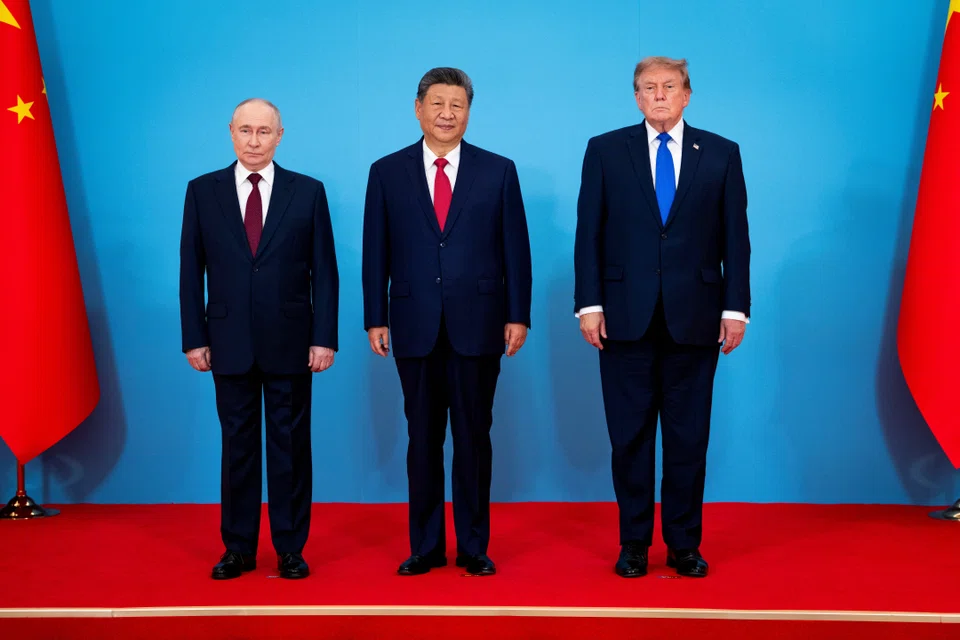
ON NOV 19, China, the US and Russia held their first-ever trilateral summit in Shenzhen. The meeting was undoubtedly of considerable geopolitical significance.
Leaders of three countries with enormous influence on international affairs, yet profound strategic differences, had finally sat down at the same table.
Afterwards, Presidents Xi Jinping, Donald Trump and Vladimir Putin issued a joint peace declaration, pledging to safeguard world peace and promote strategic stability among major powers.
They agreed that “nuclear war cannot be won and must never be fought”.
The Shenzhen summit has inevitably invited comparisons with the 1945 Yalta Conference, where the leaders of the US, Britain and then-Soviet Union discussed the post-war international order.
However, the two meetings took place in fundamentally different geopolitical circumstances and carried very different historical implications.
At Yalta, the three powers were wartime allies fighting against fascism, and their discussions involved shaping the post-war order and determining spheres of influence.
That arrangement reflected the reality of great-power dominance over smaller countries.
Today’s China, US and Russia, by contrast, have no comparable alliance foundation. Instead, they face deep strategic disagreements.
China has consistently emphasised the interests and representation of the Global South, arguing that international affairs should not be determined by a handful of major powers.
It would therefore be misleading to interpret the Shenzhen summit as a new Yalta-style arrangement for dividing the world.
Is a new pattern of relations emerging?
Rather, Shenzhen’s significance lies in establishing a channel for major-power communication and managing differences in an increasingly interconnected world.
The summit’s greatest achievement may not be any sudden resolution of conflicts, but the common signal that strategic competition must not spiral out of control.
Competition between China and the US in technology, trade and industry will continue, as will the tensions between Russia and the West.
Yet, all three powers share certain interests, including preventing military conflicts, reducing nuclear risks and maintaining stable energy supplies.
The world may therefore be witnessing the emergence of a new pattern in relations among major powers, where competition will be long term, cooperation selective, and strategic stability a public good that all sides need.
For the global economy, the Shenzhen summit’s immediate outcomes may be limited. It has reduced the likelihood of worst-case scenarios – much like installing a “shock absorber” in the global economy rather than fitting it with a new growth engine.
Asian countries are watching
For Asia, this shock absorber matters particularly.
Asian businesses increasingly have to consider geopolitical risks alongside costs, markets and technology when making investment decisions.
Tariffs, export controls and tensions among major powers can raise financing costs, delay investment and disrupt supply chains.
If the Shenzhen summit leads to sustained channels of communication, it could improve the long-term investment outlook – particularly for infrastructure, energy, advanced manufacturing and cross-border logistics.
Stable energy supplies are particularly important to energy-importing Asian economies. If better coordination among major powers could translate to a more predictable external energy environment, it would be an ideal outcome.
More importantly, the summit could create greater room for Asean to exercise strategic autonomy.
More stable relations among major powers would help Asean maintain its openness and flexibility in international economic engagement.
Amid growing US-China competition, Asean countries do not want to be forced to choose sides or lose access to the markets, capital and technology of either power.
However, Asean should not assume that improved communication among major powers will automatically remove geopolitical risks.
Implications for Asean
The region’s strategic autonomy will ultimately depend on strengthening its own economic capabilities, industrial capacity and institutional competitiveness.
This is particularly relevant to the changing nature of China-Asean economic relations, where cooperation is moving beyond trade in consumer goods towards deeper integration of industrial supply chains and productive capacity.
Chinese investment, machinery, technology and industrial intermediate goods are increasingly supporting the development of manufacturing industries in Asean.
This offers regional economies opportunities to upgrade their industrial capabilities and move into higher-value segments of global production networks.
Yet, deeper Asean-China integration also brings new challenges.
If Asean manufacturers rely heavily on the US market while using Chinese industrial inputs, their exports could face greater exposure to US tariffs, rules-of-origin scrutiny and trade restrictions.
Asean countries should therefore continue to diversify their export markets, to include China, the 15 signatory countries of the Regional Comprehensive Economic Partnership and other Global South economies.
Technology competition presents another challenge, especially as artificial intelligence has become a focal point of US-China strategic rivalry.
US restrictions on advanced semiconductors and computing capabilities could affect Chinese companies’ investments in data centres and AI infrastructure in South-east Asia.
Asean should pursue a diversified, open and rules-based AI ecosystem, moving beyond the construction of computing infrastructure towards developing practical AI applications and regional digital cooperation.
From a broader perspective, Asia as a whole has the opportunity to become an important organiser of a new form of globalisation, one that seeks a new balance between security, efficiency and resilience.
Asia can play a greater role in connecting production capabilities, technology and markets across borders.
Of course, Trump, Xi and Putin cannot determine the future of the world economy at a single summit.
What matters now is whether they can sustain high-level communication and translate political declarations into practical cooperation.
For Asia and Asean, perhaps the summit’s greatest value lies in their willingness to prevent differences from escalating into confrontation.
In an uncertain world, sometimes preventing a crisis is an economic achievement.
The writer is an associate professor at the Lee Kuan Yew School of Public Policy at the National University of Singapore






