Making room for co-living in Singapore as investors commit, demand broadens
The Republic should create clearer pathways for conversion and development
[SINGAPORE] Home ownership has long been the cornerstone of Singapore’s housing model, with nine in 10 resident households owning the homes they live in.
Against this backdrop, the emergence of a viable housing format built on shorter leases would have been less obvious a decade ago.
Yet, co-living has grown rapidly over the past five years, evolving from a niche accommodation concept into an increasingly visible segment of the country’s housing landscape.
The potential of this demand was amplified when construction delays and border disruptions hit during the pandemic. The reopening further fuelled a rapid recovery in international mobility, and rental market conditions tightened, as demand rose in multiple tenant groups.
Between 2022 and 2023, the private residential rental index of the Urban Redevelopment Authority (URA) spiked sharply, which at its peak rose by over 40 per cent.
Direct acquisitions of co-living assets climbed as operators sought to scale their portfolios, while a number of transactions for operating platforms, such as Mitsubishi Estate’s buyout of Habyt, also emerged.
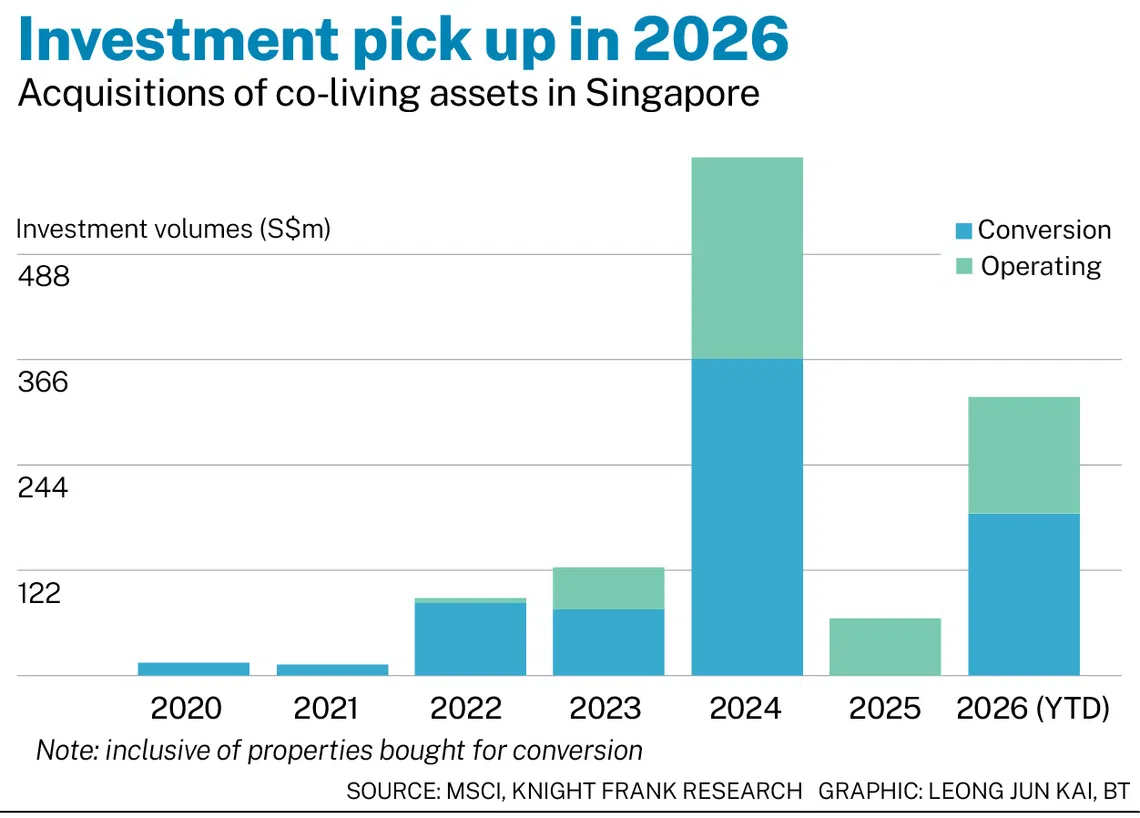
Although deal volumes softened in 2025 amid a tightening supply of investable assets, conversion opportunities have revived activity in 2026.
In August 2026, CapitaLand Ascott Trust’s proposed S$134 million acquisition and leaseback of the 212-room Coliwoo Midtown offered a further sign of the sector’s growing institutional appeal.
Demand broadening beyond expats and students
The sector has continued to expand, even after rental market conditions began to normalise, suggesting that demand was supported by longer-term structural drivers rather than a temporary spurt.
SEE ALSO



While the surge in rental costs has made the sector more viable, its durability extends beyond operating margins.
Several factors have expanded the demand for flexible housing solutions in Singapore.
International student enrolments continued to grow, while Singapore’s international workforce has remained sizeable, with more than 200,000 Employment Pass holders.
The demand base is also broadening beyond the traditional expatriate and student segments.
A growing number of local residents are choosing to rent during different life stages, be it while waiting for a new home to be completed, to be closer to workplaces or to gain greater independence.
At the same time, trends in household formation have shifted. Single-person households now account for nearly one in six resident households. Notably, much of the rise recorded between 1980 and 2015 was repeated in just the last decade.
As more people choose to live alone, demand for smaller and more flexible housing options is likely to increase. In this respect, co-living makes sense, as the presence of a community and ready amenities can make compact living more appealing.
With the demand profile of renters becoming increasingly diverse, a rental stock predominantly made up of housing developed for ownership is unlikely to be an optimal solution.
An estimated 9,000 to 10,000 co-living keys are now operating on the island, while sustained investment interest signals its growing presence within Singapore’s housing market.
Living, not just lodging
The growth of co-living indicates a broader shift in how housing is being consumed, as changing lifestyles and the way people live, work and play have contributed to a larger pool of renters.
For these groups, location, lease flexibility and ease of move-in can carry significant weight in housing decisions. These preferences align closely with the services typically offered by co-living operators.
Room rentals for co-living and private condominiums with similar attributes are generally competitive.
Headline co-living rents can be higher than conventional room rentals, but the comparison narrows once furnishings, utilities, connectivity, cleaning and shorter lease commitments are taken into account.
For anyone with shorter accommodation horizons, not having to navigate the intricacies of getting your own Wi-Fi and electricity is a big bonus.
The segment’s appeal also lies in its ability to serve multiple tenant groups through a single platform.
Each tenant group may have different housing requirements, but the preference for flexibility and convenience in a professionally managed living environment is widely shared in these groups.
This also allows operators to tap into several sources of demand, rather than relying on a single tenant profile.
Increasingly, co-living is finding its way into larger mixed-use developments alongside retail, co-working and other lifestyle amenities.
From integrated live-work concepts on Orchard Road to resort-style accommodation, co-living is increasingly being reimagined as a lifestyle offering, not just a housing solution.
This suggests a maturing sector that has moved beyond establishing viability, towards developing a differentiated product line with broader appeal.
This shift is further highlighted by the government’s recent policy adjustments.
At the National Day Rally (NDR) 2026, Prime Minister Lawrence Wong announced a major reset in public housing, raising the monthly income ceilings for Build-To-Order flats and executive condominiums to S$16,000 and S$18,000, respectively, alongside increased ballot priority for young families.
While this aggressive expansion of the public safety net ensures that subsidised home ownership remains attainable for the domestic core, the NDR left private rental dynamics and immediate alternative options for singles untouched.
By focusing heavily on the traditional family-centric home ownership model, state policy leaves a clear structural gap for non-traditional, transitional and single-person households.
Far from being a temporary post-pandemic fad, institutional co-living is firmly positioning itself as a necessary, market-driven pressure valve that addresses the exact segments of Singapore’s evolving demographic narrative that public policy has yet to fully capture.
A broader housing continuum
Conscious of the steep run-up in rents amid tight market conditions, the government has actively sought to increase rental alternatives.
Aside from higher occupancy caps for larger Housing & Development Board flats and private residential properties, the introduction of the Serviced Apartments II (SA2) framework in 2023 also established a clear housing format that sits between traditional residential and hospitality uses.
While SA2 is fundamentally a new housing typology and development framework designed for purpose-built rental accommodation, co-living, in contrast, has largely emerged as an operating platform.
As such, it remains important to recognise that co-living is and should be viewed as part of a broader housing continuum, alongside conventional private rentals.
Much of the sector’s demand stems from the transitional nature of its tenants, who may eventually gravitate towards options that offer greater autonomy, privacy and control over their living environment.
Relative to conventional rentals, a higher tenant turnover is inherent to the co-living model.
Sustained demand will thus require the continual replenishment of its tenant base, supported by Singapore’s continued appeal as a global city.
Co-living comes of age
Still, what is clear is that the sector has matured and is attracting investment commitments.
A growing track record of operating performance, an expanding occupier base and policy initiatives, such as youth independent-living pilots, have strengthened the sector’s investment case.
The sector has also demonstrated that growth can be achieved through the repositioning of existing assets.
By converting and adapting underutilised buildings, operators have been able to scale in a land-constrained market. This has broadened the range of opportunities available to investors, from direct asset acquisitions and conversions to leasing heritage developments.
This is particularly relevant in the current higher interest rate environment, as co-living offers multiple avenues for value creation, from asset repositioning and adaptive reuse to operational execution.
As prospects for further yield compression narrow, these characteristics are becoming increasingly important drivers of returns.
Underlying these opportunities is a larger and more diversified tenant base, which is indicative of the sector’s strengthening demand fundamentals.
The continued gap between existing supply and addressable demand, which refers to the pool of occupiers that could be accommodated by institutional-grade or professionally managed co-living assets, further highlights the scope for continued expansion.
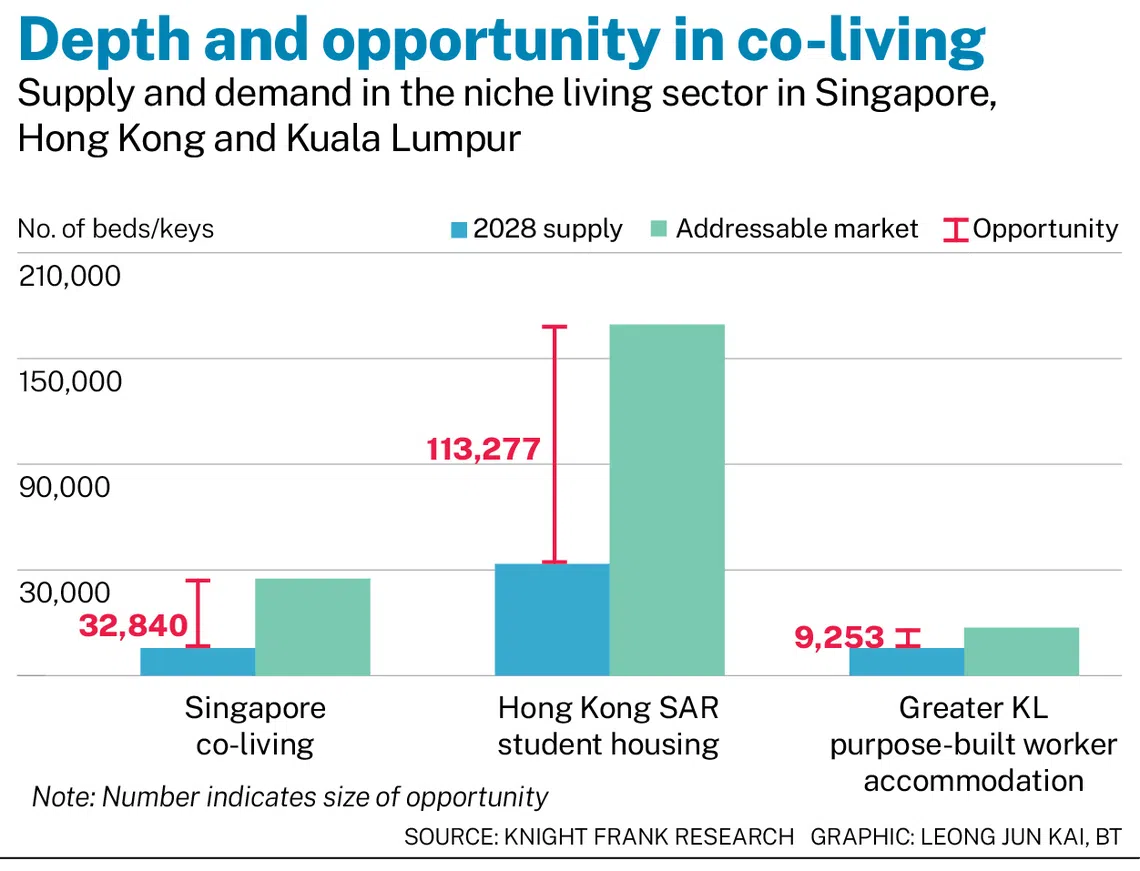
Based on the size and income profile of key renter groups, Knight Frank estimated that Singapore’s addressable demand for co-living will reach about 45,840 keys by 2028.
With total co-living keys likely to increase by just about 3,000 to 4,000 in the same period, a market gap of 32,840 keys remains.
As occupier needs become more varied and rental demand increasingly extends beyond traditional leasing models, co-living is assuming a more prominent role within the residential landscape.
For investors, the sector offers exposure to these changing housing dynamics through an asset class that is moving beyond its niche origins.
Singapore should now recognise professionally managed rental housing as a deliberate part of its broader housing and talent strategy.
Policymakers can create clearer pathways for converting suitable buildings and developing purpose-built rental accommodation.
Owners, operators and investors, in turn, must demonstrate that the model can also deliver quality, transparency and a consistently good living experience, not simply more rooms.
The choice is not between co-living and homeownership. It is whether Singapore’s housing system can offer enough flexibility between them.
Making room for co-living would help close that gap, and ensure that housing options continue to evolve with the people and economy they seek to attract and support.
The winners will not simply be those that add the most rooms, but also those that combine the right locations with disciplined operations and a consistently good resident experience.
The writer is the head of research, Asia-Pacific at Knight Frank
Decoding Asia newsletter: your guide to navigating Asia in a new global order. Sign up here to get Decoding Asia newsletter. Delivered to your inbox. Free.
Share with us your feedback on BT's products and services