

Data centre, logistics boom could further whet investor appetite
Investments in Apac industrial real estate climbed 50% in Jan to Nov 2021, and are expected to keep growing

Singapore
LOGISTICS assets and data centres in the Asia-Pacific (Apac) region are expected to become even more coveted by property investors next year amid increasing capital flows and optimism.
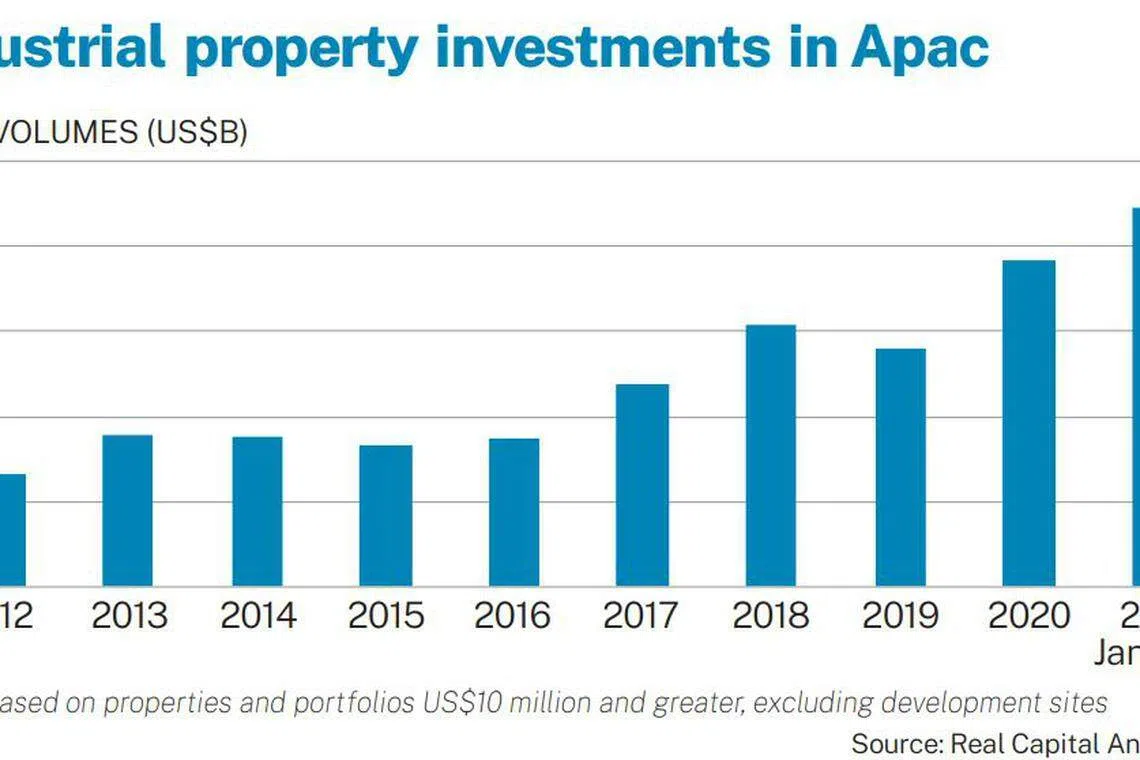
Real Capital Analytics (RCA) data showed that investments in the region's industrial real estate - for deals of at least US$10 million - amounted to US$44.59 billion this January to November, climbing about 50 per cent from the same period in 2020.
The latest tally was also an 83 per cent surge from the US$24.31 billion seen in the first 11 months of 2019, and has far exceeded annual volumes in the past decade.
Ralf Wessel, managing director of fund management at Singapore-based warehouse giant GLP, highlighted that rising inflation concerns are in part driving capital flows for long-term exposure to high-quality, core assets.
Institutional investors generally remain under-allocated in industrial real estate, and GLP thinks the weightings will continue to rise - especially as investors reallocate to logistics and away from retail and hospitality, and as the expansion of the digital economy fuels demand for data centres.
On the logistics front, Wessel noted that the pandemic has accelerated people's use of and reliance on e-commerce, which requires 3 times the logistics space of traditional storefronts. Every US$1 billion increase in online sales translates to a need for an additional 1 million square feet of warehouse space, he added.
In 2022, GLP will expand its businesses and investments across all its core markets, including China, Japan, India and Vietnam. "All over the world, companies are rethinking their supply chains and the resilience of their operations, which is driving demand for highly functional, modern warehouse space," Wessel said.
Stuart Mercier, managing director and head of Asia at Brookfield Asset Management, also pointed to an "insatiable" appetite for high-quality logistics and last-mile fulfilment amid an irreversible shift in buying habits: "For example, it was only due to the stay-home requirements of the pandemic that older households in Japan began to shop for fresh food and groceries online. Now that they've discovered the convenience, there's no going back." That has led to booming demand for cold-storage fulfilment centres, he added.
A recent Colliers survey of more than 300 global property investors found that industrial and logistics (I&L) properties are now the most sought-after, overtaking the office sector. About 7 in 10 of the respondents said they would favour I&L investments in Apac in 2022.
In terms of risk profile, the focus on I&L remains on core and core-plus assets, but investors are also increasingly eyeing development opportunities, Colliers noted. More than half of those keen on the I&L sector are planning to explore that category next year, particularly in the big-box or last-mile distribution segments, which are closely tied to e-commerce trends.
Cushman & Wakefield (C&W) wrote in a December 2021 report that South-east Asia could be at an advantage given its geographical connectivity, which is key to logistics. This will be supported by South-east Asia's low-cost base and increasing maturity. The firm added: "Some manufacturers have already begun expanding their operations in these markets to help diversify production."
More advanced markets, meanwhile, will benefit from companies' reshoring of major "mission-critical" elements of the supply chain.
As for data centres, C&W anticipates demand to continue intensifying throughout 2022, given that a massive 750 megawatts of assets are under construction in the 5 large markets of Sydney, Hong Kong, Singapore, Tokyo and Jakarta. Secondary locations such as Osaka and Melbourne are also seeing sustained growth.
Furthermore, the demand for capacity and undersea cable access is causing new areas to gain traction for the first time, such as the mid-Pacific island of Guam, the Indonesian island of Batam, and the town of Darwin in the Northern Territory of Australia, C&W said.
Sustainability is expected to be a growing focus for data centres, with new cooling methods required for the increase in rack density and as key clients double down on carbon-neutrality goals.
GLP's Wessel said: "Given the amount of energy data centres consume, solar and renewable energy is incredibly important to ensure they are as efficient as possible."
But while ample capital has flowed in, the challenge lies in creating the right product and being able to deploy the capital into the right opportunities.
Wessel stressed the importance of discipline: "In an environment where everyone is chasing the same thing at the same time, without prudence and investment discipline, shortcuts may be made and the risk of mistakes increases."
In a similar vein, Mercier from Brookfield noted that some investors may underestimate the need for local knowledge and expertise, even as logistics assets and data centres clearly benefit from strong tenant demand.
A logistics warehouse, for instance, will be significantly less valuable if the truck ramps are not wide enough or floors not flat enough to support robotics. Similarly, data centres have their own set of characteristics that can result in 2 assets in the same location having widely differing appeal to end-users. "There is certainly the risk that some capital thinks of these asset classes as a beta trade when, in reality, experience matters," Mercier said.
Meanwhile, law firm Morrison & Foerster expects to see continued robust transaction advisory demand in the industrial real estate space. Logistics and data-centre investments will continue to stand out, after having been a major driver of investment activity over the last 12 to 18 months.
Shirin Tang, managing partner of Morrison & Foerster's Singapore office, told The Business Times that fast-growth markets in South-east Asia, China and India could woo further interest.
"This is especially as asset owners look further afield to find attractively priced opportunities in emerging economies and tier 2 cities beyond primary metropolitan areas", she said. Those markets have been a hotbed for opportunities, due to the shifting of complex supply chains, booming e-commerce sectors, and a structural undersupply of these assets.
READ MORE:
- Office, retail, industrial properties underpin Asia-Pacific investment bonanza
- Big-ticket industrial property sales in Singapore nearly double to S$4 billion
- Overseas offices, industrial properties dominate S-Reits' acquisitions
- Warehouse giant GLP sees frothy valuations in certain logistics assets
- PGIM eyes Singapore, Tokyo offices and China logistics for APAC value-add fund
- Singapore industrial real estate: Going strong
TRENDING NOW
8 public officers referred to police over property buys near unannounced MRT stations: Chan Chun Sing
DBS tops trades in smaller board lots on debut of revised SGX framework

Grab CEO’s wife Chloe Tong on life with Anthony Tan and finding her purpose
Retrenched PMETs who return on lower pay see median 25% wage cut

