Overseas offices, industrial properties dominate S-Reits' acquisitions
About two-thirds of office investments last year went to UK and US properties; logistics properties and data centres dominated S-Reits' purchases in first 9 months of this year

Singapore
DESPITE pandemic headwinds, Singapore-listed real estate investment trusts (S-Reits) have continued to scoop up high-quality assets, with a focus on office properties and data centres located abroad.
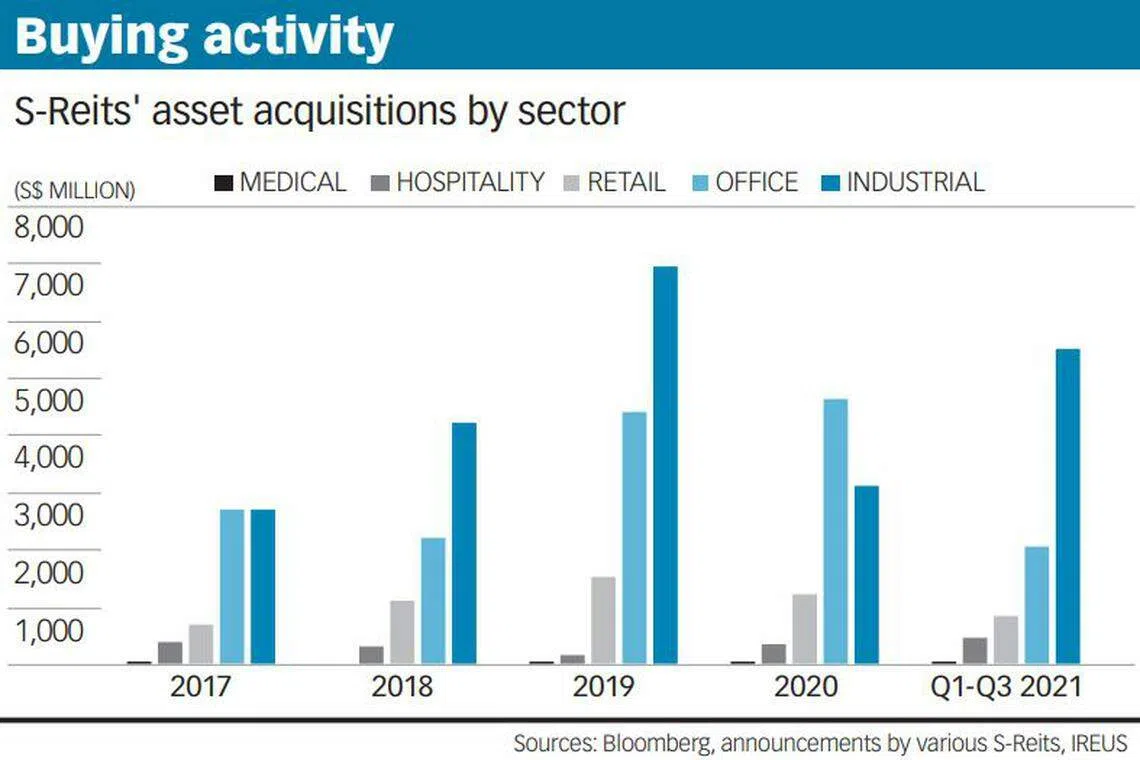
They made some S$8.9 billion in property investments in the first 3 quarters of 2021, close to the S$9.4 billion injected during the whole of 2020, according to the Institute of Real Estate and Urban Studies' (IREUS) analysis of data from Bloomberg and S-Reits' announcements.
Last year's total was lower than the S$13.1 billion in 2019, given the significant uncertainty in real estate markets amid the Covid-19 pandemic. Still, asset acquisitions in 2020 were "considerably higher" than the levels of investment activity in 2017 and 2018, IREUS noted.
The research institute excluded from its analysis, figures relating to S-Reits' mergers, such as the combination of CapitaLand Mall Trust and CapitaLand Commercial Trust, and the merger between Frasers' logistics and commercial Reits.
Office and industrial properties continued to make up the lion's share of acquisitions.
Around S$4.6 billion flowed into the office sector in 2020, accounting for about half of all S-Reit real estate investments for the year, and comparable to the S$4.4 billion that S-Reits pumped into office assets in 2019.
Roughly two-thirds of their office investments last year went to properties in the UK and US, where acquisitions amounted to S$1.9 billion and S$1.2 billion, respectively. S-Reits' appetite for office space in both countries extended into 2021, with the January-September period recording investments of about S$940 million in the UK and S$657 million in the US.
In Singapore, acquisitions of office properties approached S$652 million last year, less than half of the S$1.6 billion in 2019. Lee Nai Jia, deputy director of IREUS at the National University of Singapore, said this could have arisen from the limited availability of such assets in the city-state.
"Most of the Grade A office buildings in Singapore's Central Business District are owned by private equity funds, Reits and family offices, and are rarely put on the market for sale," Dr Lee noted. "With the upcoming supply of new office buildings expected to stay tight, there will be few options for S-Reits to consider. This may have pushed some of them to explore overseas markets for Grade A assets," he added.
On the industrial front, logistics properties and data centres dominated S-Reits' purchases in the first 9 months of this year.
S-Reit investments in industrial assets came up to S$5.5 billion in the first quarter (Q1) to Q3 2021, dwarfing those in other sectors. It also surpassed the total value of industrial property acquisitions made in the whole of last year, by nearly S$2.4 billion.
Within the sector, data centres accounted for some S$2.8 billion of the asset purchases in the first 3 quarters of 2021, while logistics properties attracted S$1.7 billion and business parks made up about S$1.1 billion.
The bulk of the data-centre investments, or almost S$2.7 billion, went to Europe and the US. The lack of acquisitions in Singapore came amid a relatively short supply of data centres in the Republic, with the authorities here having hit pause on the building of new data centres last year.
Meanwhile, the growth of the logistics and data-centre segments has accelerated as more consumers turn to online shopping during the pandemic. "Additionally, more manufacturing firms are planning more redundancies in view of possible supply-chain bottlenecks, which will further boost demand for logistics properties," Dr Lee said.
However, as these popular assets command higher prices, their yields may in turn be compressed, making them less desirable to buyers. "Hence, it is possible that the acquisitions of data centres and logistics properties may moderate," he added.
Hospitality and retail S-Reits continued to pursue asset acquisitions, even as the two sectors were badly affected by the pandemic.
Hospitality properties drew S$484 million in investments in Q1 to Q3 2021, up about 42 per cent from the S$342 million in the whole of 2019.
Most of the acquisitions this year involved student housing in the US. Dr Lee said this suggests some hospitality S-Reits may be considering pivoting to purpose-built student accommodation properties, which provide for a longer duration of stay than hotels and may thus be more resilient to uncertainties amid the pandemic.
And in the retail sector, some S-Reits invested in Singapore suburban malls during 2020 and Q1 to Q3 2021. Such malls were less affected by the pandemic as they could rely on the residential catchment areas nearby, and may also see "significant upside" when Covid-19 restrictions are lifted eventually, Dr Lee noted.
While most S-Reits faced challenges in managing their assets and maintaining revenues in the midst of the Covid-19 crisis, the pandemic could also provide opportunities for some to reposition their portfolios. "For instance, the office sector is attracting institutional funds, and certain office assets may therefore be sold at a premium," Dr Lee said. An example would be OUE C-Reit's sale of a 50 per cent stake in OUE Bayfront at an agreed value of S$1.27 billion, which was at a 26.1 per cent premium over the purchase price.
READ MORE:
- S-Reits' recent acquisitions further entrench diversity
- S-Reits' data centres, logistics properties may see their values improve
- Industrial S-Reits' return on assets most resilient: IREUS
- Warehouse giant GLP sees frothy valuations in certain logistics assets
- Singapore property players can still score from student housing in overseas markets