

The innovation gap that Singapore must close
The Republic needs to make the translation of its scientific capacity into outcomes more repeatable
EARLIER this year, at the launch of United 2.0, a clinical-grade cancer-profiling test developed by Singapore spinoff Lucence together with the Agency for Science, Technology and Research (A*Star) and the National Cancer Centre Singapore, I met Melissa Lim.
Lim, a brain tumour survivor and president of the Brain Tumour Society (Singapore), spoke about the months between knowing something was wrong and finally knowing what it was: inconclusive tests, repeated scans and the prospect of an invasive biopsy.
She called it the “diagnostic gap”.
Closing that gap is where research becomes public value.
Most people never encounter research directly. They experience its outcomes: a cancer test that provides answers, a factory process that becomes more reliable, a safer food ingredient or a home-grown company winning customers overseas.
These outcomes do not emerge by chance. They depend on years of experiments, engineering, validation, collaboration and investment – the kind of scientific capacity Singapore has spent decades building.
The question is how can Singapore make that translation more repeatable, so more of the knowledge we generate becomes technologies, companies and capabilities that improve lives, strengthen industries and anchor economic value here.
From scientific strength to economic impact
Singapore’s challenge is not a lack of scientific strength. It is whether we can build a more reliable system for converting that strength into products, enterprises and capabilities that are developed, owned and scaled from Singapore.
That conversion does not happen automatically. Promising research has to move through validation, prototyping, industry partnerships, first customers and, eventually, real-world deployment.
SEE ALSO








Not every project can or should travel the full distance. The task is to ensure that the best opportunities have a credible pathway to go further.
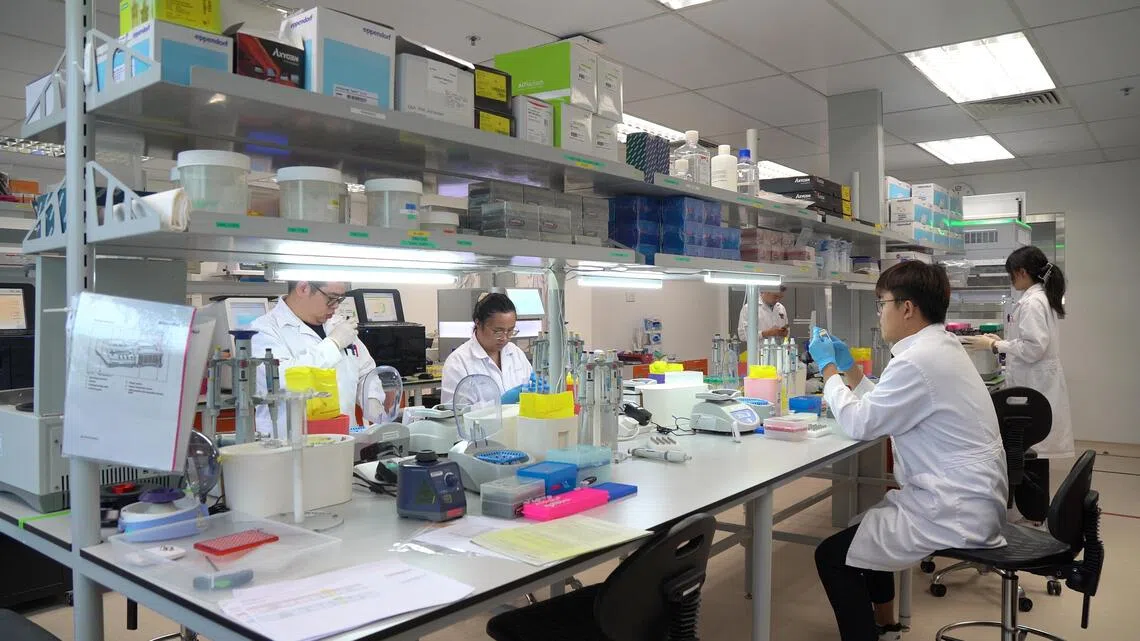
Singapore has shown this can be done across different parts of its innovation ecosystem.
In the Research, Innovation and Enterprise 2025 plan, which ran from April 2021 to March 2025, A*Star’s intellectual property helped to seed more than 40 companies, which have gone on to attract more than S$1 billion in follow-on funding.
Firms such as Lucence have shown that science developed in Singapore can move through clinical validation and venture-building to become globally market-relevant businesses.
The harder task is to make such outcomes less exceptional and more repeatable. Too many promising technologies still struggle to cross Singapore’s innovation gap: the distance between a strong scientific result and a product, company or capability that gains traction in the real world.
The friction is often practical. Many technologies clear the scientific hurdles only to stall at the commercial ones: finding an industry partner willing to take the first risk, securing a first customer, assembling a commercial team or raising the capital needed to scale.
Closing this gap means making the boundaries between research, industry, capital and customers more porous, so promising ideas meet real problems earlier, attract the right partners sooner and find people willing to take disciplined risks.
Turning research into value
Singapore has built the organs of a research nation: deep scientific capabilities, talent, infrastructure and public investment. The task now is to improve the circulation among them, so ideas, people, capital, customers and experience move more deliberately towards use and scale.
Within this system, A*Star’s role is to be Singapore’s strategic innovation engine, translating frontier science and engineering into societal and economic value. We do this by bringing together top research and entrepreneurial talent, and combining expertise across disciplines and partners to advance national priorities.
When that capability is connected with the wider ecosystem – universities, research institutes, hospitals, companies, investors and agencies such as Enterprise Singapore and the Economic Development Board – promising ideas have a stronger pathway towards validation, customers and scale.
We can already see the benefits when these connections work well. Across 1,252 industry projects in the 2025 financial year, for example, companies committed more than S$830 million of their own R&D investment alongside A*Star.
That matters because research is more likely to be adopted when companies and scientists are solving problems together, not meeting only after the science is done.
The value of such projects goes beyond a single licence, product or spinoff. They build habits of collaboration: researchers who understand industry needs, companies that know how to work with science, and customers more willing to test what is new.
When circulation improves, each success makes the next one easier. Companies become better partners. Researchers see more clearly where their work can matter. The system learns what it takes to move from discovery to adoption.
Why ownership now matters
In today’s economy, a larger share of value often accrues to those who develop the technology, control critical intellectual property, build the product and own the relationships with global customers.
As Singapore’s economic model evolves, the question is not simply whether sophisticated work happens here, but whether we capture a meaningful share of the value we help create.
The aim should be for more technologies to originate here, more intellectual property to be commercialised here, more products to be built for global markets, and more globally competitive companies to grow from Singapore.
When they succeed, they create not only revenue but experienced founders, technical leaders, customer relationships, and capital that can seed the next generation.
Making room for scientific entrepreneurs to take risks
This will depend on more scientific entrepreneurs and innovation leaders across our universities, research institutions, hospitals and companies: people who can recognise commercial potential in research, build teams around it and carry it towards customers, investors and markets.
Not every researcher should become a founder. But every researcher with a promising technology should be able to find a credible pathway towards translation.
Those who choose this path need experienced commercial partners, clearer routes into entrepreneurial roles, patient early-stage capital, and customers willing to validate technologies before they have years of sales history.
Incentives matter. Career systems should recognise patents, industry deployment, clinical adoption and company creation alongside academic achievement, while still protecting the excellence and curiosity that make breakthrough research possible.
We must also become more comfortable with a simple reality: Not every effort will succeed.
Visible failures are easy to criticise. Less visible are the opportunities never attempted: the startup not founded, the company that commercialises elsewhere, or the industry Singapore never has the chance to build.
This does not mean lowering standards. It means applying the right standards at the right stage: room for exploration, clear milestones for progression, and the willingness to stop projects that no longer justify larger bets.
Closing the gap
Lim’s “diagnostic gap” was measured in months. Singapore’s innovation gap is measured in years, from scientific insight to validated technology, from validation to first customer, and from promising company to product used at scale.
Closing it is not about forcing every discovery to market. It is about better judgment: protecting long-horizon research, connecting promising science to real demand, and backing the strongest opportunities before success is assured.
Singapore has built deep scientific capability. The next task is to make translation more repeatable, ownership more ambitious and risk-taking more disciplined.
The real test of a research system, after all, lies in what it enables: better lives, stronger industries and more value anchored in Singapore.
The writer is CEO of A*Star
Decoding Asia newsletter: your guide to navigating Asia in a new global order. Sign up here to get Decoding Asia newsletter. Delivered to your inbox. Free.
Share with us your feedback on BT's products and services
TRENDING NOW

Once staunchly pro-China, Malaysian Chinese businesses are now distancing themselves from Beijing

Looking beyond looming CEO succession, should UOB potentially pursue a transformative merger?

Could stablecoins be the future of money?

Grab CEO’s wife Chloe Tong on life with Anthony Tan and finding her purpose

