

Budget 2026: Over-reliance on taxing the rich risks shifting burden to middle class, says PM Wong
Singapore will not pursue ‘jobless growth’, the prime minister pledges in his round-up speech

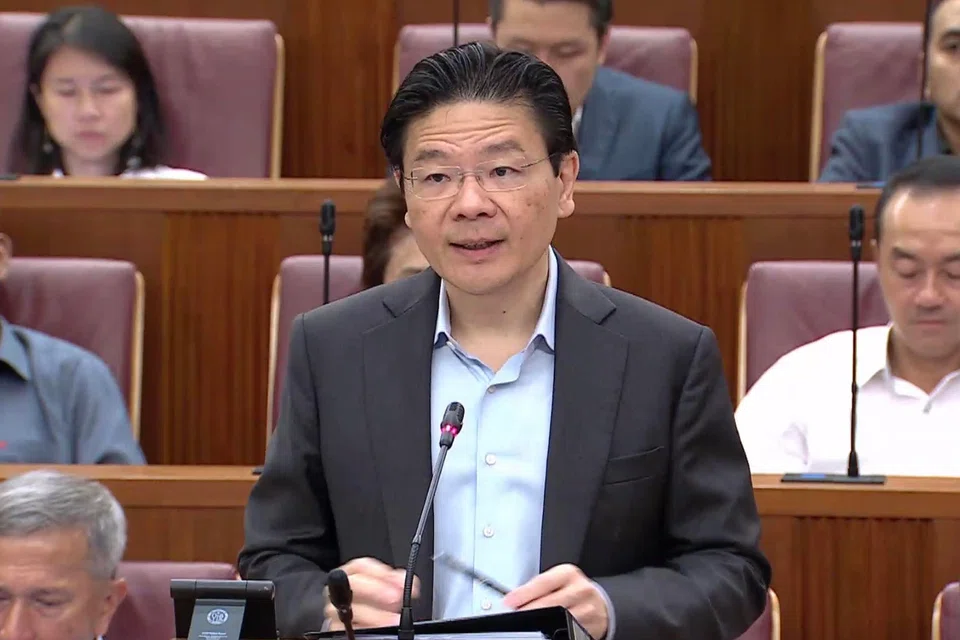
[SINGAPORE] Relying solely on “ever-higher” taxes on the wealthy risks undermining competitiveness, enterprise and job creation, and has limits in addressing inequality, said Prime Minister and Finance Minister Lawrence Wong in Parliament on Thursday (Feb 26).
As capital and talent are mobile, an over-reliance on taxing the wealthy would eventually shift the burden to the broad middle as well, he warned in a speech to wrap up the three-day Budget debate, which saw a record number of MPs participating.
Wealth taxation was a recurring theme during the debate, with MPs from both sides of the House calling for more aggressive measures to address wealth inequality.
Suggestions ranged from making property taxes more progressive and imposing progressive stamp duties on inherited properties, to reinstating estate duties and a net asset value tax on property gains that Singapore had abolished more than a decade ago.
Wealth redistribution alone is also insufficient to build a strong and resilient society, PM Wong said. The government’s approach is instead a balanced one – keeping taxes moderate but progressive, while redistributing resources to those with greater needs.
This includes progressive wealth taxes through property and vehicle levies, complemented by heavy investment in human capital – from early childhood education and quality schooling to tertiary education, and lifelong learning through the national SkillsFuture movement.

“Upward mobility remains central to our social compact, because here in Singapore, your starting point should never determine your finishing position,” he said.
The government will continue to study ways to moderate excessive wealth concentration carefully and responsibly, PM Wong added.
“Jobless growth”
Underpinning all of this, however, is the need for continued economic growth, without which wages would stagnate, capabilities erode and Singapore risks a “real decline”, said PM Wong.
SEE ALSO

The Republic’s economic strategies must adapt to a changed world, one where power and strength increasingly shape outcomes, rules are more contested, and economic relationships are being rewired, he said.
Fresh changes in the US’ tariffs serve as a reminder that uncertainty and volatility are becoming the norm, and smaller countries like Singapore risk being bypassed or marginalised if they stand still.
“We must deepen trusted partnerships, diversify our links and strengthen our resilience,” he said, adding that Singapore needs to establish leadership positions in key domains to create distinctive value that others cannot easily replicate.
Yet, growth alone does not automatically translate into job opportunities across the board, he cautioned.
"In the past, growth and jobs moved more closely together. When the economy expanded, firms hired more workers across the board. Today, the relationship is more complex."
Singapore's fast-growing sectors are export-oriented and compete at the frontier – but precisely because of that, they operate with lean manpower.
Over the years, the manufacturing sector's share of employment has declined – from 14 per cent in 2015 to 12 per cent now – even as the sector contributes around 20 per cent of gross domestic product.
Over that same period, however, employment in exportable services – areas such as finance, IT and professional services – grew as Singapore diversified its economy.
Taken together, manufacturing, finance, IT and professional services account for just around 30 per cent of total employment, PM Wong noted.
Singapore must therefore also uplift the broader domestic economy, raising productivity, wages and career pathways across the services sector through sustained action in education, healthcare and social services, he said.
Central to that effort is artificial intelligence (AI), which the prime minister described as "another powerful force reshaping our economy".
"We will not have jobless growth in Singapore," he said. "We will exploit AI to grow the economy, and we will ensure that growth translates into good jobs and better wages."
AI to enable, not displace
Yet, PM Wong acknowledged the anxieties that workers and fresh graduates are feeling, noting that concerns around displacement were real and had to be taken seriously.
Small and medium-sized enterprises, which play a "critical role" in employing Singaporeans and anchoring economic activity, face pressures around labour and rental costs – for them, innovation and transformation, rather than continued government support, remains the sustainable path forward, he stressed.
Historically, he noted, every major technological wave displaced some jobs but also created new ones – yet, there is "no economic law" that guaranteed this would always be the case.
"Many are concerned that this time may be different because AI is more powerful, advancing faster and affecting a wider range of occupations."
PM Wong flagged specific risks: companies leaning too heavily on AI at the expense of worker training; older displaced workers finding it harder to re-enter the workforce; and entry-level jobs being hollowed out.
For now, though, the labour market remains resilient, with the proportion of permanent employees at a record high of nearly 91 per cent, vacancies continuing to outnumber job seekers, and more than 40 per cent of openings at the entry level.
But current data alone is insufficient, PM Wong cautioned. “We cannot rely only on today's data, we must prepare for tomorrow."
To that end, the government will invest "more deliberately and more systematically" in its people, coordinating efforts through the National AI Council to align industry transformation and workforce upgrading – with the aim of ensuring AI uplifts workers rather than displaces them.
Cost-of-living concerns
Ensuring that growth and rising wages feed through to households is also critical, PM Wong said, as Singaporeans continued to feel cost-of-living pressures despite better-than-expected growth of 5 per cent last year.
Inflation moderated to 0.9 per cent last year from a peak of more than 6 per cent in 2022, but price levels remained higher than before – and that was what households were experiencing, he noted.
While household expenditure as a share of income either remained stable or fell across the income distribution, healthcare was a notable exception, with Singaporeans spending a larger share of their income on healthcare and health insurance as the population aged.
To address this, the government has provided “significant and growing subsidies” for healthcare services and national health insurance premiums, and taken steps to rein in overly generous private riders and other practices driving up medical inflation in the private sector.
Meanwhile, inflation for frequently consumed services, especially food and beverage, also rose faster than general inflation. While food consumption formed a smaller share of income, “the psychological impact is immediate and visible” each time Singaporeans dined out, PM Wong acknowledged.
The fundamental tension, he said, was that domestic services are labour-intensive – raising wages for workers in these sectors was the right thing to do, but it also pushed up costs – a tension the government is managing through broad-based wage growth supported by skills upgrading and productivity improvements.
To cushion the impact in the immediate term, the government has provided Community Development Council Vouchers, cash payouts, utilities rebates and Central Provident Fund top-ups for seniors in this year’s Budget.
PM Wong also pushed back against the Workers’ Party’s characterisation that the government relied on one-off handouts, noting that only about 5 per cent of the overall Budget was for one-off measures in both FY2025 and FY2026.
“The remaining 95 per cent – the overwhelming share – is for longer-term and structural schemes,” he said.
Ultimately, the durable solution to cost pressures is steady, sustainable wage increases rather than transfers, PM Wong stressed. To that end, the government will enhance and extend the Progressive Wage Credit Scheme for two more years, to support businesses in managing rising labour costs while uplifting lower-wage workers.
As for helping workers who are displaced, PM Wong said the government will review the parameters of the Jobseeker Support Scheme, launched about a year ago, once it has more experience.
The Ministry of Finance will publish updated medium-term fiscal projections extending to 2035 by next year, refreshing earlier projections that had only extended to 2030.
For more of BT’s Budget 2026 coverage, go to bt.sg/budget26
Decoding Asia newsletter: your guide to navigating Asia in a new global order. Sign up here to get Decoding Asia newsletter. Delivered to your inbox. Free.
Copyright SPH Media. All rights reserved.
TRENDING NOW

Once staunchly pro-China, Malaysian Chinese businesses are now distancing themselves from Beijing

Looking beyond looming CEO succession, should UOB potentially pursue a transformative merger?

Could stablecoins be the future of money?

Grab CEO’s wife Chloe Tong on life with Anthony Tan and finding her purpose

