Singapore factories keep humming on AI boom as PMI rises to 51.5
Strong artificial intelligence demand keeps electronics resilient, but manufacturing prospects remain uneven
 Add BT as a preferred source
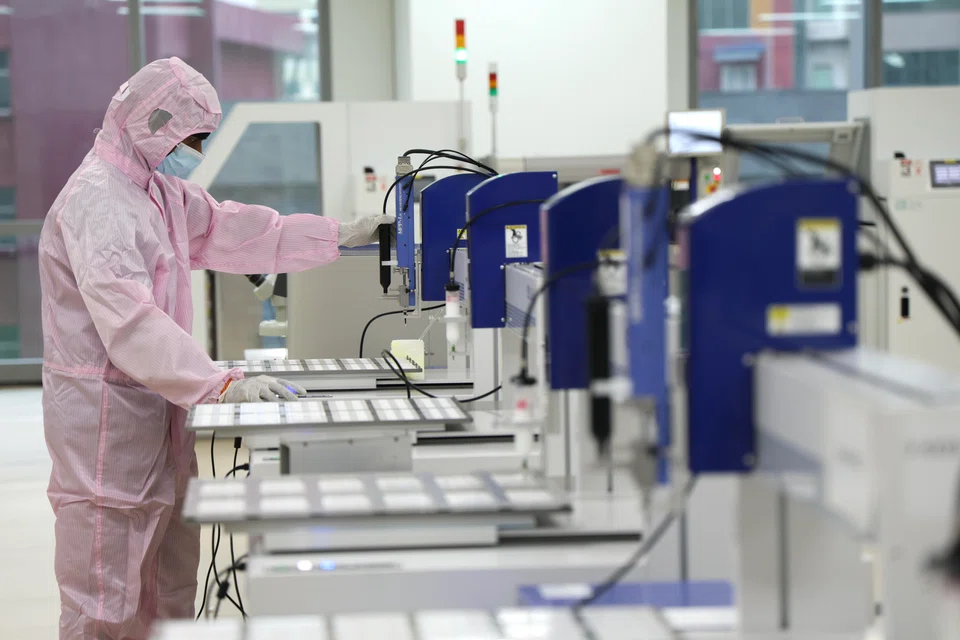
[SINGAPORE] The Republic’s factory activity expanded at a slightly faster pace in August, supported by an artificial intelligence-driven semiconductor supercycle, even as the prolonged Middle East crisis kept supply chains and energy costs under pressure.
The purchasing managers’ index (PMI) edged up 0.1 point from July to 51.5 last month, data from the Singapore Institute of Purchasing and Materials Management (SIPMM) showed on Wednesday (Sep 2).
This marked the 13th straight month of growth. A reading above 50 indicates expansion, while one below 50 indicates a decline.
Within manufacturing, the PMI for the linchpin electronics sector grew by 0.2 point to 52.6, marking the 15th consecutive month of expansion.
Stephen Poh, executive director of SIPMM, said the latest readings showed that Singapore’s manufacturing sector remained “turbocharged by the AI-driven semiconductor supercycle”, resulting in record order backlogs and robust employment.
Nevertheless, he cautioned that the deepening Middle East supply chain crisis continued to “severely cripple” supplier delivery times and send input prices, particularly energy costs, soaring.
DBS senior economist Chua Han Teng said the readings pointed to a “still-resilient manufacturing sector with a positive near-term outlook”, with electronics expected to remain the main driver.
Strong external demand for products such as memory chips and server-related equipment continues to be supported by substantial AI infrastructure investment, particularly by major US hyperscalers, he said.
UOB associate economist Jester Koh said the stronger electronics PMI suggested that recent weakness in electronics non-oil domestic exports and industrial production could reflect capacity constraints rather than softening demand.
He said this is evidenced by manufacturers continuing to draw down finished goods inventories even as new export orders and order backlogs expanded.
“This should support electronics (output) in the months ahead, given the eventual need for inventory replenishment.”
OCBC chief economist Selena Ling also does not expect a sharp pullback in manufacturing, even if growth moderates over the rest of the year.
She noted that private-sector economists in the Monetary Authority of Singapore’s latest survey raised their forecast for manufacturing growth to 8.4 per cent, from 5 per cent previously. Ling’s own forecast is slightly higher, at around 9 per cent.
“So while a moderation in the growth pace may materialise in the remaining months, we do not anticipate a sharp correction at this juncture,” she said.
Chua expects performance across manufacturing clusters to remain uneven.
Supply chain disruptions and higher input costs pose greater challenges for energy-intensive manufacturers, he said, with the chemicals and general manufacturing clusters facing a “comparatively weaker outlook”.
Koh also noted that some cargo shipments were likely being diverted from the Suez Canal and Bab el-Mandeb Strait towards the Cape of Good Hope, contributing to longer lead times.
Regional trends
Manufacturing conditions across key Asian economies were mixed in August, with most of the economies surveyed remaining in expansionary territory but showing varying momentum.
China’s official PMI remained in contraction for the second straight month, although the reading improved to 49.8 in August from 49.2 in July.
However, the RatingDog China General Manufacturing PMI, a private index compiled by S&P Global, rose to a two-month high of 51.5 from 50.9 in July.
The divergence partly reflects differences in the surveys’ coverage, with the private gauge more geared towards smaller and export-oriented manufacturers.
RatingDog founder Yao Yu said China’s manufacturing sector strengthened in August as demand, output and exports all grew at a faster pace. New export orders also rose at the fastest pace in six months.
He expects the manufacturing PMI to remain in expansionary territory in the near term, although business confidence in the 12-month outlook has weakened to its lowest since January.
Elsewhere in Asia, South Korea’s PMI dropped to 52.3 in August from 53.1 the month before.
Among other South-east Asian economies, the Philippines recorded the strongest improvement, with its manufacturing PMI rising to 54.9 from 51.8 in July – its highest reading since December 2016.
Thailand’s manufacturing sector also remained firmly in expansion, although its PMI eased slightly to 53.8 from 54.2. Malaysia continued to expand, but at a slower pace, with its PMI slipping to 50.2 from 50.7.
Meanwhile, Indonesia fell into contraction territory, with its PMI declining to 49.8 from 50.2.
Decoding Asia newsletter: your guide to navigating Asia in a new global order. Sign up here to get Decoding Asia newsletter. Delivered to your inbox. Free.
Copyright SPH Media. All rights reserved.