

From Sheng Siong to Seatrium, here are some potential winners and losers from Budget 2026
Sectors from essentials to manufacturing, defence, property and energy could be affected
 Add BT as a preferred source
[SINGAPORE] Prime Minister and Finance Minister Lawrence Wong’s Budget 2026 statement on Thursday (Feb 12) covered themes of artificial intelligence (AI) adoption, internationalisation and financial sector development.
Among the announcements, highlights included a S$1.5 billion top-up to expand the Equity Market Development Programme (EQDP), higher minimum qualifying salaries for foreign workers, a S$1 billion injection to the Startup SG Equity scheme, more Community Development Council (CDC) vouchers and a re-assessment of Singapore’s carbon tax trajectory.
With these initiatives set to affect sectors across the country’s economy – from essentials to manufacturing, defence, property and energy – some stocks on the Singapore Exchange (SGX) could benefit, while others might be disadvantaged.
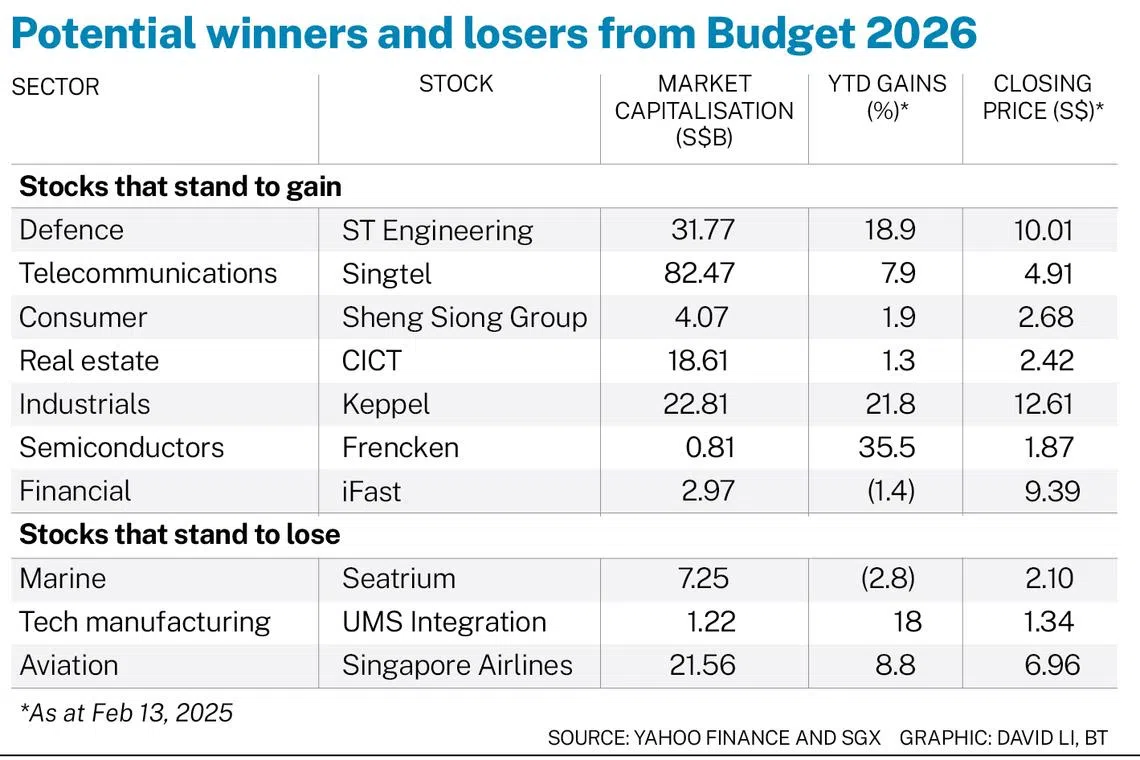
Notably, stocks with tech exposure such as ST Engineering and Singtel, real estate players like CapitaLand Integrated Commercial Trust (CICT), and firms involved in sustainability efforts such as Keppel and Sembcorp, were commonly cited by analysts as potential beneficiaries.
Consumer
The domestic consumption and essentials sector is likely to benefit “most immediately” from Budget 2026 measures, said RHB analyst Shekhar Jaiswal.
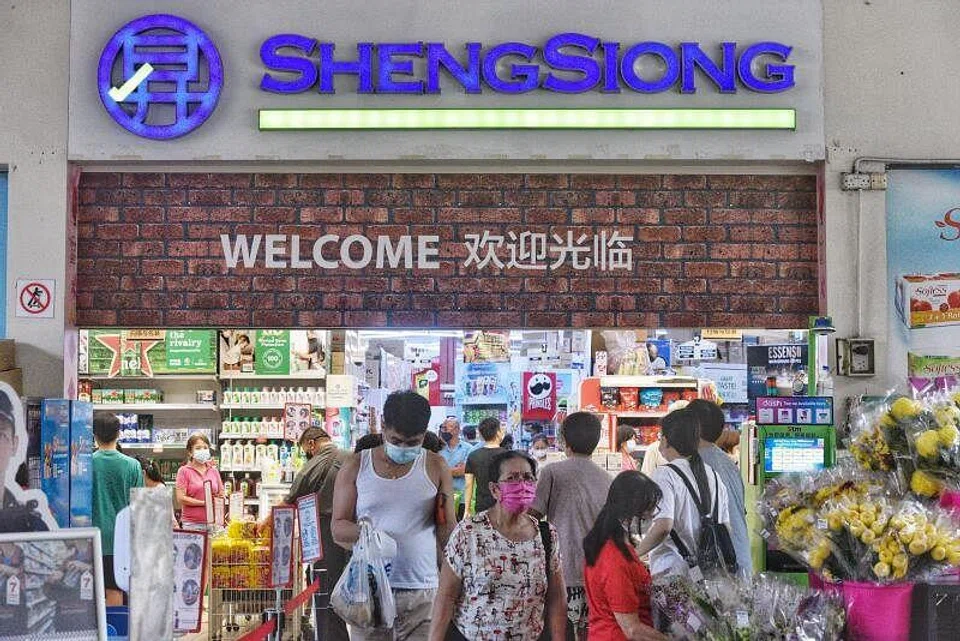
He noted that sizeable household transfers, such as CDC vouchers, U-Save and wage support, should lift mass-market spending and support stocks with supermarket exposure like Sheng Siong and DFI Retail through “resilient staples demand and voucher-enabled traffic”.

However, OCBC head of equity research Carmen Lee thinks benefits for supermarket operators like Sheng Siong will be delayed, not immediate, given that the value of CDC vouchers in 2026 is lower at S$300, compared with S$800 for both 2025 and 2024.
Lee expects outlook for supermarket operators to “dampen slightly” in 2026, before picking up in 2027.
Banking and financial sector
RHB’s Jaiswal highlighted that banks – DBS , OCBC and UOB – should gain from larger wealth and investment banking fee pools, alongside firmer trade finance and foreign exchange flows from enterprise internationalisation.
Exchange and trading platforms such as SGX and iFast should benefit from greater support for the capital market development, with measures including the addition of a S$1.5 billion top-up to the EQDP. Such measures should lift listing activity and equity fundraising, said Maybank analysts in a Friday note.
Healthcare
Maybank believes that the launch of the new national AI missions – which aim to transform key economic sectors including the healthcare industry – will benefit private healthcare players.
The brokerage named Thomson Medical and Raffles Medical Group as potential beneficiaries, given their use of AI to enhance patient care and operational efficiency, which could mitigate margin pressures, particularly those from rising staff costs.
Technology and manufacturing
Noting that the National AI Council, one-north AI park and RIE2030 funding signal a “sustained research and development and capex cycle”, Jaiswal reckons that the AI and advanced manufacturing sector could benefit.
Tech stocks such as Frencken , UMS Integration and Venture could gain from Singapore’s deeper push into AI and manufacturing, said Jaiswal.
Infrastructure providers including Singtel and Keppel DC Reit may also benefit from AI-driven innovation supporting Singapore’s next growth phase, said DBS in a Feb 5 report.
With the semiconductor sector set for gains, Nanofilm Technologies , which offers thin-film coating for next-generation semiconductor manufacturing, could potentially benefit, noted OCBC’s Lee.
Another beneficiary of Budget 2026’s spending and revenue plans is the defence and cybersecurity sector, given that defence spending is at around 3 per cent of Singapore’s gross domestic product, with broader security outlays rising, added Jaiswal. This could support multi-year order visibility for ST Engineering .
Energy
Jaiswal highlighted that the energy transition sector remains “structurally positive”, with carbon tax potentially landing around the lower end of a projected S$50 to S$80 per tonne range, alongside the import of low-carbon electricity from the region.
OCBC’s Lee named Keppel and Sembcorp as preferred picks, given their active involvement in Singapore’s progress to net-zero emissions.
Firms such as ComfortDelGro and Keppel Infrastructure Trust , with exposure to electric-vehicle charging, could benefit amid Singapore’s drive towards cleaner vehicles, said Lee.
Property
Property developers should benefit mainly from there being no new cooling measures, said Jaiswal. For real estate investment trusts (Reits), retail names such as CICT and Frasers Centrepoint Trust could get an uplift.
CapitaLand Ascendas Reit and CapitaLand Investment could benefit from the establishment of the one-north AI park, as both have a presence in one-north, pointed out OCBC.
Services
The government’s expansion of the Productivity Solutions Grant to support more digital and AI-enabled solutions bodes well for Info-Tech Systems , said OCBC’s Lee.
The grant currently provides Info-Tech Systems’ SME customers with financial support for their initial adoption of its human resource management and accounting software, and could support further uptake of its product offerings.
Possible fallout in marine and process sectors
Higher worker levies in the marine and process sectors may raise labour costs for industrial names such as Seatrium and tech manufacturing names like UMS Integration, noted Macquarie Capital analysts, who added that the higher levies will likely be passed on to end customers.
OCBC’s Lee agreed that higher labour costs could weigh on Seatrium in the medium-term, with the changes set to kick in from 2028.
Push for sustainable fuel could hit aviation
Singapore Airlines may be negatively affected by the government’s push for sustainable aviation fuel, which is more expensive than conventional jet fuel, said Maybank analysts. The target is for this greener fuel to account for 1 per cent of all jet fuel used for flights departing from Singapore in 2026.
This could translate to more expensive air fares, added OCBC’s Lee, citing data from the Civil Aviation Authority of Singapore.
However, as the increase in flight ticket prices is unlikely to be significant, she does not expect it to have much of an effect on dampening travel demand.
For more of BT’s Budget 2026 coverage, go to bt.sg/budget26
Decoding Asia newsletter: your guide to navigating Asia in a new global order. Sign up here to get Decoding Asia newsletter. Delivered to your inbox. Free.
Copyright SPH Media. All rights reserved.
TRENDING NOW

‘I felt like dying’: Thai Singha beer scion speaks up after disclosure of alleged sexual abuse

DBS to launch tokenised physical gold for retail customers in Singapore

S$500 CDC vouchers for all Singaporean households from June 11; Government ready to do more if needed: DPM Gan

Singapore men, are you OK?

