Singapore invests S$150 million in AI-driven materials discovery, launches business AI adoption support
Marvel-AI platform will focus on four material classes, with applications in areas such as energy and chemicals
[SINGAPORE] Advanced manufacturing will get a boost as the Singapore government invests S$150 million in the Materials Accelerator for Research, Venture and Enterprise Launchpad or Marvel-AI.
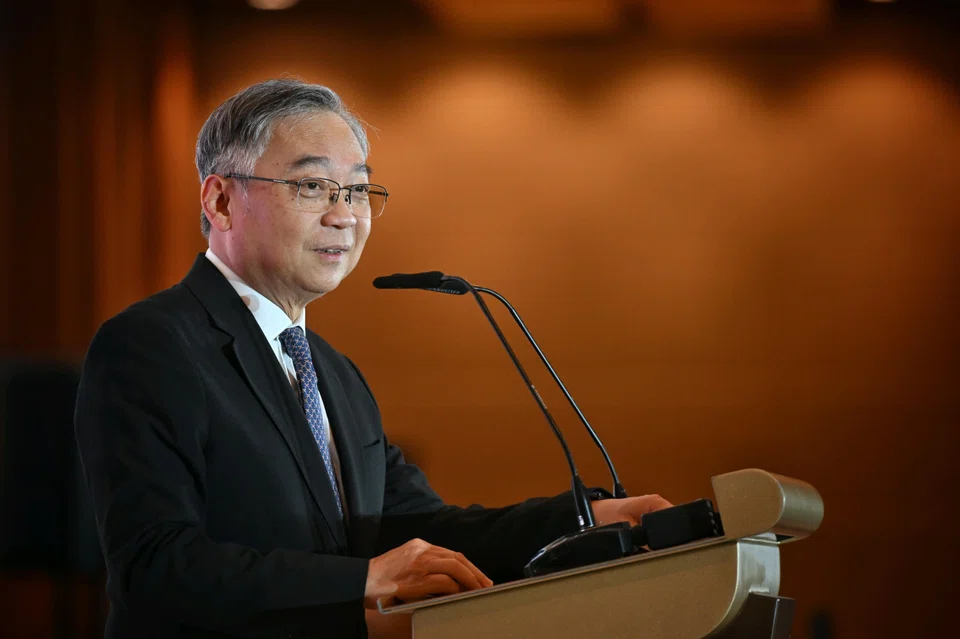
Deputy Prime Minister Gan Kim Yong, who is also minister for energy, trade and industry (trade), made the announcement in his opening speech at the Singapore Week of Innovation and Technology on Tuesday (Oct 27).
The platform will help in the discovery of new materials, and investment in it is part of the four sectoral artificial intelligence missions previously outlined by Prime Minister Lawrence Wong.
Marvel-AI is led by the Agency for Science, Technology and Research (A*Star), and supported by the Ministry of Energy, Trade and Industry (METI), Enterprise Singapore (EnterpriseSG), the Economic Development Board (EDB) and the National Research Foundation.
Marvel-AI will focus on four material classes – metal alloys, polymers and organics, ceramics and composites – with applications in fields such as semiconductors, advanced manufacturing, energy and chemicals.
The platform uses AI for prediction, experimentation and validation in an iterative closed loop, using robotics to automate the entire process. The AI models learn from the outcome of every experiment to further hone their capabilities.
This can speed up workflows. In one instance, 75 samples of polymers could be produced in 24 hours, about 25 times more than what is possible with human researchers. Up to 470 unique metal alloys can also be screened and tested in a day, more than 400 times the usual amount using conventional methods.
“We will also develop talent with capabilities spanning materials science, AI and automation, creating good job opportunities,” noted DPM Gan.
Professor Loh Xian Jun, executive director of Marvel-AI, said that the new platform builds on Singapore’s strengths in materials science, and connects them with AI.
“This will help bridge the gap between discovery and deployment, enabling companies to evaluate whether promising materials can be validated, manufactured and applied in real-world settings,” he added.
Marvel-AI has a number of industry partners that are looking for new materials, such as Foxconn Industrial Internet and ST Engineering.
Companies and investors will connect to Marvel-AI via A*Star, EnterpriseSG and EDB to access the specialist expertise, infrastructure and validation capabilities needed to deploy new materials more quickly.
“Together, these efforts can deepen our industrial capabilities, develop new sources of growth, and strengthen Singapore’s position in advanced materials innovation,” said DPM Gan.
AI champions
Separately, DPM Gan also announced the Champions of AI programme aimed at supporting Singapore-based companies to make AI a core driver of growth and transformation.
The initiative will begin with a cohort of 24 companies including OCBC, UOB, Singtel, Seatrium, Sembcorp Industries, Keppel, CapitaLand Investment, Singapore Airlines and ST Engineering.
“Our champions are committed to developing their workforce, creating new jobs, redesigning roles and building AI capabilities across their organisations,” said DPM Gan.
The investment in people will be essential to make effective use of the technology as well, he added.
EnterpriseSG will help these champions to identify problems and develop tailored long-term AI transformation road maps, as well as gain access to AI expertise, solution providers and capability-building support.
Chris Ong, CEO of Seatrium, said: “This could unlock new ways of solving complex challenges and set new industry benchmarks to address the evolving global energy demands and landscape.”
Champions are to focus on workforce development and strengthening AI capabilities across their organisation, as well as on AI adoption within their supply chains and ecosystems.
UOB previously announced a target of S$900 million in economic value by 2030 from AI initiatives delivered and measured across the organisation. The bank is looking to measure the tech’s impact in terms of enhancing productivity rather than cost-cutting, said CEO Wee Ee Cheong.
“This is something that is part and parcel of life, and we should take full advantage of (it),” he added.
Training for the workforce will be geared towards different levels of ability to overcome organisation inertia.
“It’s not about speed, it must be about purpose,” said Wee.
Small and medium-sized enterprises (SMEs) are also getting support in their AI journey as EnterpriseSG will be introducing a series of agentic AI workshops titled “Driving Entrepreneurship with AI” to provide hands-on guidance.
Another initiative, Catalytic AI Solutions, will be launched to aid in AI adoption.
The workshops are targeted at micro-entrepreneurs and small-business owners to help them identify AI use cases and build working prototypes tailored to their needs. A pilot run of the workshops reached more than 280 small businesses, and enabled them to apply AI agentic tools within their operations.
The Catalytic AI Solutions programme will support SMEs in improving productivity, strengthening operations and addressing industry challenges. The initiative will cover the advanced manufacturing, trade and logistics industries at the start, with more details set to be announced later.
EnterpriseSG aims to announce the set of support measures by early 2027.
“We must turn AI’s capabilities into new opportunities for our industries, stronger businesses and better jobs for our people,” said DPM Gan.
Decoding Asia newsletter: your guide to navigating Asia in a new global order. Sign up here to get Decoding Asia newsletter. Delivered to your inbox. Free.
Copyright SPH Media. All rights reserved.