

Great Eastern shares jump 39% as OCBC mounts S$1.4 billion privatisation bid at S$25.60 per share
OCBC chief executive says the delisting move is a natural progression


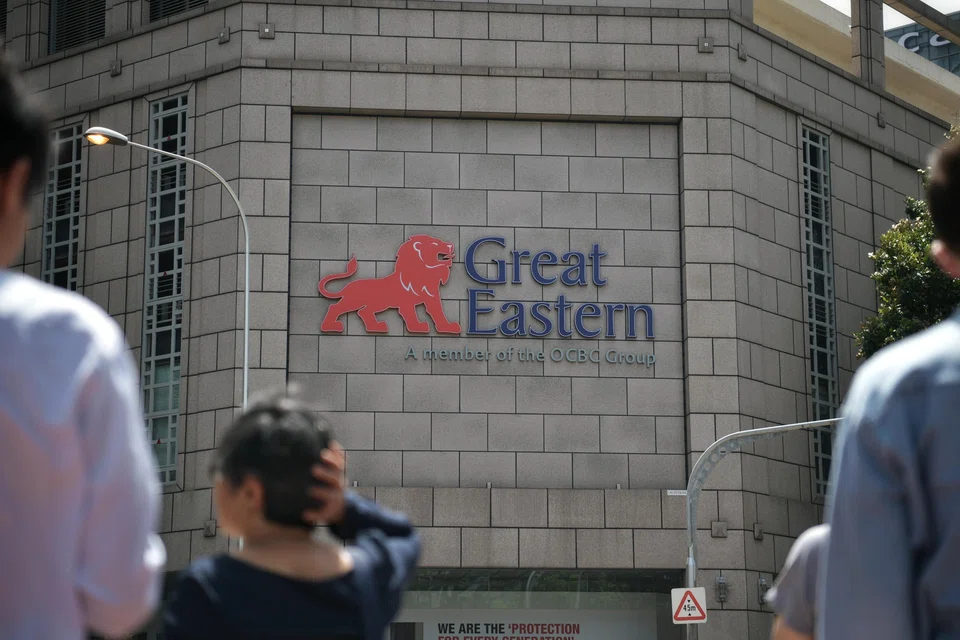
OCBC has made a voluntary unconditional general offer of S$1.4 billion for the remaining 11.56 per cent stake in Great Eastern that it does not own, with the aim to delist its insurance arm.
The offer price of S$25.60 per share represents a 36.9 per cent premium over Great Eastern’s last traded price of S$18.70 before the offer announcement. It is, however, at a 30 per cent discount to Great Eastern’s embedded value per share of S$36.59 as at Dec 31, 2023.
The privatisation aims to strengthen OCBC’s business pillars of banking, wealth management and insurance, as well as optimise its capital to enhance shareholder returns, said the bank in the morning.
OCBC group chief executive Helen Wong said that the privatisation offer is a natural progression of the bank’s strategy.
“We have moved intentionally to build up a strong wealth-management franchise by hiring the best people, instituting best practices and processes, and raising our investment in Great Eastern.
“We have been looking at opportunities to best use our capital and believe the offer allows us to deploy our resources into a key business that is expected to be earnings accretive to OCBC,” she added.
Shares of Great Eastern rocketed as much as 39 per cent shortly after it lifted its trading halt, following the announcement of the offer.
As at 1.19 pm on Friday, Great Eastern rose S$7.30 to S$26 with 45,700 shares changing hands. The last time it closed at this level was in June 2019. The counter later closed at S$25.72, up 37.5 per cent or S$7.02.
OCBC noted that the privatisation of Great Eastern is expected to be earnings accretive, given that the insurer has contributed an average of about S$700 million annually in net profit to the bank over the past 10 years. This translates to an average of about 15 per cent of OCBC’s annual net profit over the decade.
The lender also highlighted that this offer presents an opportunity to deploy its capital to generate greater returns for its shareholders.
“By increasing its investment in Great Eastern, OCBC can further capture the benefits from ongoing synergies and have a greater share of Great Eastern’s value,” said OCBC.
Noting its intention to continue to develop and grow the businesses of Great Eastern, OCBC said it does not want to introduce major changes to the insurer, nor does it intend to redeploy the fixed assets of Great Eastern or discontinue the employment of the existing employees of Great Eastern and its subsidiaries, other than in the ordinary and usual course of business.
“However, the offeror retains the flexibility to at any time consider undertaking a strategic and operational review of Great Eastern with a view to realising synergies, economies of scale, cost efficiencies and growth potential,” OCBC added.
Great Eastern group chief executive Khor Hock Seng said on Friday that the advice of the independent financial adviser and the recommendation of the directors on the offer will be made available to shareholders in due course.
“For now at Great Eastern, it is business as usual, and we will continue to execute and deliver on our strategic priorities and work closely with our financial representatives, stakeholders and other business partners to meet and serve the needs of our customers across the region,” he said.
Phillip Securities research analyst Glenn Thum said that while OCBC priced the deal at below embedded value, it is still above the counter’s last traded share price, which appears to give investors a good reason to sell.
He noted that investors who bought into the insurer after 2019 could be enticed by the deal as the counter has traded at about half its embedded value since then.
However, he added that the counter has traded at levels higher than 0.7 times embedded value at times between 2014 and 2018.
As the share price of the company rose higher than OCBC’s offer price, he suggested that investors take a wait-and-see approach over a couple of trading days to observe if the market expects OCBC to raise its offer price.
During OCBC’s earnings briefing, Wong declined to comment on whether the bank would revise its offer price. She said that the bank would be willing to buy shares on the stock exchange.
Thum said: “They’re really quite coy about saying anything so it’s quite hard to predict what they will do.”
DBS analyst Lim Rui Wen also noted that there is no mention of the offer price being “final” in the offer document. She added that the timing of the deal does not come as a surprise, as OCBC has been stepping up its ownership of Great Eastern shares over the years to its current level of ownership.
“The offer price compares to peers like AIA, (which) is trading at 1.3 times embedded value, and Prudential, (which) is trading at 0.6 time embedded value,” she said.
Similarly, Thilan Wickramasinghe, head of research for Singapore at Maybank Securities, said that minority shareholders could ask for a higher valuation if investors consider how Great Eastern is valued against its peers.
Meanwhile, former remisier Ong Chin Woo noted that the offer is lower than the 0.8 time enterprise value reflected in the resolutions he had tabled at Great Eastern’s annual general meeting. His resolution called for withholding 30 per cent of the board’s fees until the insurer’s share price recovered to 0.8 time enterprise value, which was the average valuation of the company from 2011 to 2022.
“I urge the independent directors and independent financial adviser of Great Eastern to thoroughly evaluate all available options. This includes exploring options such as putting Great Eastern up for open bidding, while giving OCBC the first right of refusal,” he said, adding that he will engage minority shareholders on their next course of action.
In response to the offer, the Securities Investors Association (Singapore) (Sias) commended OCBC for its proactive response to feedback from minority shareholders of Great Eastern, who had recently raised concerns about the company’s performance and potential misalignment between them and its management.
“While the offeror intends to seek a delisting of (Great Eastern) if the free float falls below 10 per cent, Sias would like to advise all shareholders to exercise patience and due diligence before making any decision,” it said, adding that they should wait for guidance from an independent financial adviser.
Shares of OCBC ended 1.5 per cent, or S$0.21 higher at S$14.12 on Friday.
Meanwhile, shares of Great Eastern’s peer, United Overseas Insurance, also spiked up S$0.041 or 7 per cent to S$6.29 after OCBC announced the offer – its highest level since Sep 8, 2023. It later closed at S$6.13.






