



Malaysia Budget 2027: Election appeal meets the investment test
Wage hikes, tax relief deliver quick gains, but investors are looking to productivity and fiscal discipline


[KUALA LUMPUR] Malaysia’s Budget 2027 offers voters higher incomes and tax relief, but leaves a harder question for investors: whether the government can finance its politically appealing promises while raising productivity and narrowing the fiscal deficit.
Prime Minister Anwar Ibrahim unveiled a RM510 billion (US$124.8 billion) spending package on Friday (Oct 9), comprising RM459.8 billion in federal expenditure and RM50.2 billion mobilised through government-linked entities.
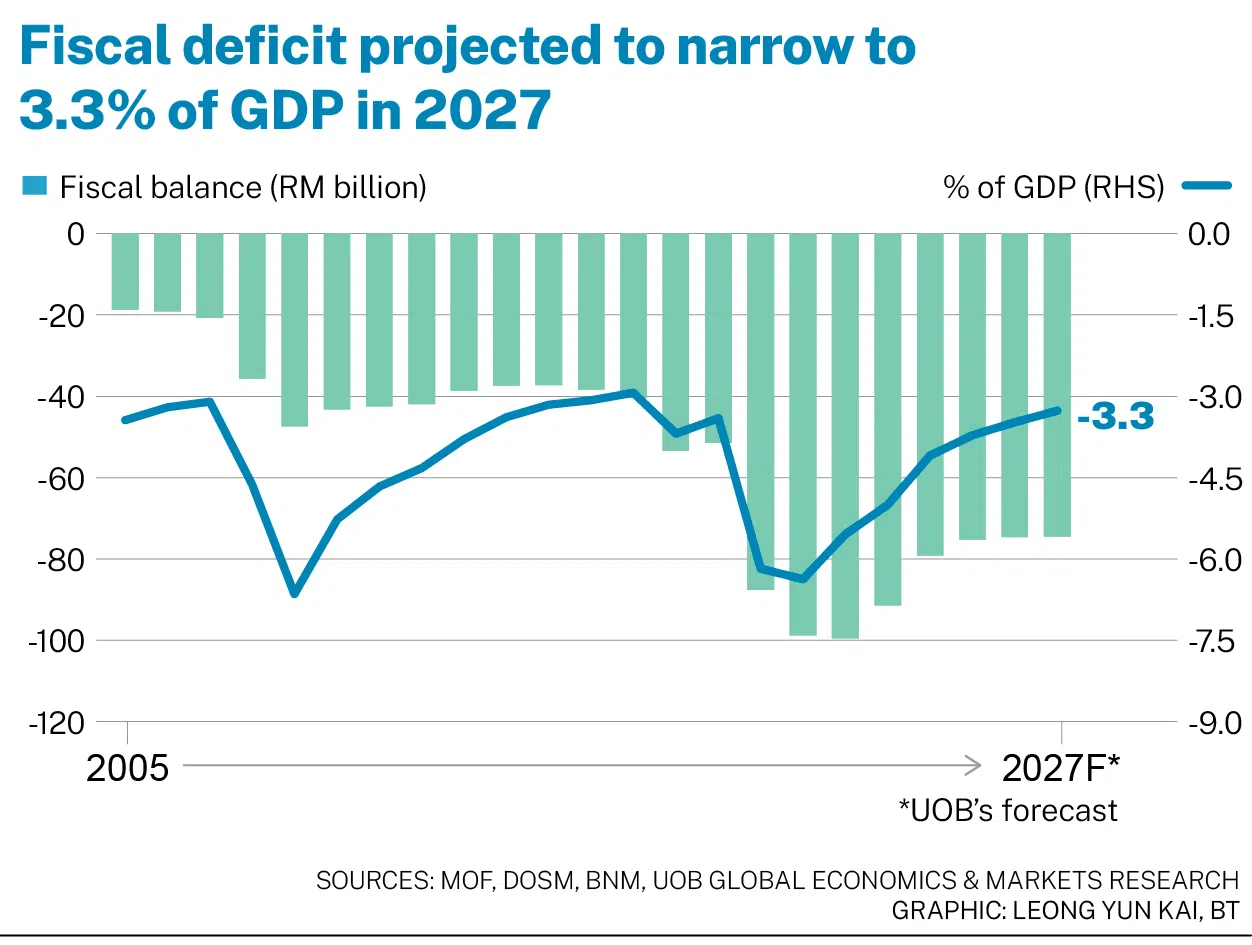
The government targets a fiscal deficit of 3.3 per cent of gross domestic product in 2027, down from 3.6 per cent this year.
However, the shortfall in ringgit terms shrinks by only RM1 billion to RM77.5 billion, indicating that consolidation is to rely heavily on economic growth rather than deep expenditure cuts.
Market observers said that the package combines immediate household benefits with business tax reductions and infrastructure commitments, offering electoral appeal along with measures intended to strengthen Malaysia’s productive capacity.
Economist Yeah Kim Leng said Budget 2027 gives Anwar the “runway” to call an early general election, pointing to the offers of cash assistance and middle-income tax relief, which deliver visible benefits.
The allocation for cash-aid programmes will rise to RM16 billion from RM15 billion, and basic individual income-tax relief will go from RM9,000 to RM12,000. Selected middle-income tax rates are also being reduced.
Crucially, the monthly minimum wage will jump 17.6 per cent to RM2,000 in June 2027, though micro, small, and medium enterprises (MSMEs) with under RM50 million in sales are exempted from complying.
Yeah warned, however, that household gains would be sustainable only if they are backed by skills development and innovation.
SEE ALSO






“Without meaningful productivity improvements, the wage increase risks being absorbed by higher prices, leaving real purchasing power unchanged,” he said.
To cushion the transition, the budget channels funding towards technical skills programmes and industrial training, as well as SME technology upgrades.
Standard Chartered Malaysia interim CEO Mushahid Syed emphasised that workforce capability is vital for moving up the value chain.
“Malaysia’s capacity to attract quality investment and move further up global value chains will increasingly depend on the depth, adaptability and technical sophistication of its workforce,” he said.
Pressure on businesses
The exemption from paying the higher minimum wage may offer smaller employers less protection than it initially appears.
Teh Kee Sin, adviser and founding president of the SME Association of South Johor, warned that competition for workers could force small businesses to match larger employers’ pay.
“Who would want to work for a small company when larger companies are required to pay RM2,000?” he asked.
Teh nevertheless welcomed SME tax reductions as a step towards improving regional competitiveness.
The proposed rates fall to 14 per cent on the first RM150,000 of chargeable income, and 16 per cent on the portion above RM150,000, up to RM600,000. The government estimates savings of up to RM6,000 for eligible businesses.
Manufacturing sales-tax relief and extended capital allowances could also help companies invest in equipment and technology. Whether these measures offset higher costs will depend on firms’ profitability, eligibility and ability to raise output.
Bank Muamalat chief economist Mohd Afzanizam Abdul Rashid described the Budget as pragmatic, balancing fiscal discipline with support for households and businesses.
He highlighted the increased cash transfers, tax reductions and credit guarantees intended to preserve SMEs’ access to financing.
Lavindran Sandragasu, tax partner at PwC Malaysia, offered a less pessimistic assessment of the wage increase, arguing that businesses could respond through training, greater labour efficiency and automation.
“On balance, I think the impact of the increase should be minimal.”
He said competition could constrain companies’ ability to pass costs to consumers, and that the MSME exemption would cushion smaller employers.
Energy prices and supply-chain disruptions were other significant factors affecting business decisions, he added.
The differing assessments highlight the uneven effects of wage reform: Larger companies may have more capacity to automate, even as smaller firms could still face recruitment pressure without equivalent resources.
Fiscal credibility
PwC’s Lavindran noted that Malaysia’s investment appeal rests on fiscal consolidation and stability rather than tax incentives alone, making companies more eager to invest.
However, fiscal figures highlight underlying constraints. Operating expenditure comprises 82 per cent of the federal budget at RM376.84 billion, while development spending rises just 2.5 per cent to RM83 billion.
Subsidies and social assistance will stay high at RM72.7 billion. Debt-service charges are to rise to RM61.01 billion, consuming 16.2 per cent of operating outlays.
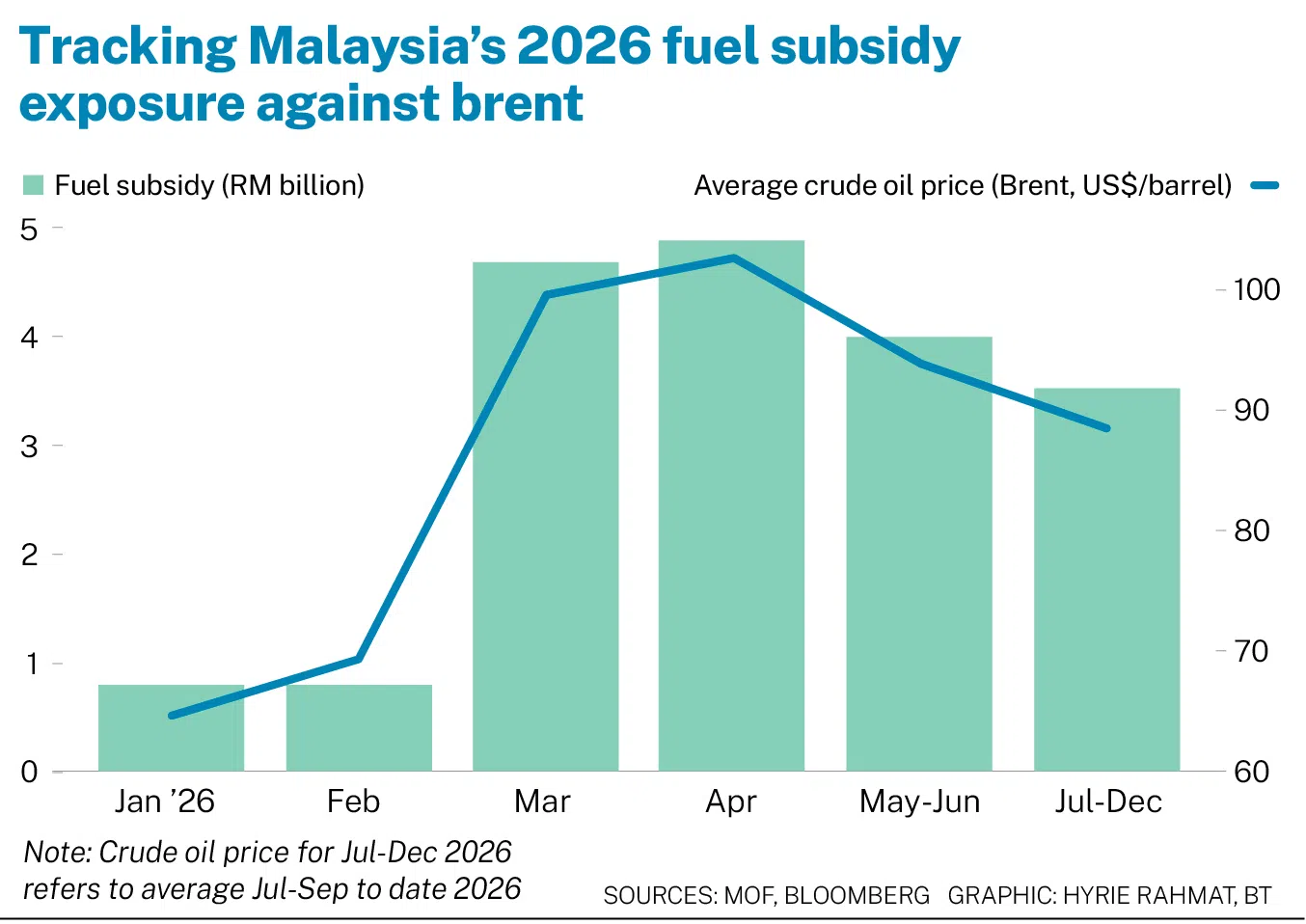
The surge in energy costs expanded this year’s fuel subsidy to RM40 billion, up from the RM15 billion budgeted, lifting the 2026 deficit.
Arshad Mohamed Ismail, group chief executive of Malaysian Rating Corporation, said the 2027 deficit target reinforced the government’s commitment to consolidation. But investment outcomes would depend on spending effectiveness.
“The focus should therefore not only be on the size of the allocation, but also on the quality and effectiveness of spending and its ability to generate longer-term economic returns,” he said.
A competitiveness test
For regional investors, Malaysia’s infrastructure commitments offer a direct test of its competitiveness.
To anchor high-tech growth, Budget 2027 will extend green tax incentives to 2030. It will also earmark RM15 billion for power-grid upgrades, and set up a RM100 million Khazanah-InvestPenang fund for semiconductor startups.
Following RM431.1 billion in approved investments in 2025, private and public investments are projected to grow 7.1 per cent and 6.8 per cent respectively in 2027.
Leo Leow, Malaysia country director at Turner & Townsend, stressed that the main hurdle remains converting capital inflows into well-executed projects.
He said key drivers include cross-border corridors like the Johor-Singapore Special Economic Zone (JS-SEZ), which secured RM132 billion between 2025 and June 2026, and the Sabah-Sarawak-Kalimantan corridor. Both are expanding demand for industrial real estate, logistics, digital networks, and energy.
In his budget speech, Prime Minister Anwar said he and Singapore Premier Lawrence Wong will launch the official JS-SEZ Master Plan late this year.
Transport connectivity, anchored by new train sets and the commencement of the Johor Bahru–Singapore Rapid Transit System (RTS) Link ecosystem, will further reinforce regional trade, said Leow.
Decoding Asia newsletter: your guide to navigating Asia in a new global order. Sign up here to get Decoding Asia newsletter. Delivered to your inbox. Free.
Copyright SPH Media. All rights reserved.
TRENDING NOW

Mooted COE changes will solve category issues, but higher premiums likely: observers

Grab CEO’s wife Chloe Tong on life with Anthony Tan and finding her purpose

Once staunchly pro-China, Malaysian Chinese businesses are now distancing themselves from Beijing

Cliff Tan has 7 million followers and a 4-month waitlist. Why won’t he expand his business?

