



Vietnam pitches its real economy, not a Singapore replica, in two-city IFC push
Vietnam is courting long-term global capital to finance its ambitious, double-digit growth plan
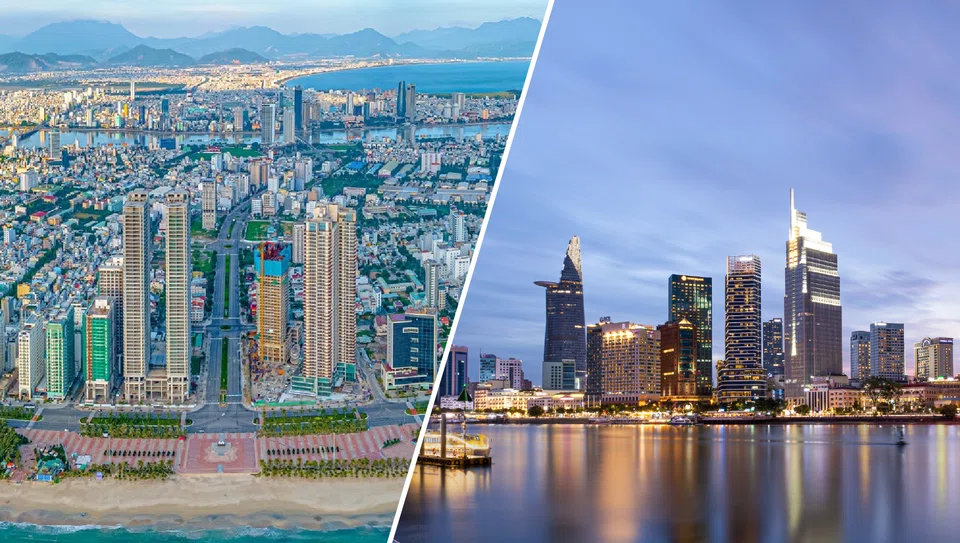
South-east Asia is building a new generation of financial centres to draw global capital. The second instalment in our series discusses Vietnam’s dual-city pitch.
SIX months into Vietnam’s experiment of having a global financial hub spanning two cities, investment activity is clicking higher in Ho Chi Minh City (HCMC). The Vietnam International Financial Centre (VIFC) in the southern metropolis has attracted about US$21 billion in capital commitments, and some of the country’s largest lenders are preparing to set up wholly owned units there.
Da Nang, the beach city in central Vietnam, is still building an investor pipeline for its financial hub, with 12 official members, 11 prospective investors that have submitted expressions of interest, and more than 90 others exploring opportunities.
The figures, provided by the executive authorities of VIFC-HCMC and VIFC Da Nang, offer an early glimpse of how the country’s international financial centre ambitions are taking shape.
Vietnam is betting that its new hub can draw global capital without it trying to become another Singapore. Its proposition is premised on global investors’ direct access to its rosy domestic growth story through the VIFC.
That pitch also addresses a structural problem. Vietnam’s capital needs are rising faster than what the country’s domestic financial market can keep pace with, as it seeks to fund its double-digit growth ambition and drive development across infrastructure, advanced manufacturing and other emerging industries.
“We are building a distinctive, real-economy-anchored financial hub,” Rich McClellan, CEO of VIFC-HCMC, told The Business Times.
“Rather than competing with established regional centres, our competitive edge lies in direct connectivity to one of Asia’s fastest-growing real economies,” he added.
The game plan
Launched in early 2026, the VIFC follows what the government describes as a “one centre, two destinations” model.
SEE ALSO


Under this, HCMC and Da Nang operate under common institutions, incentive structure, governance and supervisory standards, while specialising in different parts of the financial market.
A Jul 22 development plan formalised the division of roles.
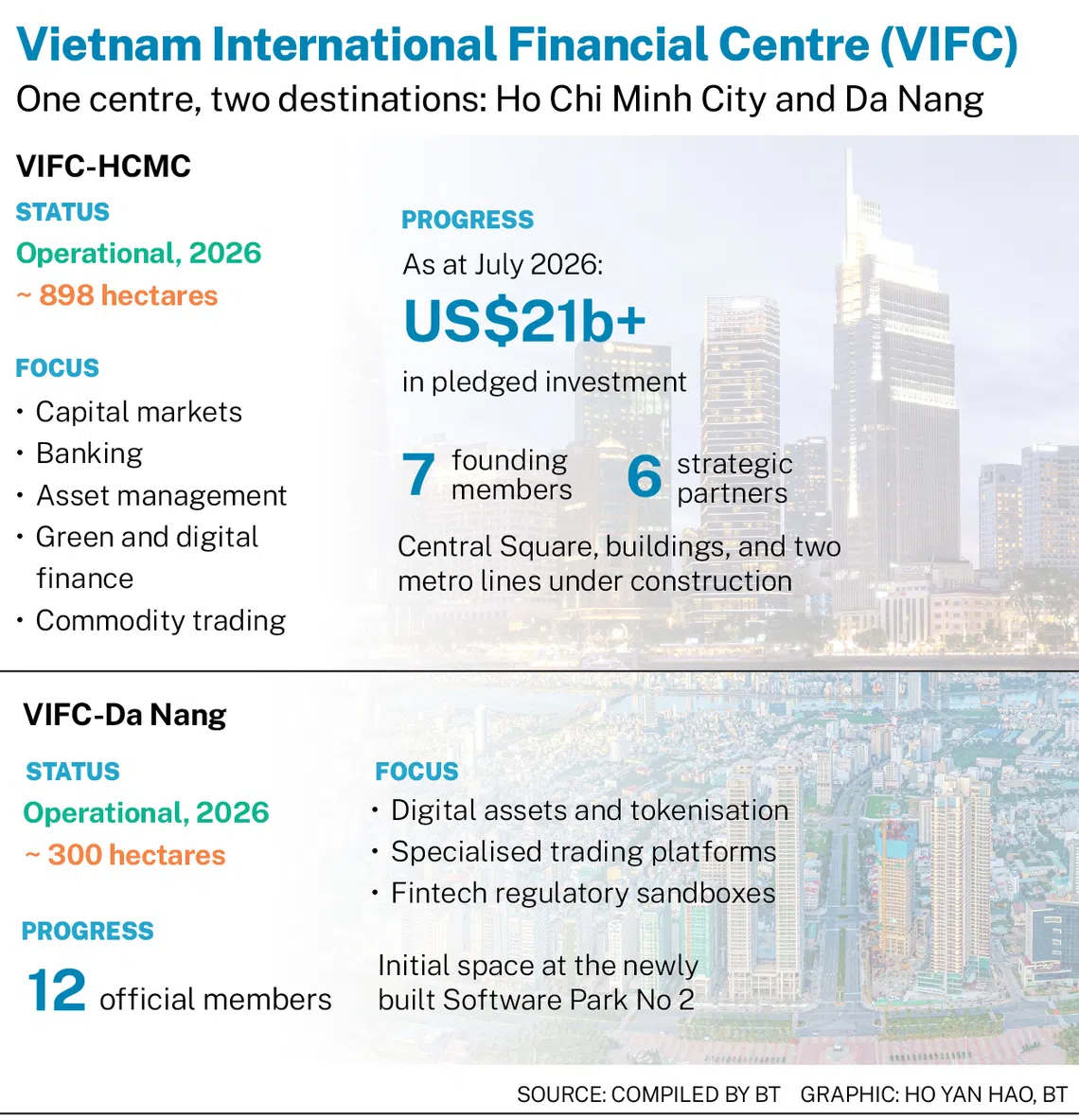
HCMC will serve as the broader financial hub, covering capital markets, banking, asset management, green and digital finance. Meanwhile, Da Nang will focus on fintech and innovation, including digital assets, tokenisation, specialised trading platforms and regulatory sandboxes.
The idea is not to make the two cities compete, but to spread the benefits more evenly, with Da Nang giving central Vietnam a share of the financial activity and investment that might otherwise be concentrated in the south.
Vast funding needs
Vietnam’s credit-to-gross domestic product ratio hit 145 per cent in 2025 – the highest in Asean – according to World Bank figures. To ease such reliance on bank lending, the country is seeking US$76 billion a year through to 2030 from capital markets.
Muralidharan Ramakrishnan, head of Asia-Pacific utilities at Fitch Ratings, noted that banks prefer to extend short to medium-term loans because their funding is largely drawn from shorter-term deposits.
This creates a shortage of long-term funding for Vietnam as it expands transport networks, ports, airports and energy – infrastructure projects that require financing over more than a decade.
“The ability to attract offshore capital across debt and equity will remain key,” he said, pointing to initiatives such as the VIFC to attract global capital.
“Based on discussions, market participants do not expect VIFC to start attracting large capital immediately,” Ramakrishnan added. “It’s going to take time, because many of these policies and processes are still evolving.”
Early institutional commitments
Investor interest appears to have emerged faster than the full regulatory architecture, though most commitments so far have centred on developing the financial district’s physical infrastructure.
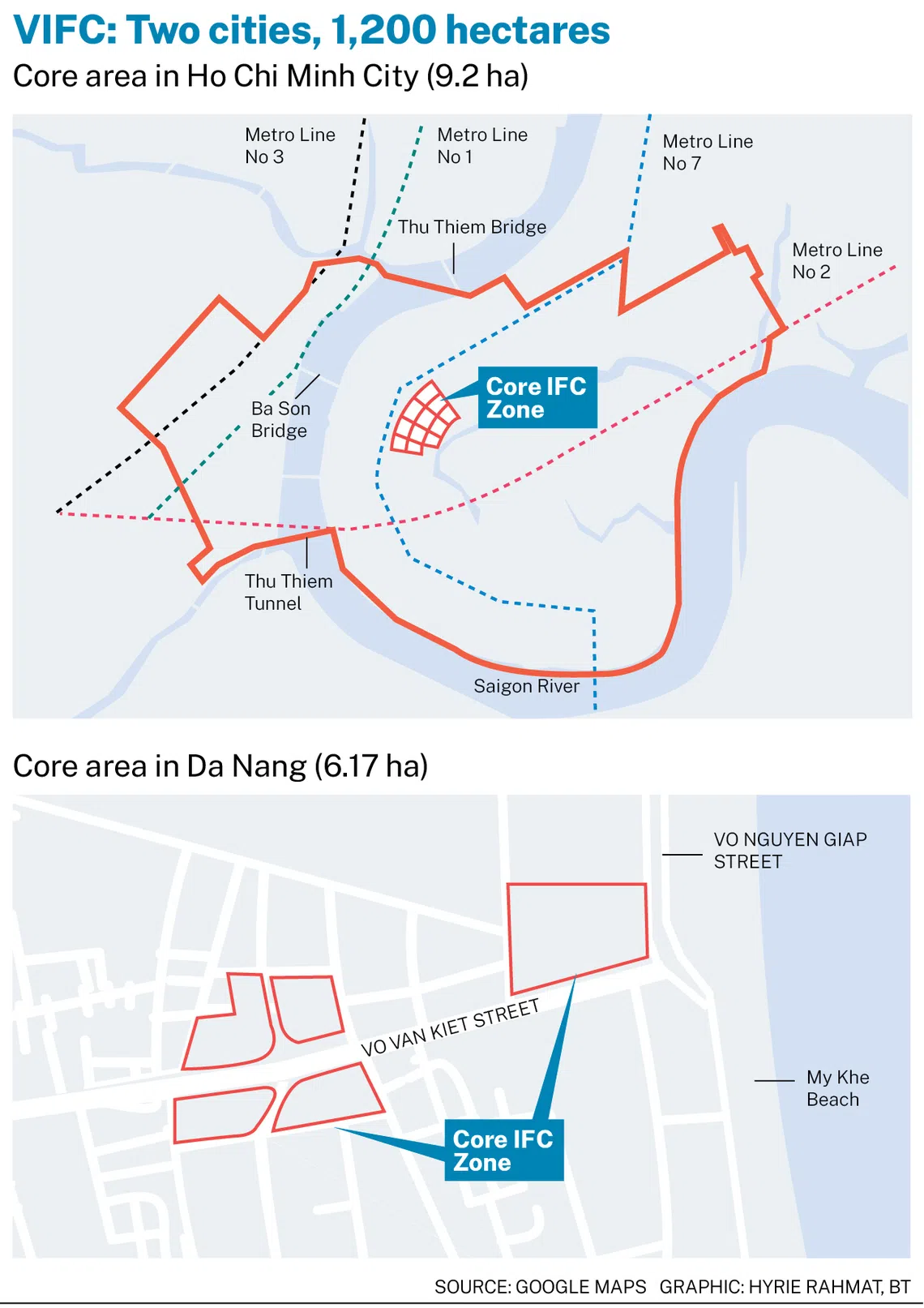
VIFC-HCMC covers about 898 hectares (ha) spanning the existing central business district and the Thu Thiem New Urban Area just across the Saigon River.
So far, major local banks including Vietcombank, MB and HDBank have said that they plan to open up units in the area.
Sun Group broke ground in April on the US$1.14 billion Central Square and new HCMC Administrative Centre in the area, while UOB began construction in July on a US$450 million purpose-built headquarters there.
Advanced transport links are also taking shape, with two rail lines targeted for completion by 2030 to connect the VIFC with downtown HCMC and the new Long Thanh International Airport.
Meanwhile, Da Nang has designated around 300 ha across several locations for its VIFC, including a 6.17-ha core financial district and roughly 282 ha within a sea-reclamation development area along Da Nang Bay.
Its initial infrastructure includes part of the newly built Software Park No 2, featuring a 20-storey building with roughly 27,000 square metres of floor space designated to house investment funds, tech firms and sandbox activities.
The physical development, however, will need to keep pace with the market.
“Development pacing will closely track market absorption through the city’s master planning and investment processes,” McClellan said, noting that the institutional and regulatory core should be established first to avoid “speculative overbuilding”.
From financial centre to financing products
Vietnam’s Prime Minister Le Minh Hung has increasingly pressed officials to focus on what investors can actually transact within the VIFC.
At an April meeting, he compared the centre with a marketplace without merchandise or trading rules. “You build the market and then there are no stalls, no management rules, and nobody knows where to buy or sell,” he noted. “How can investors come?”
By June, Hung was urging agencies to start with a smaller set of priority products rather than wait for a perfect system. These could include medium and long-term financing instruments, such as government and project bonds linked to critical municipal infrastructure.
Capital raised through the centre, he said, should “flow deep into the territory,” rather than simply circulate within the VIFC.
Familiarising Vietnam to global capital
Before the VIFC can become a vibrant marketplace, Vietnam faces a tougher challenge in attracting international institutions: building familiarity with its rules.
The July plan makes predictability a stated principle. It calls for a transparent and stable legal framework consistent with international practices, mechanisms for resolving disputes and recognising international awards, and simplified and digitalised administrative procedures.
McClellan said at a Savills’ property-market event in August that the VIFC is intended to enable global institutions to use the English language and US dollars in their operations, while relying on common-law principles and international judges as well as clearer mechanisms for foreign-exchange convertibility and cross-border capital movement.
The objective is to allow investors to “get money in and out in a predictable fashion”, he noted, referring to some key hurdles faced by foreign investors not familiar with Vietnam’s existing financial system.
He further told BT that detailed frameworks covering capital-flow mechanics, fund structures, tax treatment and licensing for banks, custodians and asset managers within the VIFC are expected to be finalised over the next six to 12 months. The transition from pre-licensing engagement to formal operations is expected to be phased in throughout 2027.
On Aug 17, the VIFC also launched its one-stop platform for membership registration and accreditation, although specialised financial and banking institutions still need to follow separate licensing tracks.
“The true measure of VIFC’s success will be recurring transaction activity and capital retention,” McClellan said.
The VIFC’s credibility, he added, will ultimately come from its “members, rules, products, supervisory standards and capital flows – not the physical towers”. THE BUSINESS TIMES
Decoding Asia newsletter: your guide to navigating Asia in a new global order. Sign up here to get Decoding Asia newsletter. Delivered to your inbox. Free.
Share with us your feedback on BT's products and services
TRENDING NOW

DBS, OCBC, UOB rout lops billions off STI as inflation, rate concerns spook investors

Grab CEO’s wife Chloe Tong on life with Anthony Tan and finding her purpose

OCBC sheds S$8 billion in value as shares close nearly 6% down; analysts cautious on banks

Deal between tycoon friends sparks scrutiny of Philippine power sector

