

Range Rover Sport Electric review: Uncovering the plane truth behind the marque’s sporty new EV
Through deserts, marble quarries and a decommissioned jet, the car is designed to go anywhere
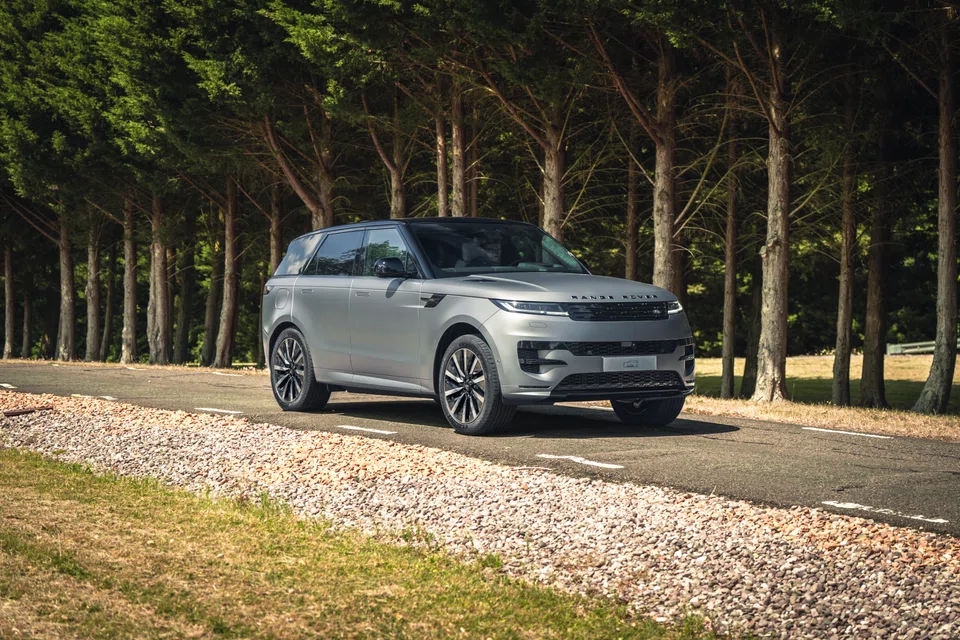
[GAYDON, ENGLAND] Of all the things I expected to do on a day at Jaguar Land Rover’s sprawling home grounds in Gaydon, England, driving the new Range Rover Sport Electric through an aeroplane wasn’t on the list.
It’s the sort of stunt that sounds invented for Internet clout, except Range Rover did it 13 years ago with the second generation of its most athletic model. Maybe it thought dragging the plane out of storage would bring luck to the pure electric version of a model that has picked up more than a million sales.
Then again, Range Rovers are supposed to go everywhere and anywhere. To torture test the batteries in both furnace and frost, engineers took prototypes to the deserts of Dubai and to Arjeplog in northern Sweden, where temperatures hit 40 degrees Celsius below freezing.
They fettled the car’s high-speed behaviour at the fearsome Nurburgring circuit in Germany because, uniquely, Range Rover Sports are designed to be as at home on a racing track as they are wading through water 90 cm deep.
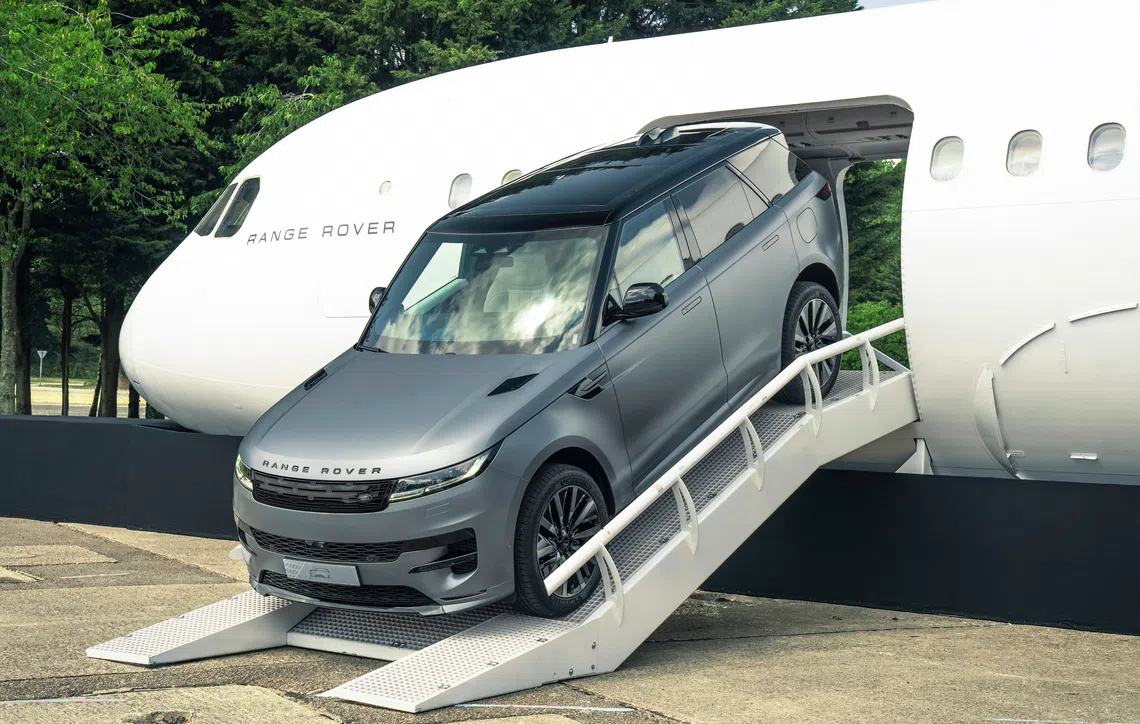
“It is first and foremost a Range Rover Sport,” Martin Limpert, global managing director of Range Rover, says of the new electric car, the brand’s second.
Engineers finally capped off the testing regime in Carrara, making the car climb marble quarry peaks on surfaces ranging from polished stone to loose dust, presumably because northern Italy isn’t a bad place to wrap up endless kilometres of development driving.
Unveiled on Wednesday (Sep 30), it packs two motors that send 550 horsepower to all four wheels. The Business Times briefly drove a pre-production unit, which has more torque than any Range Rover Sport before it, and sprints to 100 kmh in a sportscar-rivalling 4.5 seconds.
The chassis is 61 per cent stiffer than the plug-in hybrid version, with a centre of gravity lowered by 73 mm, which aids handling precision and cornering poise, respectively. All-wheel steering, standard on the top-spec version, turns the rear wheels by up to 7.3 degrees, tightening the turning circle to under 11 metres despite the car’s considerable size.
Matt Becker, the brand’s vehicle engineering director, says it “feels smaller, more planted and more responsive than you would imagine”.

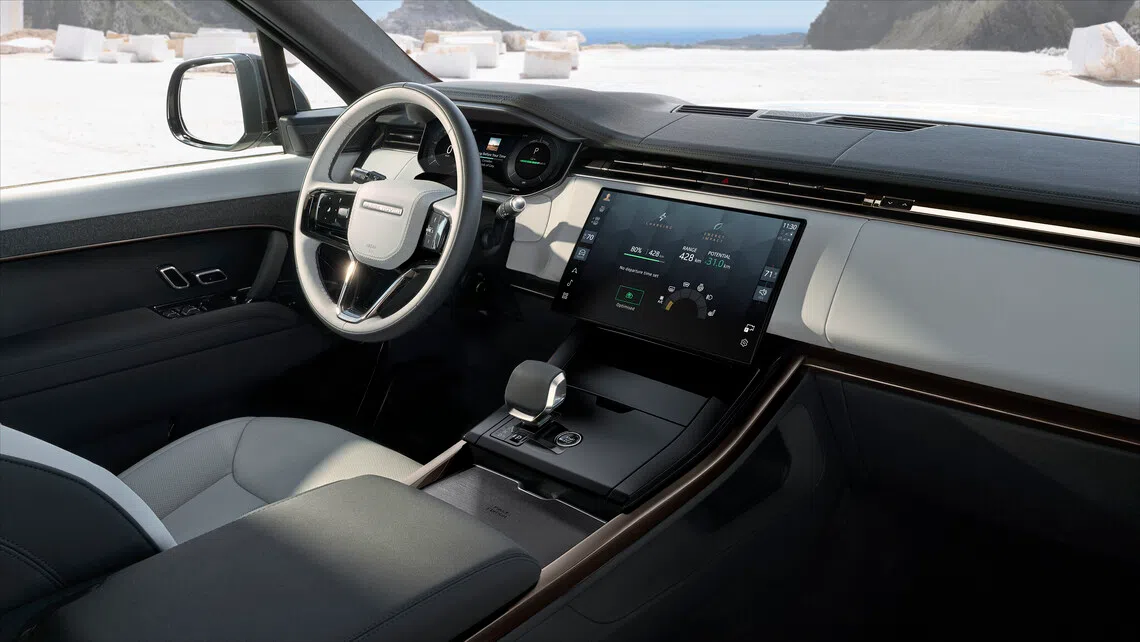
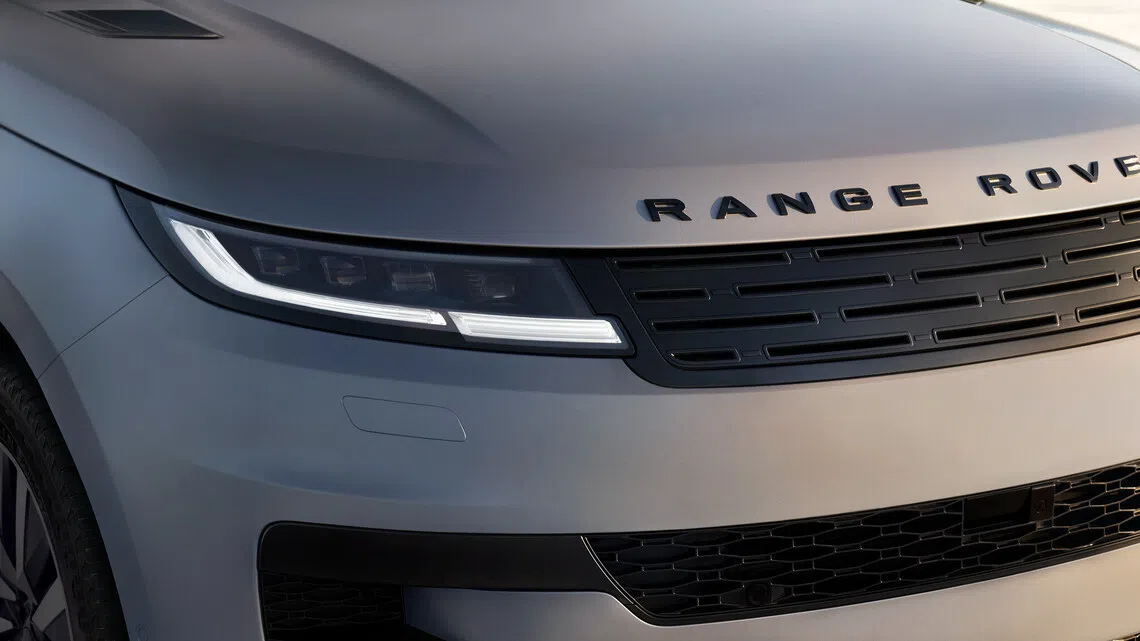
If the boffins are enthusiastic about the car’s abilities, the designers have little to say about it. Like the Range Rover Electric, the Sport Electric looks almost entirely the same as its combustion counterpart.
Except for a smoother grille and new wheels (both sculpted to reduce aerodynamic drag by a minuscule amount), along with wheel caps that say “EV”, the new electric models have almost nothing to distinguish them from their combustion siblings.
Under the skin, the electric Range Rovers have the same 118.5 kWh, 800-volt battery pack. The enormous capacity was achieved by stacking the batteries in two layers. Charging it at the maximum 350 kW rate adds roughly 218 km of range in 10 minutes.
Apart from the battery cells, which Range Rover buys from a supplier, everything about the electric powertrain was designed in-house. The whole lot is assembled in England, on newly commissioned production lines at a Jaguar Land Rover plant.
While both Range Rovers are outwardly coy about their technology, the Sport Electric is still meant to be the more exciting of the two to drive. It has a distinct voice built around low bass frequencies, synthesised by a sound designer. Floor the accelerator, and the notes crescendo to a timbre that almost mimics a mechanical supercharger’s whine.
That touch of raucousness is essential to a car intended to thrill. Sound designer Alex Vine, a former music producer, crafted the Range Rover Electric’s more dulcet voice from piano notes, to suit its more refined character. But whether the driving enthusiasts who are typically drawn to the Range Rover Sport will miss the roar of an engine remains to be seen.
Limpert insists that batteries and motors more than complement the brand’s cars. “Electric is the right platform to elevate Range Rover,” he tells BT. Getting me to drive the Range Rover Sport Electric through an aeroplane might have been his subtle way of getting that idea across.
Range Rover Sport Electric
Motor power/torque 550 hp/850 Nm Battery type/net capacity Lithium-nickel manganese cobalt/118.5 kWh Charging time/type About 8 hours (22 kW AC), 22 minutes 10 to 80 per cent (350 kw DC) Range 609 km 0-100 kmh 4.5 seconds Top speed 200 kmh Efficiency 21.8 to 22.7 kWh/100 km Agent Wearnes Automotive Price To be announced Available 2027
Decoding Asia newsletter: your guide to navigating Asia in a new global order. Sign up here to get Decoding Asia newsletter. Delivered to your inbox. Free.
Share with us your feedback on BT's products and services
TRENDING NOW

KKR founders among investors buying 42% of Peter Lim’s Valencia; club valued at US$1.4 billion

Singapore’s central gas buyer affirms Indonesia’s role as ‘important partner’ amid export review warning

Why the biggest business decision about AI isn’t which model to choose

NEA issues notices to 10 Singapore-based companies, including Wilmar and APP, over haze

